

There’s a specific kind of stress that comes with owning a home in Annadale — you’re responsible for everything inside it. No building super, no property manager, no one else to call first. When you smell something off near your stove or notice your pilot light keeps going out, that’s on you to handle. And the longer it sits, the worse the odds.
What a professional gas leak detection visit actually gives you is clarity. You find out whether there’s a problem, where it is, and what it takes to fix it — before it becomes an emergency. For homeowners on the South Shore, that peace of mind is more than abstract. The Environmental Defense Fund’s mapping study of National Grid’s Staten Island service territory identified close to a thousand low-level leaks along underground distribution lines across the borough. That’s the infrastructure running beneath your street. What’s happening inside your house is a separate question — and one only a licensed inspection can answer.
Annadale’s housing stock is also working against you quietly. The median home here was built in 1981. That means original gas connections, aging flexible appliance connectors, and shutoff valves that have been in place for over 40 years in many cases. These systems weren’t built to last forever, and most of them have never been looked at by a professional. A detection visit doesn’t just check for active leaks — it gives you a real picture of where your system stands.
We’ve been operating since 1983 — two years after the median Annadale home was constructed. That’s not a coincidence worth ignoring. Bobby and Rob have spent four decades working on exactly the kind of 1970s and 1980s-era gas systems that populate this neighborhood. We know where those systems tend to fail, what the original materials look like when they’ve aged, and what it takes to bring them up to current standards.
Every technician who comes to your door is a NYC Licensed Master Plumber — not a subcontractor, not a supervised apprentice running point. That’s the legal requirement for gas line work in New York City, and it’s a standard we hold across every job, whether it’s a routine inspection in a home off Hylan Boulevard or an emergency call in Southeast Annadale’s waterfront properties along Raritan Bay.
Our technicians are also drug-tested and vetted — which matters when you’re letting someone into your home to access your basement, utility room, and appliance connections. We quote transparent pricing before any work begins. No surprises, no pressure.

When you call with a gas concern, the first thing that matters is speed. We commit to a 30–60 minute emergency response time — and Annadale’s location on the South Shore, accessible via Hylan Boulevard, makes that window realistic, not a marketing stretch.
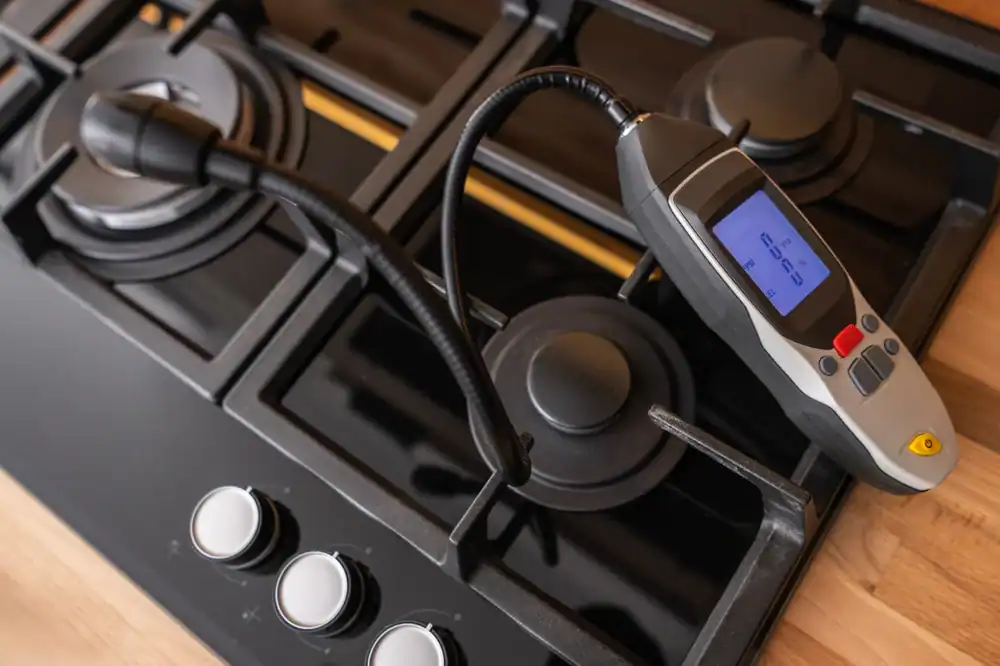
Once on-site, our technician starts with a full assessment of your building-side gas system — everything from the meter into the house. This is the part National Grid doesn’t cover. Their inspectors handle the utility-side infrastructure; what’s inside your home is your responsibility, and it requires a licensed professional with the right equipment to evaluate it properly. We use professional-grade gas detectors and infrared cameras to locate leaks that aren’t visible to the eye — behind walls, in crawl spaces, around appliance connections, and along lines that may have shifted or corroded over time.
If a leak is found, you’ll know exactly what it is and what fixing it involves before any work begins. Pricing is stated upfront. If repairs are needed, they’re handled by the same licensed team — no handoff to a second contractor, no coordination headache. For homes in Annadale that fall under NYC’s Local Law 157 natural gas detector requirements (compliance deadline: January 1, 2027), that conversation can happen during the same visit. Our goal is to leave your home safer than it was when we arrived, with documentation that reflects what was found and what was done.

Ready to get started?
Gas leak detection in Annadale covers more ground than most homeowners expect. It starts with the building-side gas system — the piping, connections, and appliances from your meter inward. For homes in Southeast Annadale especially, where salt air off Raritan Bay accelerates corrosion on outdoor meter connections and exposed fittings, that inspection includes a close look at the components most vulnerable to coastal weathering. Infrared cameras make it possible to check areas that would otherwise require opening walls, which matters when you’re dealing with custom finishes in a high-value waterfront property.
Beyond active leak detection, the visit covers appliance connections — gas stoves, ranges, water heaters, and boilers. In a neighborhood where most homes are running original or near-original boiler systems, those connections are often the first place a slow leak develops. If your system hasn’t been looked at since it was installed, that’s where the inspection starts.
We also handle the full compliance side. If a repair requires a NYC DOB filing, that’s managed in-house. If your home needs natural gas detectors installed to meet Local Law 157 requirements, that can be addressed during the same visit. And if gas damage has occurred, we coordinate directly with your insurance company — something most plumbers in the Staten Island market don’t offer. One call covers detection, repair, documentation, and compliance. That’s the practical difference between a licensed master plumber and a general service call.

Yes, and this is one of the most common points of confusion for Annadale homeowners. National Grid is responsible for the utility-side infrastructure — the gas mains running beneath your street and the service line up to your meter. Their inspectors are not looking at what’s inside your home, and they’re not authorized to repair it even if they found something. The building-side piping — everything from the meter into your house — is your responsibility as a homeowner.
In practical terms, National Grid can tell you the distribution line to your property is clear. They can’t tell you whether the flexible connector behind your stove is deteriorating, whether your boiler’s gas valve is seating properly, or whether a fitting in your basement has been slowly leaking for years. Those are separate systems, and they require a NYC Licensed Master Plumber with professional-grade detection equipment to evaluate properly. If you’ve had a National Grid visit and still have concerns, that visit doesn’t replace a building-side inspection — it just covers a different part of the picture.
Intermittent gas smells are not a sign that the problem is minor. In many cases, they’re a sign that a leak is present but fluctuating — affected by pressure changes, ventilation, or the position of an appliance. There’s also a documented phenomenon called odor fade, where the mercaptan added to natural gas (the compound that gives it that rotten egg smell) can dissipate through physical and chemical processes. A leak that you can no longer smell is not a leak that’s gone away.
The pattern of smelling gas occasionally and then not smelling it is exactly the kind of situation where homeowners in Annadale wait too long. The smell goes away, life gets busy, and the inspection gets pushed back. In a single-family home on the South Shore — where there’s no building management structure to escalate to — that delay is entirely on the homeowner. If you’ve noticed an intermittent gas odor near any appliance, connection point, or in your basement, the right move is a professional inspection with detection equipment, not a wait-and-see approach.
Consumer gas detectors serve a real purpose — they can alert you when gas concentrations in a room reach a certain threshold. But they have significant limitations that matter when you’re trying to actually understand and resolve a problem. They can’t pinpoint the source of a leak. They can’t assess severity or distinguish between a loose appliance connection and a compromised gas line. And they produce no documentation — which becomes relevant if you need to file an insurance claim or demonstrate compliance with NYC regulations like Local Law 157.
For Annadale homeowners, there’s also a practical gap between what a consumer detector measures and what a professional inspection covers. A hardware store detector sitting on your kitchen counter isn’t checking the gas line running through your basement, the connection at your boiler, or the fittings behind your dryer. Professional-grade equipment used by a licensed master plumber is calibrated to locate the source of a leak, not just confirm that gas is present somewhere in the room. If you have a consumer detector and it’s going off — or if you smell gas and it isn’t — a professional inspection is the next step.
We don’t publish flat-rate pricing for gas leak detection because the scope genuinely varies — a single-family home in Annadale with one gas appliance is a different job than a larger property in Southeast Annadale with multiple systems, a crawl space, and complex piping. What doesn’t vary is our approach: pricing is stated transparently before any work begins, and there are no hidden fees added after the fact. You know what you’re agreeing to before the job starts.
On the insurance side, whether a homeowner’s policy covers gas leak detection and repair depends on your specific policy and what caused the leak. Damage resulting from a sudden and accidental event is more commonly covered than gradual deterioration. What helps significantly is having a licensed professional document the inspection and findings — which is exactly what a visit from us produces. We also coordinate directly with insurance companies when gas damage has occurred, which takes a meaningful administrative burden off the homeowner during an already stressful situation. If you’re uncertain about your coverage, calling your insurer before the inspection is a reasonable first step.
That determination comes from the inspection itself — and it depends on several factors that are specific to your property. The age of the piping, the material it’s made from, the extent of corrosion, and how many connections are involved all factor into whether a targeted repair is sufficient or whether a section of line needs to be replaced. For homes in Annadale built in the 1970s and 1980s, the original gas piping and fittings are now 40 to 50 years old in many cases. That doesn’t automatically mean replacement, but it does mean the inspection needs to be thorough.
For properties in Southeast Annadale near Raritan Bay, coastal corrosion is an additional variable. Salt air accelerates the oxidation of metal fittings and outdoor connections at a faster rate than you’d see in an inland neighborhood. A fitting that looks intact from the outside may be compromised enough internally to warrant replacement rather than a patch repair. Our licensed master plumber will walk you through exactly what was found and what the options are — repair or replacement — before any decision is made. Nothing gets done without your understanding and agreement first.
Not automatically, no. Age alone doesn’t make a gas system dangerous — but age combined with no professional inspection history is a legitimate concern. The majority of homes in Annadale were built between the 1970s and 1990s, and a significant number of those properties have never had their building-side gas systems evaluated by a licensed plumber. That’s not a crisis — it’s a gap that a single inspection can close.
What age does mean is that certain components are more likely to show wear. Flexible connectors behind appliances have a finite service life. Original shutoff valves can become difficult to operate or develop slow seeps. Gas lines that were installed to older code standards may not reflect current safety requirements. None of this means your home is in immediate danger — but it does mean that “nothing has gone wrong yet” isn’t the same as “everything is fine.” A professional inspection gives you an accurate picture of where your system actually stands, so you’re making decisions based on real information rather than assumption. For a home worth what Annadale properties are worth, that’s a straightforward investment in knowing what you own.
Other Services we provide in Annadale