


Bulls Head residents know that smell. In late 2024, the rotten-egg odor on Merrill Avenue near Graham Avenue was bad enough to force multiple evacuations. National Grid came out, investigated, and ruled out a leak on their end. The DEP cleaned the sewers. And the smell kept coming back.
That experience — shared by real neighbors on real streets in this neighborhood — is exactly why professional gas leak detection matters. National Grid handles their infrastructure. Your building’s gas system, from the meter inward, is completely separate.
Most homes in Bulls Head were built in the late 1960s through the 1980s, right after the Verrazano-Narrows Bridge opened and turned this part of Staten Island into a suburban neighborhood almost overnight. That means most of the gas connections, flexible lines, and fittings inside these homes are now 40 to 60 years old. That’s the window where things start to quietly fail — not with a dramatic hiss or an obvious smell, but with the kind of slow deterioration that only shows up on a calibrated detector.
When we perform a professional inspection, you stop guessing. You get a clear answer about what’s happening inside your home’s gas system, documented findings you can use for insurance purposes if needed, and — if something does need to be fixed — a licensed plumber who can handle it the same day. No second calls, no runaround, no waiting for a different company to come finish the job.
We’ve been doing gas work in New York City since 1983. That’s before most of the homes on Bulls Head’s residential streets were even a decade old. Bobby and Rob — the father-and-son team behind RB Mechanical Plumbing and Heating — have worked on the kind of aging suburban housing stock that defines this neighborhood: semi-detached homes, high ranches, townhouses, and the occasional multi-unit building along Richmond Avenue. We know what 40-year-old gas infrastructure looks like when it starts to go, because we’ve been seeing it happen in real time across Staten Island for decades.
Every technician we send to your door is a NYC Licensed Master Plumber — drug-tested, vetted, and credentialed at the highest level the state issues for gas piping work. We carry professional-grade gas detectors and infrared cameras, not the kind of equipment you’d find at a hardware store. When the job is done, we tell you what we found, what it means, and what it costs — before any work begins.

When you call RB Mechanical Plumbing and Heating, the first thing that happens is a real conversation — not a form submission that disappears into a queue. You describe what you’re experiencing, whether that’s an intermittent smell, a utility notice, a recent appliance installation, or just a sense that something isn’t right. Based on that, we give you a response time. For true emergencies, that’s 30 to 60 minutes. Bulls Head’s location at the intersection of I-278, Victory Boulevard, and Richmond Avenue makes it one of the most accessible points on Staten Island — that response time is realistic here.
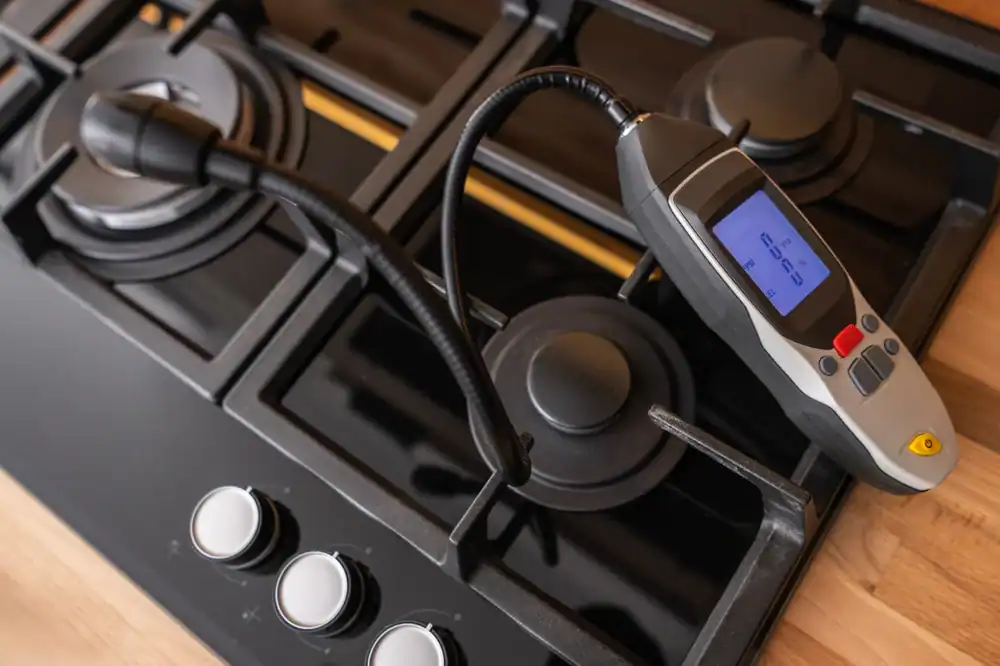
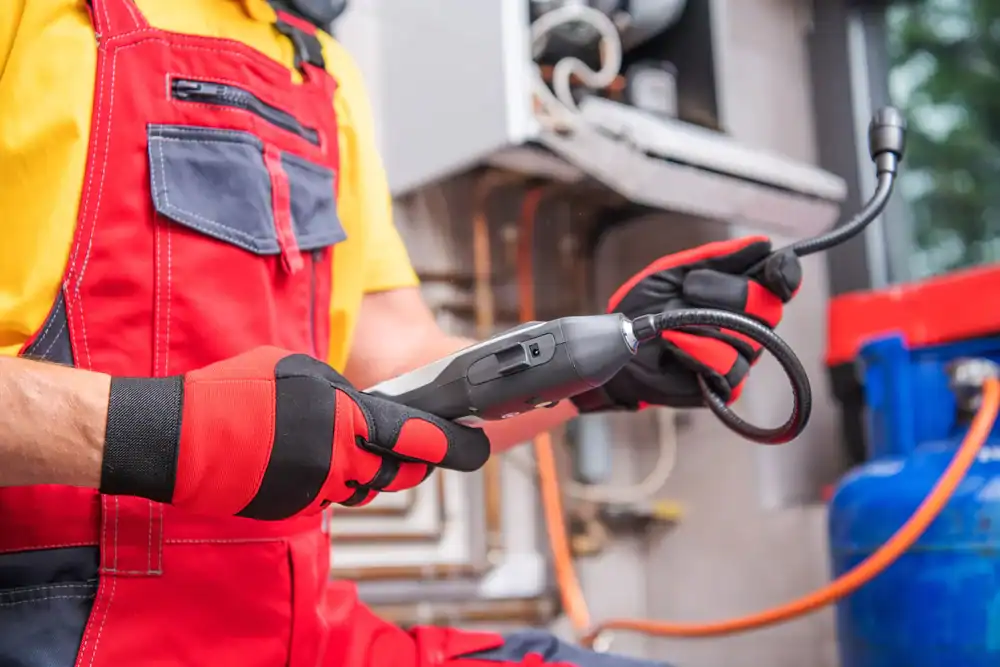
When our technician arrives, we start with a full walkthrough of your home’s gas system using professional-grade gas detectors and infrared cameras. This isn’t a visual check — it’s a calibrated scan that can find leaks hidden behind walls, under floors, and in areas that would never register as a smell. We check the connections at every appliance, the flexible lines behind your stove and dryer, the joints along your exposed piping, and the meter connection. If something is found, you get a clear explanation and a transparent price before any repair work starts.
If your property is a multi-unit building or commercial space on Richmond Avenue or elsewhere in Bulls Head, there’s an additional layer to consider: Local Law 152 requires a gas piping inspection by a Licensed Master Plumber on a four-year cycle, and Bulls Head falls under Community District 2, which had a compliance deadline of December 31, 2025. We handle the inspection, any required repairs, and the DOB filing — all under one roof, so you’re not coordinating between multiple vendors to close out a compliance requirement.
Ready to get started?
Our gas leak detection service covers the full scope of your building’s gas system — not just the spot where you noticed a smell. That includes all exposed gas piping, flexible connectors, appliance hookups, valves, and fittings throughout the property. We use professional-grade gas detectors and infrared cameras, so the results reflect what’s actually happening in the system, not just what’s visible to the eye.
For Bulls Head homeowners dealing with aging 1970s and 1980s construction, that thoroughness matters. The underground National Grid mains feeding this neighborhood have been independently documented as among the leakiest in the region — some of the pipes date back to the late 1800s. That’s the utility side, and National Grid is responsible for it. But the building-side system — everything from your meter inward — is yours, and it ages on its own timeline. A flexible connector that’s been behind your stove since the Ford administration doesn’t announce when it starts to degrade.
When a repair is needed, we handle it on the same visit wherever possible. We also coordinate directly with insurance companies when gas leak damage has occurred, so you’re not managing that process alone. For property owners in Community District 2 who need to satisfy Local Law 152 requirements, our service includes the inspection certification and DOB filing — not just the pipe work. Pricing is stated before work begins, with no hidden fees added after the fact.
Yes, and this is one of the most common points of confusion for Bulls Head homeowners. National Grid’s technicians inspect and maintain the gas distribution infrastructure — the mains running under the street and the service line that runs to your meter. That’s where their jurisdiction ends. Everything from the meter inward — the gas piping inside your walls, the connections to your boiler, your water heater, your stove — is your building’s system, and it’s completely separate from what National Grid checks.
So when National Grid clears their side and leaves, that’s actually a narrow finding. It means the utility’s infrastructure is intact. It says nothing about the condition of your home’s internal gas system. Given that most of Bulls Head’s housing stock was built in the late 1960s through the 1980s, the internal piping in many of these homes is now 40 to 60 years old. A Licensed Master Plumber using calibrated gas detection equipment is the only way to know what’s actually happening on the building side. If you’ve had an unexplained smell — even an intermittent one — that’s worth a professional inspection.
Consumer-grade gas detectors — the kind you’d buy at a hardware store — are designed to alert you when gas concentrations in the air reach a threshold level. They’re useful as an alarm, but they can’t tell you where the leak is coming from, how significant it is, or whether there are multiple sources. They also can’t detect leaks in enclosed spaces like wall cavities, under flooring, or in areas with limited airflow where gas hasn’t yet concentrated enough to trigger the sensor.
Professional-grade gas detectors used by a Licensed Master Plumber are calibrated to detect trace concentrations well below what a consumer device would register. Infrared cameras add another layer — they can identify temperature differentials caused by gas escaping from a joint or fitting, even when the leak is behind a wall. This combination means we can locate the source of a leak, not just confirm that gas is present somewhere in the area. For a home built in the 1970s with original flexible connectors still in place, that level of precision is the difference between finding a slow leak early and discovering it after it’s become a serious problem.
Local Law 152 is a New York City law that requires most buildings with gas service to have their exposed gas piping inspected by a Licensed Master Plumber on a four-year cycle. The law applies to all buildings except one- and two-family homes — so if you own a multi-unit residential building, a mixed-use property, or a commercial space in Bulls Head, you’re almost certainly covered.
Bulls Head falls within Staten Island Community Board 2, which is Community District 2 for Local Law 152 purposes. The most recent inspection deadline for CD 2 properties was December 31, 2025. If your building missed that deadline, the civil penalty is up to $5,000 — and that’s before any repair costs. The next deadline for CD 2 is December 31, 2029. We’re certified to perform LL152 inspections and handle any required repairs, and we file the DOB certification as part of the same engagement. If you own property along Richmond Avenue or anywhere else in the neighborhood and aren’t sure whether your building is current, it’s worth a call to confirm your compliance status before a penalty notice arrives.
Not necessarily. An intermittent smell is one of the most commonly misread signs of a gas issue. There’s a documented phenomenon called odor fade, where the mercaptan odorant added to natural gas dissipates through physical and chemical processes — meaning a real leak can exist without producing a consistent or detectable smell. On top of that, gas can accumulate in enclosed spaces and then disperse, creating a pattern where the smell is noticeable at certain times and absent at others depending on airflow, temperature, and how much gas has built up.
This is exactly the pattern that played out on Merrill Avenue in Bulls Head during the 2024–2025 odor investigation. Residents described the smell as coming and going — sometimes strong enough to force them out of their homes, other times absent entirely. The intermittent nature of the odor didn’t make it less real; it made it harder to trace. A professional inspection with calibrated equipment doesn’t rely on smell at all. It measures gas concentrations directly, which means it can find a slow leak that the human nose would never catch consistently.
For true emergencies, we target a 30 to 60 minute response time. Bulls Head is one of the more accessible neighborhoods on Staten Island — it sits directly at the intersection of I-278 (the Staten Island Expressway), Victory Boulevard, and Richmond Avenue, which are three of the island’s primary arterials. That road access makes a fast response realistic in a way it might not be in more isolated parts of the borough.
If you smell gas and believe you have an active leak, the first step is to leave the building, avoid using any electrical switches or open flames, and call 911 or National Grid’s emergency line at 718-643-4050. Once the utility has assessed their side and the immediate danger has been addressed, that’s when you call a Licensed Master Plumber to handle the building-side system. We can mobilize quickly for that follow-up, and in many cases the detection visit and any necessary repairs can be completed in the same appointment — so you’re not left waiting days to have your gas service restored.
Whether a gas leak is covered by homeowner’s insurance depends on your specific policy and the nature of the damage. Generally speaking, if a gas leak caused physical damage to your home — to appliances, walls, flooring, or other structures — that damage may be covered under your homeowner’s policy. The leak itself, and the cost of repairing the gas line, is typically treated separately and may or may not be covered depending on how the leak originated and what your policy includes.
Where a licensed plumber becomes directly relevant to the insurance process is documentation. Insurance companies require detailed, professional findings to process a claim — not a homeowner’s description of a smell. A Licensed Master Plumber can provide a written inspection report, document the source and extent of the leak, and describe the repairs performed in terms that satisfy an insurance adjuster’s requirements. We work directly with insurance companies when gas leak damage has occurred, which means we can coordinate that process on your behalf rather than leaving you to manage the back-and-forth alone. For Bulls Head homeowners dealing with an unexpected gas situation on top of a claim process, having a plumber who handles that coordination is a practical advantage that most people don’t know to ask about until they need it.
Other Services we provide in Bulls Head