


That faint smell that comes and goes — the one you’ve been second-guessing for weeks — isn’t something you should keep waiting on. Gas doesn’t always announce itself with a strong odor. The odorant added to natural gas can actually fade over time, which means a leak can be present long before your nose gives you a clear signal.
Getting a professional inspection is the only way to know for certain what you’re dealing with. For Graniteville homeowners specifically, this matters more than most people realize. The majority of homes in this neighborhood were built in the 1960s and 1970s — right after the bridge opened and the North Shore started filling in fast. That housing stock is now 50 to 60 years old. The gas lines, flexible connectors, and fittings that were installed during original construction weren’t designed to last forever.
Corrosion, joint fatigue, and worn connectors are a natural outcome of that age, and most of those systems in Graniteville have never been formally inspected. On top of that, the Environmental Defense Fund and Google mapped underground gas leaks across Staten Island’s National Grid distribution system — and the results showed hundreds of documented leak locations across the borough. Graniteville sits within that same distribution network. When you smell something and aren’t sure, you’re not being paranoid. You’re responding to a real and documented infrastructure picture.
We’ve been operating in the New York City market since 1983. That’s over 40 years of working on the exact kind of housing stock that fills Graniteville’s streets — post-war Colonials, High Ranches, semi-attached homes, and condos built during the North Shore’s development boom. We’re a father-and-son team, Bobby and Rob, and Staten Island is part of our stated service area, not an afterthought.
Every technician who shows up to your door is a NYC Licensed Master Plumber — the highest credential available for gas work in New York State. We’re also drug-tested and vetted, which matters when you’re letting someone into your home. In a neighborhood where 65% of households are owner-occupied and plenty of families have kids at home, that’s not a small thing.
Our pricing is transparent and given to you before any work begins. No surprises, no hidden fees, no pressure to approve work you didn’t ask for.
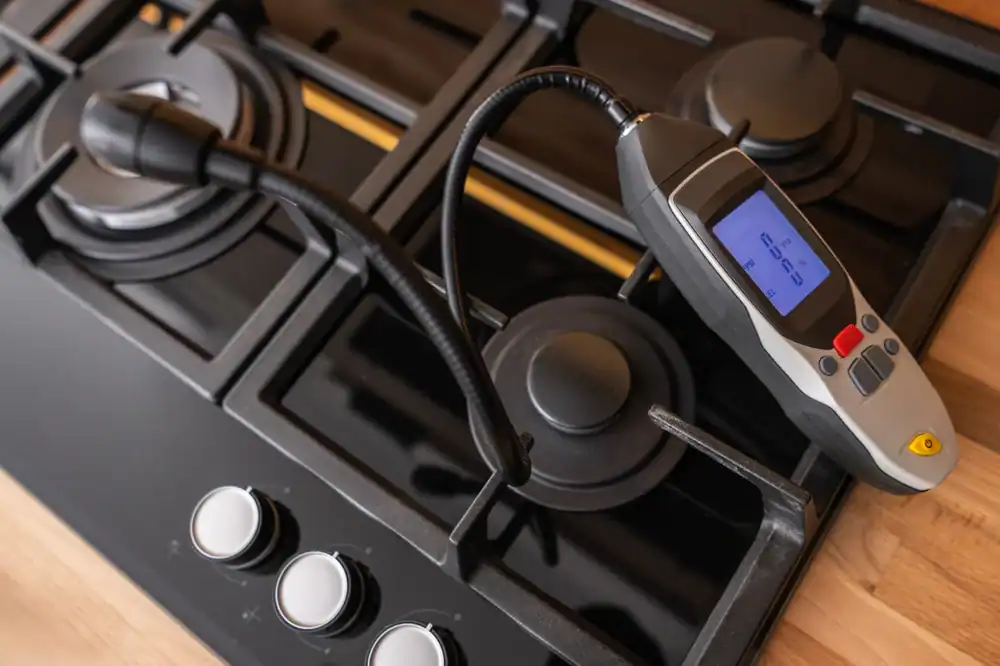
When you call about a gas smell in your Graniteville home, the first thing that happens is a real conversation — not a script. You’ll describe what you noticed, when it started, and where it seems to be coming from. That context helps us arrive prepared and focused on the right areas.
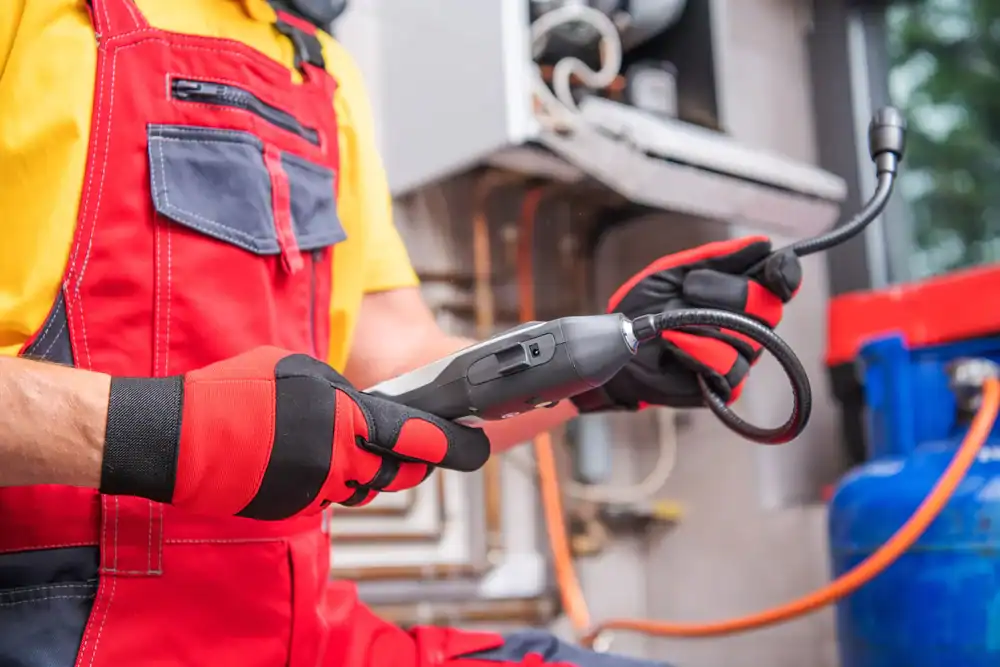
On-site, we use professional-grade gas detectors and infrared cameras to systematically check your gas lines, connections, appliances, and fittings. This isn’t a visual-only walkthrough. Our equipment can locate leaks that are hidden behind walls, under floors, or in areas you’d never think to look. If something is found, you’ll know exactly where it is, what’s causing it, and what the repair involves — before any work is authorized.
If a repair is needed, it gets handled by the same Licensed Master Plumber who found the problem — no handoffs, no subcontractors. For Graniteville properties that fall under NYC’s Local Law 152 requirements (which applies to condos, townhomes, and multi-unit buildings — not single-family homes), we handle the full compliance workflow: the inspection, any required repairs, the DOB filing, and the certification. National Grid handles the utility side of your gas service, but everything inside your building’s walls is your responsibility — and that’s exactly what we address.

Ready to get started?
Gas leak detection with us isn’t just a sniff test and a handshake. Our inspection covers your exposed gas piping, flexible connectors, appliance connections, shutoff valves, and any areas of concern specific to your property. For homes in Graniteville — many of which were built during the 1960s and 1970s construction boom that followed the Verrazzano-Narrows Bridge opening — that often means looking closely at original fittings and connectors that haven’t been touched in decades.
If the inspection turns up a problem, we handle the repair under the same roof of accountability. There are no separate vendors to coordinate, no waiting for a second company to come out. The same licensed team that finds the issue fixes it and files the necessary paperwork with the NYC Department of Buildings. For Graniteville’s condos and multi-unit buildings, that includes Local Law 152 compliance documentation — the mandatory gas piping inspection required by NYC for most buildings outside of one- and two-family homes. Failing to meet that requirement carries a $5,000 civil penalty, and we handle the entire process.
If gas leak damage has occurred, we also work directly with insurance companies to help coordinate the claim — something you won’t find offered by most plumbers serving the Staten Island market.
Leave the building immediately — don’t stop to open windows, turn off appliances, or use your phone while you’re still inside. Once you’re outside and at a safe distance, call National Grid at 718-643-4050. They are the gas utility for all of Staten Island, including Graniteville, and they’ll respond to make the utility side of the situation safe.
Here’s what most people don’t realize: National Grid handles the distribution infrastructure — the main lines running under your street and up to your meter. What they don’t do is repair the gas piping inside your building. Once they’ve confirmed the utility side is secure and left, the building-side piping is still your responsibility. That’s where a Licensed Master Plumber comes in. If National Grid found an issue or simply couldn’t clear the source, we can come out, locate the exact problem with professional-grade detection equipment, and handle the repair and any required NYC DOB filings.
There’s no reliable way to judge the severity of a gas leak on your own. The odorant that makes gas smell like rotten eggs can fade through a process called odor fade, meaning a leak that’s been present for a while might actually smell weaker than a fresh one, not stronger. A faint smell doesn’t mean a small problem.
The only way to accurately assess severity is with professional-grade gas detection equipment. Consumer detectors from a hardware store can alert you to the presence of gas, but they can’t tell you where the leak is, how significant it is, or whether it requires immediate repair or a scheduled fix. A Licensed Master Plumber using calibrated gas detectors and infrared cameras can give you a real answer — including a clear explanation of what was found, where it is, and what the repair involves. In Graniteville, where a lot of the housing stock is 50 to 60 years old and some of that original gas infrastructure has never been formally inspected, having a professional assessment on record is genuinely useful.
Local Law 152 applies to most NYC buildings except one- and two-family homes. If you own or manage a condo, townhome, co-op, or any multi-unit building in Graniteville, there’s a good chance your property is subject to the law’s mandatory gas piping inspection requirement. The inspection must be performed by a Licensed Master Plumber and repeated every four years on a schedule tied to your community district.
Non-compliance isn’t a paperwork technicality — the civil penalty is $5,000, and building owners are also required to submit the Gas Piping System Periodic Inspection Certification to the NYC Department of Buildings within 60 days of the inspection. We are licensed to perform Local Law 152 inspections and certified to make any repairs that come out of them, which means you’re dealing with one team from start to finish rather than coordinating an inspector and a separate repair contractor. If you’re unsure whether your Graniteville property falls under the law or where your community district stands in the inspection cycle, that’s a straightforward question to ask when you call.
National Grid handles the utility side of your gas system — the distribution mains running under the street, the service line coming into your building, and the meter. If there’s a problem on that side, they’ll address it. But their responsibility ends at the point where the gas enters your building. Everything from that point inward — the piping inside your walls, the flexible connectors behind your stove or dryer, the shutoff valves, the connections to your boiler or water heater — is the building owner’s responsibility.
This is one of the most common points of confusion for Graniteville homeowners. National Grid may respond to a gas smell, inspect the utility side, find nothing wrong on their end, and leave — and you’re left wondering why the smell is still there. The answer is often that the issue is on the building side, which National Grid doesn’t touch. A Licensed Master Plumber is the correct call for building-side gas piping work in NYC. In Graniteville, where much of the residential gas infrastructure dates back to the 1960s and 1970s, building-side issues are genuinely common in homes that have never had a formal inspection.
For most residential properties, the detection portion of the visit takes anywhere from 45 minutes to a couple of hours, depending on the size of the home, how many gas appliances are present, and whether any areas require more thorough investigation. Graniteville has a mix of single-family detached homes, semi-attached houses, townhomes, and condos — and the layout of the gas system varies quite a bit between those building types. A semi-attached home with a shared wall, for example, may require a more careful sweep than a standalone Colonial with a straightforward layout.
If a leak is found and the repair is something we can address the same day — a worn connector, a loose fitting, a faulty valve — that’s often handled in the same visit. More involved repairs, like gas line replacement or work that requires a NYC DOB permit, may take additional time to schedule and complete. Either way, you’ll know exactly what was found and what the repair involves before any work is authorized.
Whether your homeowner’s insurance covers gas leak detection and repair depends on your specific policy and what caused the leak. Most standard homeowner’s policies cover sudden and accidental damage — so if a gas line was damaged by something unexpected, like construction activity near your property, there’s a reasonable chance some of the repair cost is covered. Gradual deterioration or normal wear and tear is typically excluded.
Graniteville homeowners living near the Staten Island Expressway corridor or in areas where nearby development has been active should be aware that external construction damage to underground gas lines is a documented cause of leaks — and that type of damage is more likely to fall within a covered claim than simple aging. We work directly with insurance companies when gas leak damage has occurred, which takes a significant amount of the administrative burden off your plate during an already stressful situation. If you’re not sure whether your situation might be covered, it’s worth making the call — we can help you understand what documentation you’ll need and how the coordination process works.
Other Services we provide in Graniteville