


Most Pleasant Plains homeowners who call about a gas smell have already been through the National Grid visit. The crew came out, checked the street-side infrastructure, said everything looked fine, and left. But here’s what that visit doesn’t cover: the gas lines inside your home. The piping running to your boiler, your gas range, your fireplace — that’s building-side infrastructure, and it’s entirely your responsibility.
National Grid handles the mains under Amboy Road. What’s behind your walls is a different conversation.
After a professional gas leak detection with us, you know what you’re actually dealing with. Not a guess, not a “probably fine” — a documented assessment using professional-grade gas detectors and infrared cameras that can find leaks behind walls and inside mechanical spaces that a nose would never catch. That matters especially in Pleasant Plains, where a lot of residents are commuting out early and getting home late. A slow leak doesn’t wait for you to be home to smell it.
The other thing that changes is the paperwork trail. If a leak is found and repaired, you have documentation — something your insurance company can work with, something that protects the value of a home that, in this neighborhood, is likely worth close to $850,000. That’s not a small asset. Treating it that way makes sense.
We’ve been operating since 1983 — that’s over 40 years serving Manhattan and Staten Island, through every code change, every DOB update, and every shift in how the city handles gas safety. This is a father-and-son operation. Bobby and Rob are the business. When something goes wrong, there’s a real name attached to the work.
Staten Island is one of our two primary service areas, and that’s not a footnote. We’ve worked on the South Shore’s housing stock — the older homes near the Pleasant Plains station, the newer construction along the 10309 corridor, the planned communities with gas fireplaces built in as standard. We know the difference between a 1965 gas system and one installed in 2012, and what each one looks like when it starts to fail.
Every technician is a NYC Licensed Master Plumber — not a journeyman, not a subcontractor. That’s the highest credential available for gas work in New York State, and it’s also a legal requirement for anyone touching gas piping in NYC. You can verify it. That’s the point.
When you call us, the first thing that happens is a real conversation — not a scripted intake form. You describe what you’re experiencing: a smell that came and went, a hissing sound near the boiler, a National Grid notice, whatever triggered the call. That context shapes how our technician approaches the job.
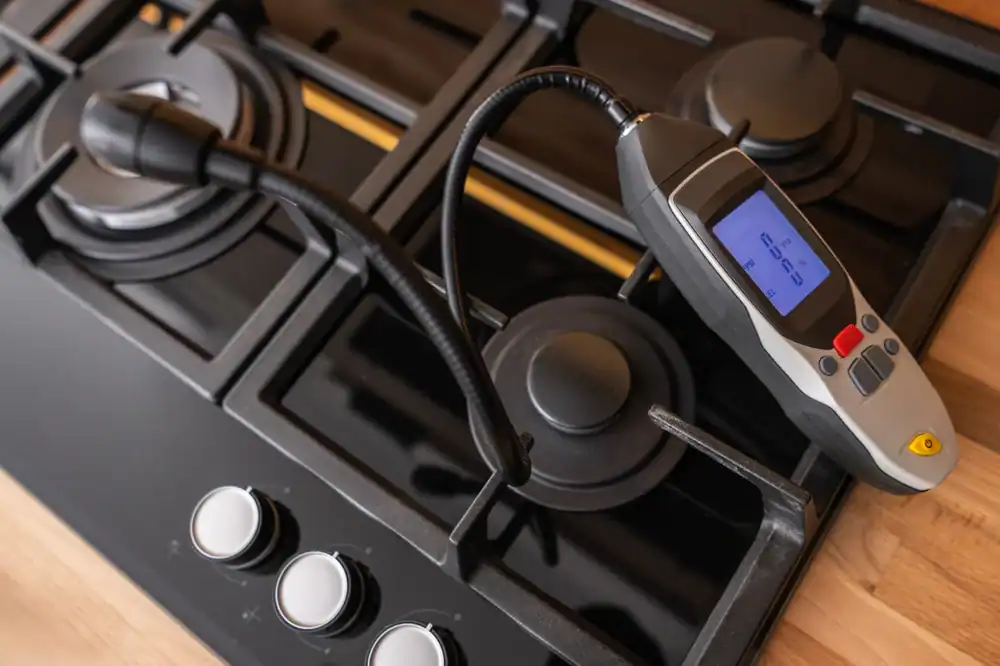
On-site, we use professional-grade gas detectors and infrared cameras to sweep your home’s gas system — the lines running to every appliance, the connections at your boiler, the flexible connectors behind your range, the fireplace gas supply if you have one. Infrared cameras are particularly useful in Pleasant Plains homes where gas lines run through finished walls or below-grade mechanical spaces, because they pick up what standard detectors miss and what no human nose can locate.
This is not a visual-only walkthrough. If a leak is found, you get a clear explanation of where it is, what caused it, and what the repair involves — before any work begins. Pricing is stated upfront. No hidden fees, no surprise line items at the end.
If the repair requires a DOB filing or any NYC compliance documentation, we handle that as part of the same visit. You don’t get handed off to a third party. For Pleasant Plains homeowners dealing with fall heating system startups — historically the highest-risk period for gas connection failures — getting ahead of this before the first cold snap is the right call.

Ready to get started?
Our gas leak detection covers the full building-side picture. That means the gas lines from your meter to every appliance in the home — boiler, water heater, gas range, dryer connection, gas fireplace. In Pleasant Plains, where newer construction often includes gas fireplaces as a standard feature and where homes frequently have multiple gas appliances running off the same system, a thorough sweep matters more than a spot check.
We use electronic gas sensors and infrared imaging — not just a visual inspection. If your home has older sections of piping, or if you’ve had any recent renovation work done that involved walls being opened and closed, those areas get specific attention. The South Shore’s coastal air and humidity accelerate corrosion on exposed fittings and connections over time, and that’s something our technicians will look for without being asked.
If a repair is needed, it’s done under a NYC Licensed Master Plumber’s license — which is the only legal way to perform gas piping work in New York City. Any required permits are filed. If there’s a DOB component, we handle it. And if your situation involves damage that may be covered by your homeowner’s insurance, we coordinate directly with your insurer — so you’re not left managing that process on your own while also dealing with a gas system that’s out of service.

This is one of the most common points of confusion for Staten Island homeowners, and it’s worth understanding clearly. National Grid is responsible for the gas distribution infrastructure — the mains running under the street, the service line from the street to your meter. When they respond to a gas call, they check and address that side of the system. If they find an issue there, they make it safe. But their scope ends at the meter.
Everything from the meter into your home — the gas lines running to your boiler, your range, your water heater, your fireplace — is building-side infrastructure, and it’s your responsibility as the homeowner. National Grid does not inspect or repair that portion of the system. Only a NYC Licensed Master Plumber can legally do that work. So if National Grid came out, cleared their side, and left, that doesn’t mean the inside of your Pleasant Plains home has been inspected. It means half the system has been looked at.
We don’t publish flat-rate pricing for gas leak detection because the scope genuinely varies depending on your home’s size, the number of gas appliances, and the complexity of the piping system. What we commit to is transparent pricing stated before any work begins — no hidden fees, no charges that appear after the fact. You’ll know what the job costs before our technician starts.
On the insurance question: whether your homeowner’s policy covers gas leak detection and repair depends on your specific coverage and what caused the leak. If the leak resulted in property damage, there’s a stronger case for a claim. We work directly with insurance companies when gas leak damage is involved, which means you’re not navigating that process alone. If you’re unsure whether your situation qualifies, that’s a conversation worth having when you call — not something to figure out after the fact.
The short answer is yes — you can have a gas leak and not reliably smell it. Natural gas has an odorant called mercaptan added specifically so people can detect it, but that odorant can dissipate through a process called odor fade. Physical absorption, chemical reactions, and even the materials in your walls can reduce the concentration of the smell before it reaches you. A leak that produces an intermittent odor — something you catch once and then can’t find again — is not a leak that resolved itself. It’s often a slow leak in a location where the smell disperses before it builds up enough for you to notice consistently.
This is particularly relevant in Pleasant Plains, where many residents are away from home for long stretches during the workday. A slow leak that develops during the day can accumulate in a mechanical room or behind a wall for hours before you return home. By the time you’re back and the house has aired out a bit, the smell may be faint or gone entirely. That pattern — “I thought I smelled something but it went away” — is exactly the scenario where professional electronic detection finds what your nose cannot.
Local Law 152 requires periodic gas piping inspections for most NYC buildings — but there’s an important exemption that applies to the majority of Pleasant Plains residents. One- and two-family homes are exempt from the mandatory four-year inspection cycle. Since Pleasant Plains is predominantly single-family and semi-attached residential, most individual homeowners in the neighborhood are not legally required to comply with Local Law 152 for their own residence.
Where it becomes relevant is if you own a larger rental property, a multi-unit building, or a commercial space anywhere in New York City. Those buildings are subject to the inspection schedule, which rotates by community district on a four-year cycle, and the penalty for missing the deadline is a $5,000 civil penalty. Even if your Pleasant Plains home is exempt from Local Law 152, that doesn’t mean a voluntary inspection is a bad idea — especially in a home with multiple gas appliances and an older section of piping. The law sets a floor, not a ceiling, for what responsible gas system maintenance looks like.
The most common sources of building-side gas leaks in residential homes are flexible connectors — the corrugated metal hoses that connect gas appliances to the rigid supply line. These are found behind gas ranges, dryers, and in some cases water heaters, and they’re designed to allow some appliance movement without stressing the connection. Over time, they can crack, corrode, or loosen, especially in homes where appliances have been moved during renovations or cleaning.
Boiler connections are another common source, particularly in Pleasant Plains homes where the heating system runs hard through the winter and then sits idle from spring through early fall. That cycle of pressure and dormancy stresses fittings and seals over time. Gas fireplaces — a standard feature in a number of newer Pleasant Plains townhome communities — have their own supply connections and shutoff valves that can develop issues, particularly if the fireplace isn’t used regularly and the connection hasn’t been inspected in years.
Proximity to the coast and the salt air off Prince’s Bay also accelerates corrosion on any exposed metal fittings, which is something specific to South Shore homes that inland neighborhoods don’t deal with to the same degree.
If you smell gas inside your home, don’t try to locate the source yourself. Don’t turn any lights or appliances on or off — electrical sparks can ignite accumulated gas. Don’t use your phone inside the house. Get everyone out, leave the door open behind you, and once you’re outside and away from the building, call National Grid’s emergency line at 718-643-4050. They serve all of Staten Island including Pleasant Plains, and they respond 24 hours a day. If you believe the situation is immediately dangerous, call 911 first.
Once the immediate emergency is addressed and National Grid has cleared the utility side, that’s when you call a Licensed Master Plumber to assess the building-side gas system. We offer a 30 to 60-minute emergency response time for true gas emergencies on Staten Island. Don’t re-enter the home and assume everything is fine just because the smell has dissipated — as covered above, odor fade is real, and a cleared smell is not the same as a cleared leak. Getting a professional inspection before you resume normal use of your gas appliances is the right next step, not an optional one.
Other Services we provide in Pleasant Plains