


A gas leak doesn’t always announce itself. Sometimes it’s a faint smell that comes and goes. Sometimes there’s nothing at all — because the odorant added to natural gas can actually dissipate over time, a process called odor fade. That means the absence of a smell is not clearance. It just means you don’t know yet.
For Richmond Valley homeowners, this matters more than it might in newer neighborhoods. A significant portion of Richmond Valley’s housing stock was built no later than 1939. That’s 80-plus years of gas piping — galvanized steel lines, aging flexible connectors behind stoves, fittings that have been in place through decades of freeze-thaw cycles, ground shifts, and the kind of moisture exposure that comes with living near the Arthur Kill.
These systems don’t fail loudly. They fail quietly, over time, in places you can’t see. What changes after a professional gas leak detection visit is simple: you know. You have a clear picture of what’s happening inside your gas system, documented by a Licensed Master Plumber, with any issues addressed before they become emergencies. For a home that may be worth close to or over a million dollars, that clarity is worth a great deal more than the alternative.
We’ve been operating since 1983 — over 40 years in this market. That’s long enough to have worked on pre-war Richmond Valley homes, post-war additions, and everything built since. Richmond Valley is a named core service area, not an afterthought. When you’re at the southwestern tip of Staten Island near the Outerbridge Crossing, that distinction matters.
Bobby and Rob — the father-and-son team behind RB Mechanical Plumbing and Heating — are Licensed Master Plumbers. Not journeymen working under a distant supervisor. We hold the highest credential available for gas piping in New York State, and we’re drug-tested and vetted before we ever set foot in your home.
Richmond Valley is a tight-knit community. Reputation travels fast on Amboy Road and through the neighborhoods off Page Avenue. That’s exactly why we operate the way we do — transparent pricing stated before any work begins, no hidden fees, and a commitment to doing exactly what was described.

When you call about a suspected gas leak, the first step is getting someone to you. We commit to a 30-to-60-minute response time for true emergencies. For a neighborhood at the far end of Staten Island’s South Shore, that’s a real commitment — not a generic promise pulled from a template.
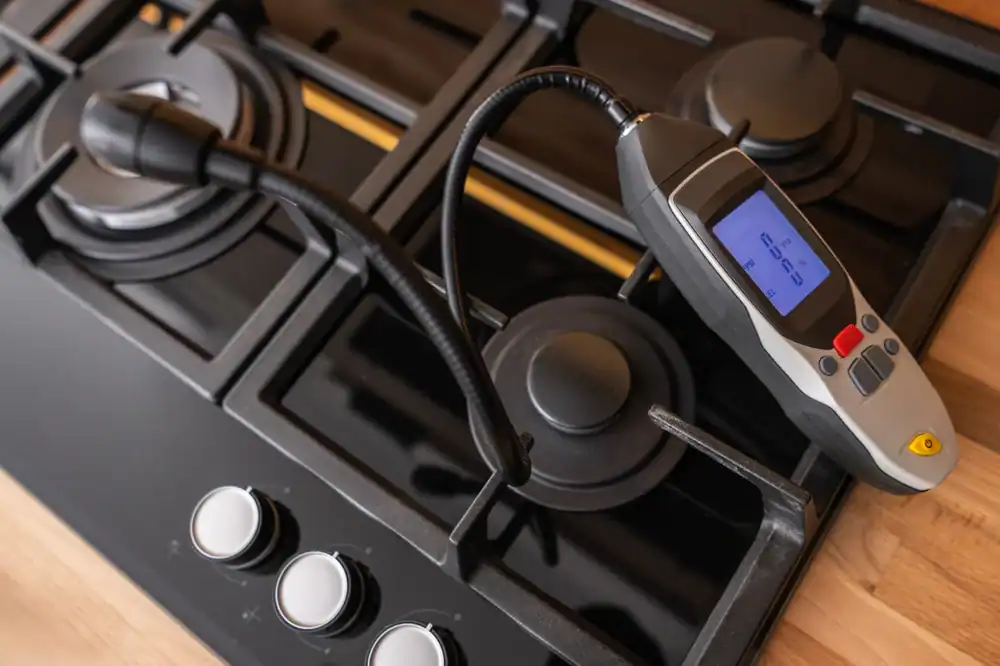
Once on-site, our technician begins with a systematic inspection using professional-grade gas detectors calibrated to identify natural gas concentrations that the human nose would never catch. Infrared cameras go to work on areas behind walls, under floors, and along basement piping runs — the places where 80-year-old connections tend to develop problems without any visible sign.
In Richmond Valley, where homes near the Arthur Kill have dealt with moisture infiltration and ground movement over the years, these hidden areas are exactly where issues tend to hide. If a leak is found, you get a clear explanation of what was detected, where it is, and what the repair involves — with pricing stated upfront before anything is touched.
If your property requires a DOB permit filing or falls under Local Law 152 inspection requirements, that paperwork is handled as part of the process. National Grid handles the utility-side distribution mains under your street. Everything from your meter inward is your responsibility — and that’s exactly what we’re licensed to address.

Ready to get started?
Our gas leak detection isn’t a single-step visit. It’s a complete evaluation of your gas system — from the meter inward, through every line, connection, and appliance hookup. That includes the gas piping running through your basement, the flexible connector behind your stove, and any gas dryer or water heater connections that may not have been touched since the home was last renovated.
For Richmond Valley residents, there are a few layers worth understanding. National Grid is your gas utility — not Con Edison. National Grid’s responsibility ends at the meter. The building-side piping, which runs through your home and connects to every gas appliance, is yours. A Licensed Master Plumber is the only person legally authorized to inspect, repair, or modify that system in New York City.
If National Grid has ever come out and found nothing on their end, that doesn’t mean your building-side system is clear — it means two different systems were checked, and only one of them was. For property owners in Richmond Valley with multi-unit buildings, Local Law 152 requires gas piping inspections by a Licensed Master Plumber on a rotating four-year cycle, with a $5,000 civil penalty for non-compliance.
Local Law 157 adds a natural gas detector installation requirement for all NYC residences, with a compliance deadline of January 1, 2027. We handle the inspection, any required repairs, the DOB filing, and the compliance certification — one call, no coordinating between multiple vendors.
National Grid handles the gas distribution mains that run under the streets of Richmond Valley and the South Shore. Their responsibility ends at the meter on the outside of your building. Everything from that meter inward — the gas piping running through your basement, walls, and to each appliance — is the building owner’s responsibility, not the utility’s.
This is one of the most common points of confusion for Staten Island homeowners. National Grid may come out, check the utility side, find nothing on their end, and leave. That doesn’t mean your home’s internal gas system is clear. It means the street-side infrastructure was checked. If you’re still smelling gas or have concerns about your building-side piping, you need a Licensed Master Plumber — not another call to National Grid. We’re licensed and equipped to handle exactly that side of the system.
Yes, and the reason matters. The smell associated with natural gas comes from mercaptan, an odorant added specifically so leaks can be detected. The problem is that mercaptan can dissipate over time through a process called odor fade — meaning an intermittent smell, or a smell that seems to have gone away, does not mean the leak is gone. Gas can still be accumulating in enclosed spaces even when you can’t smell it.
In Richmond Valley, where many homes were built before 1940 and have aging gas infrastructure, an intermittent smell is worth taking seriously. Older galvanized piping, worn flexible connectors, and fittings that have been in place for decades can develop slow leaks that come and go depending on pressure changes, temperature, and airflow inside the home. A professional gas leak detection visit with calibrated equipment will tell you definitively what’s happening — something a passing smell or its absence simply cannot do.
The two primary tools are professional-grade gas detectors and infrared cameras. Gas detectors are calibrated to identify natural gas concentrations far below what the human nose can register — they don’t rely on smell, and they don’t miss slow leaks that haven’t built up enough concentration to be obvious. Infrared cameras allow the technician to look behind walls, under floors, and along piping runs without opening up the structure, which is particularly useful in older homes where the piping is embedded in original construction.
Consumer-grade gas detectors from a hardware store can alert you that gas is present, but they can’t locate the source, assess severity, or produce any documentation. For Richmond Valley homeowners dealing with pre-war construction — where piping may run through plaster walls and original hardwood floors — the ability to find a leak without tearing apart a well-maintained historic home is a real practical advantage. It’s also the only way to generate documentation that satisfies DOB requirements or an insurance claim.
Local Law 152 is a New York City law that requires gas piping inspections in most NYC buildings — specifically, any building that is not a one- or two-family home. The inspection must be performed by a Licensed Master Plumber, or by a Qualified Gas Operator working under LMP supervision, and it must happen once every four years on a rotating schedule by community district. Richmond Valley falls within Staten Island Community Board 3, which determines the specific inspection cycle for this area.
If you miss the inspection deadline or fail to submit the required certification to the NYC Department of Buildings within 60 days of the inspection, the civil penalty is $5,000. That’s a significant financial consequence for something that’s entirely avoidable with the right plumber. We’re licensed to perform Local Law 152 inspections and to make any repairs identified during the inspection, so you’re not coordinating between an inspector and a separate contractor. It’s handled in one process.
We commit to a 30-to-60-minute response time for true gas emergencies, and Staten Island is a named core service area. For a neighborhood at the southwestern tip of NYC — adjacent to the Outerbridge Crossing and at the far end of the South Shore — that response time commitment is worth asking about specifically, because not every provider based in northern Staten Island or Manhattan can realistically reach Richmond Valley within that window.
If you suspect an active gas leak, the first step is always to leave the building, avoid using any switches or appliances, and call 911 and National Grid’s emergency line from outside. Once the immediate utility-side situation is assessed and you’re cleared to re-enter, a Licensed Master Plumber handles the building-side inspection and any necessary repairs. Having a provider already identified before an emergency — one who explicitly serves this area and can give you a specific response time — is a much better position than searching at 2 AM.
Older homes in Richmond Valley — particularly those built before 1940 along and around Amboy Road — tend to have a few recurring gas system vulnerabilities. Galvanized steel piping, which was standard in that era, corrodes from the inside out over time. The corrosion isn’t visible from the outside, and it doesn’t always create an obvious smell until it’s advanced. Flexible connectors behind gas stoves and dryers also degrade with age, and in homes that have been renovated over the decades, those connectors may have been disturbed without being properly inspected afterward.
The proximity to the Arthur Kill adds another layer. Moisture infiltration from the waterfront environment, combined with the freeze-thaw cycles common to this part of Staten Island, can accelerate corrosion on underground service lines and basement-level connections. Homes in lower-lying areas near the water have also dealt with the aftermath of significant storm events over the years, which can shift ground and stress piping connections in ways that aren’t immediately obvious. A professional inspection with infrared imaging is the only reliable way to assess what’s actually happening inside a gas system that’s been in place for 80 or more years.
Other Services we provide in Richmond Valley