


When we run a proper gas leak detection on your Woodrow home, you stop guessing. You get a clear picture of the condition of your gas system — what’s fine, what’s aging out, and what needs attention before it becomes an emergency. That’s not a small thing when your home is worth over a million dollars and your family is inside it every day.
Most Woodrow residents are homeowners, not renters. There’s no building manager, no super, and no co-op board watching over your gas system. That responsibility is entirely yours. A professional inspection gives you the documentation, the peace of mind, and — if something does need repair — a licensed professional who can fix it the same day and restore your service without leaving you in the cold.
The South Shore’s coastal proximity and older housing stock add real factors here. Homes near the Arthur Kill waterway and in low-lying areas have seen moisture exposure that accelerates corrosion on gas fittings and meter connections. Every October when boilers fire up after sitting idle all summer, connections that have quietly degraded over months can suddenly make themselves known. Getting ahead of that is a lot easier than dealing with it after National Grid has shut off your gas on a January night.
We’ve been doing this work in the New York market since 1983. That’s over 40 years of gas systems, NYC code changes, utility shutoffs, and the kind of institutional knowledge that only comes from time in the field. Bobby and Rob — the father-and-son team behind RB Mechanical Plumbing and Heating — are the people accountable for every job. You’re not dealing with a dispatch center.
Every technician we send to a Woodrow address is a NYC Licensed Master Plumber. That’s the highest credential available for gas work in New York State, and it’s a legal requirement for any gas piping repair or inspection in the city. They’re also drug-tested and vetted before they ever knock on a door — because in a residential neighborhood like Woodrow, who you let into your home matters.
We serve Staten Island alongside Manhattan, and we understand what South Shore homes actually look like — single-family construction, gas boilers in the basement, forced-air systems, and aging flexible connectors that haven’t been touched since the house was built. That’s a different job than servicing a Manhattan high-rise, and we handle it accordingly.

It starts with a call. You describe what you’re experiencing — a smell that comes and goes, a utility notice from National Grid, a heating system that’s been acting up since fall startup, or simply the fact that you’ve never had your gas lines looked at and your house is 35 years old. We can typically reach Woodrow within 30 to 60 minutes for a true emergency, and same-day for non-urgent inspections.
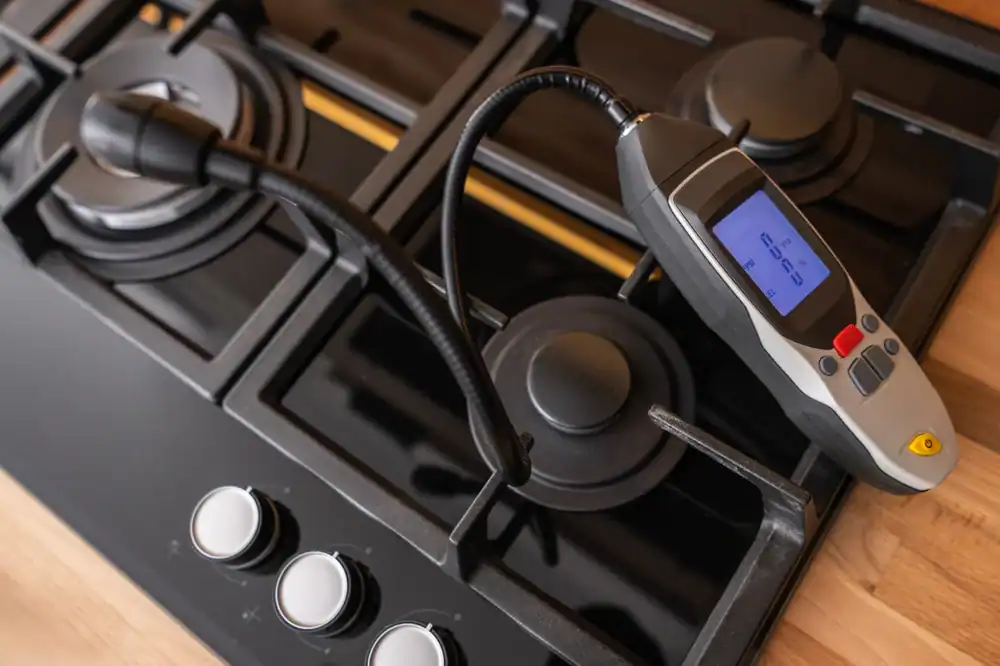
Once on-site, our technician uses professional-grade combustible gas detectors and infrared cameras to assess the exposed gas piping, appliance connections, flexible connectors behind the stove and dryer, and the boiler room. This isn’t a visual pass — the equipment finds leaks that the human nose misses, including slow seeps where the mercaptan odorant has already dissipated. If something is found, you get a clear explanation of what it is, where it is, and what fixing it involves before any work begins. No pressure, no surprises.
If repairs are needed, we handle them with the same licensed team — no handoff to a subcontractor, no second appointment. Once the work is complete, we coordinate directly with National Grid for service restoration if the gas was shut off. For Woodrow homes that may also have multi-unit structures or mixed-use components subject to Local Law 152, we handle the full compliance filing and DOB coordination in-house as well.
Ready to get started?
Our gas leak detection service covers the full scope of your home’s gas system — not just the line you can see. That means exposed piping, flexible connectors, appliance hookups, the boiler and water heater connections, and any gas-fired equipment in the home. For Woodrow’s 1970s-to-1990s housing stock, the flexible connectors behind kitchen ranges and dryers are a particular focus. These components have a manufacturer-recommended service life of 10 to 15 years, and many haven’t been replaced since the home was built.
If the inspection turns up a problem, we handle the repair the same visit whenever possible. We’re licensed to perform the repair and file any required permits with the NYC DOB — you don’t need to manage multiple vendors or figure out the paperwork yourself. If your gas was shut off by National Grid prior to our visit, we coordinate service restoration directly after the repair is confirmed.
Woodrow homeowners should also be aware that NYC Local Law 157 — finalized by the DOB in February 2024 — requires natural gas detectors in all NYC residences, with a compliance deadline of January 1, 2027. If your home doesn’t have compliant detectors installed, we can address that in the same visit. For any Woodrow property with three or more units or a commercial component, Local Law 152 gas piping inspections are a separate legal obligation — one that carries a $5,000 civil penalty for non-compliance. We handle that work too.

National Grid handles the utility side — the distribution infrastructure that runs to your property. When they respond to a reported leak or shut off your service, they’re focused on the main line and the meter. What happens inside your home, from the meter connection inward, is the building owner’s responsibility, and National Grid cannot legally perform that repair work for you.
That’s where we come in. In New York City, all gas piping work inside a residential property must be performed by or under the direct supervision of a NYC Licensed Master Plumber. Once National Grid has cleared the utility side, we assess and repair the building-side issue, then coordinate with National Grid to restore service. If you’re waiting for gas to come back on at a Woodrow address in the middle of winter, this distinction matters — and knowing it in advance can save you hours of confusion.
The absence of a gas smell is not the same as the absence of a leak. Natural gas has an odorant called mercaptan added to it specifically so people can detect it, but that odorant can dissipate over time through a process called odor fade. A slow leak in a well-ventilated area — like a basement boiler room with an exterior vent — may never produce a smell strong enough to notice, even while gas is accumulating.
Consumer-grade detectors from a hardware store will alert you if gas concentrations reach a certain threshold, but they can’t tell you where the leak is coming from, how significant it is, or whether it’s getting worse. They also can’t produce the documentation needed for an insurance claim or a utility service restoration. Professional detection equipment — specifically calibrated combustible gas indicators and infrared cameras — can locate the source precisely, assess the severity, and give you a written record of what was found and what was done. For a Woodrow homeowner with a gas boiler in the basement and connections that haven’t been inspected in decades, that level of specificity is what actually resolves the problem.
Yes, and the age of the home is exactly the reason. Flexible gas connectors — the corrugated metal lines that connect your stove, dryer, water heater, and boiler to the gas supply — have a manufacturer-recommended service life of roughly 10 to 15 years. A home built in 1985 has gas system components that are now 40 years old. If those connectors have never been replaced or professionally inspected, they’ve been operating well past their intended lifespan.
This isn’t unique to one or two homes — it describes a large portion of Woodrow’s housing stock. The neighborhood was developed heavily between the 1970s and 1990s, and many of those original gas system components are still in place. The fact that nothing seems wrong is actually part of the problem — slow leaks and degraded connections don’t always announce themselves with a smell or a sound. A professional inspection with calibrated detection equipment is the only way to know for certain what condition your system is in, and it’s far less disruptive than dealing with a gas shutoff or a damaged appliance after the fact.
When National Grid shuts off gas service at a Woodrow property, they do it because something triggered a safety concern — a detected leak, a failed appliance inspection, a neighbor’s complaint, or a routine utility check that flagged an issue. Before they restore service, they need confirmation that the problem on the building side has been addressed by a licensed professional.
The process works like this: a NYC Licensed Master Plumber inspects the building-side gas system, identifies and repairs the issue, and then coordinates directly with National Grid to schedule a service restoration. National Grid will typically require documentation of the repair before they send a technician to restore flow at the meter. The timeline depends on the nature of the repair and National Grid’s scheduling, but having a licensed plumber who is already familiar with this process — and who can communicate directly with the utility — makes a real difference in how quickly your heat and hot water come back on. We handle this coordination as part of the repair process, not as a separate step you have to manage yourself.
They are two completely different hazards, and yes, they require different detectors. Natural gas is primarily methane, and it has an odorant (mercaptan) added to it so you can smell it. A natural gas leak is a fire and explosion risk. Carbon monoxide is a combustion byproduct — it’s produced when gas appliances burn fuel incompletely, and it is completely odorless and colorless. You cannot smell a carbon monoxide problem, which is what makes it so dangerous.
A natural gas detector responds to the presence of methane or propane in the air. A carbon monoxide detector responds to CO levels. They are not interchangeable, and having one does not replace the other. NYC Local Law 157 specifically addresses natural gas detectors — separate from the existing carbon monoxide detector requirements that have been in place for years. For a Woodrow home with a gas boiler, a gas water heater, and a gas stove, both types of detectors are relevant, and both have specific placement requirements under NYC code. If you’re not sure what you have installed or whether it meets current standards, that’s worth a conversation with us before the January 1, 2027 Local Law 157 compliance deadline arrives.
It depends on your policy and the circumstances of the leak. Most standard homeowner’s insurance policies cover sudden and accidental damage — meaning if a gas leak caused damage to your home’s structure or your personal property, there’s a reasonable chance some of that is covered. What’s typically not covered is the cost of the repair itself if the leak resulted from gradual deterioration or lack of maintenance, which is how many aging-connector failures are classified.
The practical takeaway for Woodrow homeowners is this: document everything. When we perform a gas leak detection and repair, you receive a professional assessment of what was found and what was done. That documentation is exactly what an insurance company needs to evaluate a claim. We also work directly with insurance companies when gas leak damage has occurred, which reduces the back-and-forth you’d otherwise have to manage on your own. Given the median home values in Woodrow — well above $700,000 in most of the ZIP codes serving this neighborhood — having that paper trail and a licensed professional in your corner is worth more than most homeowners realize until they actually need it.
Other Services we provide in Woodrow