
When you upgrade a kitchen or move into a new build off Amboy Road or Bloomingdale Road, the last thing you want is a gas line that can’t keep up with the appliances you paid for. A professional-grade range pulling 50,000 to 60,000 BTUs needs a line that was actually sized for that load — not one that was installed in the 1990s for a standard residential stove and never touched since. Getting this right upfront means your appliances perform the way they’re supposed to, and you’re not calling someone back six months later to figure out why the burners won’t reach full heat.
There’s also the documentation side of things. In a neighborhood where homes regularly sell in the $800,000 to $1.5 million range, unpermitted gas work is a problem that surfaces at the worst possible moment — during a home inspection before closing. Every gas line installation we complete comes with a full paper trail: DOB permits filed through the city’s online portal, pressure testing results, National Grid authorization, and written safety documentation you can hand to a buyer, an insurance carrier, or a building inspector without hesitation.
Pleasant Plains also sits along the Lower New York Bay, and the coastal exposure is real. Homes near the water can see corrosion and wear on gas infrastructure that inland neighborhoods don’t deal with at the same rate. Getting a proper inspection and documented installation now means you’re not guessing about the condition of your lines when the next major storm rolls through.
We’ve been operating since 1983. That’s over four decades of gas line installations, permit filings, utility coordination, and safety certifications across Manhattan and Staten Island. Pleasant Plains and the South Shore aren’t a stretch of our service area — they’ve been part of our work since the neighborhood was being built out.
Staten Island runs on National Grid, not Con Edison. That distinction matters when you need a new gas service connection or a capacity upgrade. The authorization process, the inspection requirements, and the filing sequence are different from what Manhattan contractors deal with, and a plumber who doesn’t know that difference will cost you time. We’ve navigated both utility systems for decades and know exactly what National Grid needs to activate your service without delays.
Every gas line installation is performed by or under the direct supervision of a Licensed Master Plumber — the credential required by New York City law for all gas work. This isn’t a subcontractor arrangement. The LMP is on the job, signs the permits, and is personally accountable for the work.
It starts with a real assessment of what you’re working with. If you’re in a new construction home in Pleasant Plains, there’s no existing infrastructure to evaluate — everything gets sized from scratch based on the total BTU load of every appliance the home will run: the range, the boiler, the water heater, the dryer, the fireplace if there is one. If you’re upgrading an existing home, the first step is figuring out whether your current line can handle the new demand or whether it needs to be upsized. That calculation drives everything else.
Once the scope is clear, we file the permit through DOB NOW — New York City’s online portal for all gas piping work. No paper submissions, no workarounds. After the permit is issued, the installation happens: pipe run, fittings, shutoff valves at each appliance, and a pressure test at one and a half times working pressure as required by the NYC Fuel Gas Code. We use electronic leak detection equipment at every joint before anything is considered done.
The final step is National Grid coordination. New service connections and capacity upgrades on Staten Island require National Grid authorization before the meter is active. We handle that filing and follow up through the utility’s process so you’re not sitting on a completed installation waiting for gas that nobody thought to authorize. When the job is done, you get written documentation of everything — permits, test results, and authorization records.

Ready to get started?
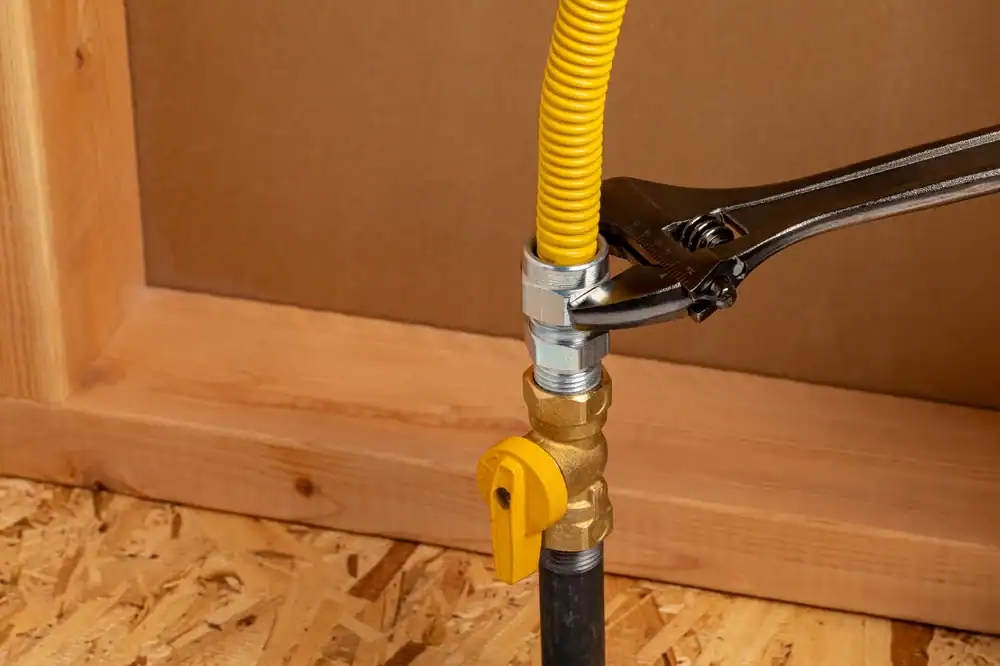
Gas line installation in Pleasant Plains covers the full range of what a South Shore homeowner actually needs. New construction gas lines run from the National Grid main through the meter and throughout the home to every appliance connection point. Appliance hookups — for ranges, water heaters, boilers, dryers, and gas fireplaces — include a dedicated shutoff valve at each appliance, proper sizing for the BTU demand of that specific unit, and a pressure test before the connection is considered live. If you’re putting in a professional-grade range or a tankless water heater, the line feeding it gets sized for what that appliance actually requires, not what was there before.
Pricing for single-appliance hookups in the Staten Island area typically runs $500 to $2,000 depending on the complexity of the run and the type of pipe required. Whole-home gas installations generally fall in the $1,300 to $3,500 range, with linear footage priced at $12 to $25 per foot based on the project. These figures reflect real job costs, not estimates built to look low before extras get added.
Local Law 152 compliance services are also available for any multifamily buildings in the Pleasant Plains area. That includes the full inspection by a Licensed Master Plumber, any required repairs, and GPS-2 certification filing with the DOB. Missing the LL152 deadline carries penalties up to $10,000 — we handle the entire process so building owners don’t have to navigate it alone.

National Grid serves Pleasant Plains and all of Staten Island for natural gas. Con Edison covers Manhattan, the Bronx, and parts of Queens — but not the island. This matters practically because new gas service connections, capacity upgrades, and meter work in Pleasant Plains all run through National Grid’s authorization process, which has its own requirements and inspection sequence separate from Con Edison’s system.
If you hire a contractor who primarily works in Manhattan and isn’t familiar with how National Grid handles new service authorizations, you can end up with a completed installation that sits idle while the utility authorization catches up. We work across both service territories and know how to file correctly with National Grid from the start, which keeps your project on schedule rather than stalled at the last step.
The short answer is that you need someone to calculate it, not guess at it. A standard residential gas range typically pulls around 35,000 to 40,000 BTUs. A professional-grade range — the kind showing up in Pleasant Plains kitchen renovations — can demand 50,000 to 60,000 BTUs or more. If the line feeding your kitchen was sized for a conventional appliance, it may not be able to deliver the pressure and volume the new range requires, which shows up as burners that won’t reach full heat or ignition issues that look like an appliance problem but are actually an infrastructure problem.
The fix isn’t always a full line replacement. Sometimes it’s upsizing a section of pipe, sometimes it’s a different routing. But you need a Licensed Master Plumber to do the BTU load calculation, assess the existing pipe diameter and run length, and tell you exactly what’s needed before the new appliance goes in — not after you’ve already paid for installation and the range is underperforming.
Yes, a permit is required for all gas line work in New York City, including Pleasant Plains. There are no exceptions for small jobs, single-appliance hookups, or work inside an existing home. The permit gets filed through DOB NOW, the city’s online portal — paper submissions are no longer accepted. The permit must be filed by or on behalf of a Licensed Master Plumber, since only an LMP can legally perform or oversee gas line work in NYC.
We handle the permit filing as part of the job. You don’t need to create a DOB NOW account, figure out which forms apply, or follow up with the department. The permit is filed before work begins, the installation is done under that permit, and the documentation comes back to you when the job is complete. For homeowners in Pleasant Plains who are also coordinating with a general contractor on a renovation or new build, having the gas permit handled separately by us — rather than left to the GC to sort out — keeps the project moving without gaps.
For a single appliance hookup where the line routing is straightforward, the physical installation usually takes a few hours. More involved projects — running a new line through walls or floors, upsizing a line for a high-BTU appliance, or installing gas piping throughout a new construction home — can take a full day or more depending on the scope. The installation time itself is usually not the longest part of the process.
The part that adds time is the permit and utility authorization sequence. The DOB permit needs to be issued before work starts, and if the project involves a new gas service connection or a capacity upgrade, National Grid needs to authorize the service before the meter is active. In Pleasant Plains, where new construction is ongoing and new service connections are common, it’s worth starting that process early rather than waiting until the installation is already done. We initiate the permit and utility filings at the beginning of the project so the authorization timeline runs parallel to the work, not after it.
If an inspection finds a deficiency — whether it’s an undersized line, a missing shutoff valve, a pressure issue, or aging pipe material that doesn’t meet current code — the path forward is a repair or replacement of the specific problem, followed by re-inspection and documentation. The inspection finding itself doesn’t shut your gas off automatically, but if National Grid or the DOB identifies a hazardous condition, service can be suspended until it’s corrected and certified.
For Pleasant Plains homeowners, the more common scenario is discovering during a kitchen renovation or appliance upgrade that the existing gas infrastructure doesn’t meet today’s code requirements or can’t handle the new load. That’s actually the best time to find out — when the work is already planned and the walls may already be open — rather than during a sale or after a failed inspection. We can assess the existing system, identify what needs to be corrected, handle the repair, and file the updated documentation with the DOB so the record reflects the corrected installation.
Local Law 152 applies to virtually all New York City buildings with more than two residential units, and that includes buildings in Pleasant Plains. One- and two-family homes are exempt, but any multifamily building — even a small three-unit — falls under the law’s requirement for a gas piping inspection every four years. The inspection must be performed by a Licensed Master Plumber, and the results have to be filed electronically with the DOB using the GPS-2 certification form. Missing the filing deadline carries penalties up to $10,000.
Pleasant Plains has a mix of housing types, and while the neighborhood is predominantly single-family, there are multifamily properties along the Amboy Road corridor and in other pockets of the neighborhood that are subject to LL152. If you own or manage one of those buildings and aren’t sure where you stand on the inspection cycle or the filing deadline for your Staten Island community district, that’s worth sorting out before the deadline rather than after. We handle the full LL152 process — inspection, any required repairs, and GPS-2 filing — so building owners have a single point of contact from start to finish.
Other Services we provide in Pleasant Plains