

Once a backflow prevention device is installed and the initial testing is finalized, it has to be tested every twelve months by a New York State certified tester. That is permanent, for the life of the device.
In a managed building that should be routine. In practice, the annual backflow test is one of the easiest compliance items to lose, because it sits between the super, the board and the managing agent and belongs clearly to none of them day to day.
The Department of Environmental Protection sends a notification letter when a test is due, which helps right up until the letter goes to an agent who no longer manages the building. A letter that was sent still counts as sent.
What is at stake is not only a fine. Failing to perform the annual test can result in fines or the disconnection of your water service. We are deliberately not quoting a penalty figure, because the amounts sit in city rules and there is legislation before the City Council that would change them. Ask us or ask the Department for the current number rather than trusting a figure on any plumber’s website.
RB Mechanical Plumbing and Heating is third generation and owner operated, licensed master plumbers working in New York City since 1983. We are on Staten Island’s south shore, directly across the Verrazzano from Bay Ridge.
Backflow is a good illustration of why the licence matters on this one. In New York City, backflow prevention assemblies may only be installed, repaired and overhauled by a licensed master plumber. The annual test form is completed by a state certified tester and signed by a licensed master plumber. And a plumbing permit is required before a device is installed, relocated or replaced.
So a building using a testing company alone still needs an LMP for the signature, and needs one again the moment the device fails and something must be repaired. For a board, splitting that across two firms is how a failed test becomes six weeks of scheduling between contractors.
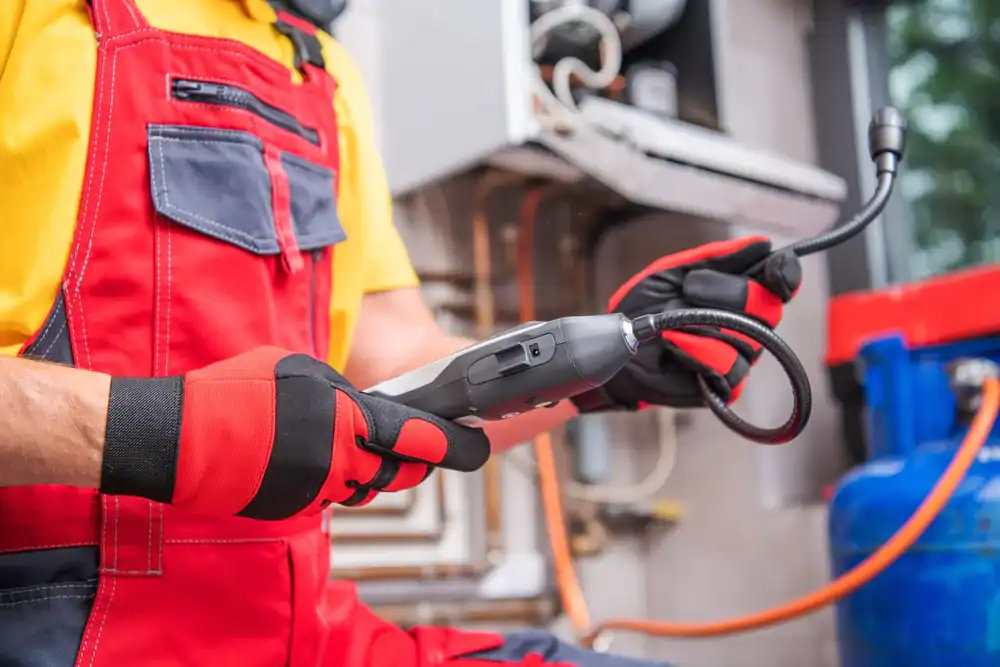
The test itself is short. A reduced pressure zone assembly or a double check valve assembly is tested to confirm both check valves are drip tight, which is the whole job the assembly exists to do.
The paperwork is form GEN215B. For an annual test or re-certification, only parts A and B are completed, filled out by the certified tester and signed by a licensed master plumber.
Results are filed with the Department of Environmental Protection, through its online test form submission system or by post to the Cross Connection Control unit in Flushing. We file rather than leaving a board with a form to send.
If the device fails, it is repaired or overhauled and retested. The Department’s handbook also recommends that assemblies are rebuilt or overhauled roughly every five years after installation, which for many Bay Ridge buildings is a date nobody has ever tracked.

Ready to get started?
Whether the building has a device at all, and where it is. Not every board knows, particularly after a change of agent.
What address the Department of Environmental Protection has on file for the notice. If it is a former agent, the reminders are going somewhere useless.
When it was last tested, and when it was last overhauled. Those are different dates, and the second is the one nobody has.
Who signs. The test form needs a licensed master plumber’s signature as well as the certified tester’s, so a testing-only arrangement is incomplete by design.
And whether the tester’s certification is current. The roster published on the Department’s own site is years out of date with expiry dates long passed. For a current list, the New York State Department of Health is the source.

The building, as the water customer, carries the obligation. How that is handled internally between the board, the managing agent and the super is a governance question rather than a plumbing one, and we will not pretend to rule on it.
What we would say practically is that this item fails most often when nobody is explicitly named. Putting one person on it, with the test date and the overhaul date written down, prevents nearly every missed test we see.
No. The Department of Environmental Protection sends a notification letter when a test is due, but the obligation to test every twelve months sits with the building regardless of whether the letter arrived or reached the right person.
Worth checking what address the Department holds for your property, especially if the managing agent has changed. A letter sent to an old agent is still a letter sent.
Not the whole thing. The annual test form is completed by the certified tester and signed by a Licensed Master Plumber, so the LMP signature is part of the filing.
And if the device fails, repairs and overhauls to a backflow assembly may only be carried out by a licensed master plumber. That is where testing-only arrangements stall, with a failed device already on the record and a new contractor to find.
Not automatically, but it is worth knowing. The Department’s handbook recommends that assemblies are rebuilt or overhauled about every five years after installation.
An assembly that has passed annual tests for a decade without an overhaul is working on original internals. If it has just failed, that is the context rather than bad luck, and a rebuild is usually the answer rather than a replacement.
Failure to perform the annual test can bring fines or disconnection of your water service. We will not quote an amount, because the penalty figures sit in city rules and there is legislation before the City Council that would change them, so any number on a contractor’s website may already be wrong.
The disconnection risk is the part boards should weigh. For a residential building that is a very bad day for a very cheap annual item.
Yes, and that is the point of using us for it. We are licensed master plumbers, so the test, the LMP signature on the form, the filing and any repair or overhaul all sit with one company.
For a board, that means one contact, one schedule and no gap between a failed test and whoever is allowed to fix it.