


The most dangerous gas leaks aren’t the dramatic ones. They’re the slow, intermittent ones — the kind you catch a whiff of on a Tuesday morning in Grasmere and then convince yourself was nothing by the time you’re on the Staten Island Railway heading to St. George. That hesitation is completely normal. It’s also how small problems become serious ones.
When we run a proper gas leak detection visit — using professional-grade gas detectors and infrared cameras, not just our nose — you stop guessing. You get a clear answer about whether there’s a problem, where it is, and what it takes to fix it. That’s not a small thing when you’re protecting a home worth well over a million dollars in a neighborhood where the median sale price has climbed to around $1.2M.
Grasmere’s housing stock skews heavily toward homes built between the 1940s and 1990s. That means a lot of gas supply lines, flexible connectors behind stoves, and boiler connections that are anywhere from 30 to 80 years old. These systems weren’t built to last forever, and the absence of a smell doesn’t mean the absence of a leak — the odorant added to natural gas can actually dissipate over time, a phenomenon called odor fade. A professional inspection gives you something a sniff test never can: documented confirmation.
We’ve been doing this work in New York City since 1983 — over 40 years of gas lines, boilers, DOB filings, and utility coordination. We’ve spent that time working in National Grid territory across Staten Island, including Grasmere and the East Shore, which means we know the neighborhood’s infrastructure, housing stock, and the specific challenges older homes face when it comes to gas systems.
The business is run by Bobby and Rob — a father-and-son team that puts their names on every job. Every technician we send is a NYC Licensed Master Plumber, which is the credential the law requires for any gas piping work in New York City. We also drug-test and vet every team member, which matters when you’re inviting someone into your Grasmere home rather than a commercial building with a front desk.
When National Grid shuts off your gas — or when you just want to know whether those 50-year-old pipes behind your boiler are still holding — we know exactly what needs to happen on the building side to get things right.

When you call us about a potential gas leak, the first thing that happens is a real conversation — not a scripted intake form. You’ll describe what you noticed, when you noticed it, and what type of appliances or systems are involved. That context matters because a boiler connection behaves differently than a flexible connector behind a gas range, and our inspection approach adjusts accordingly.
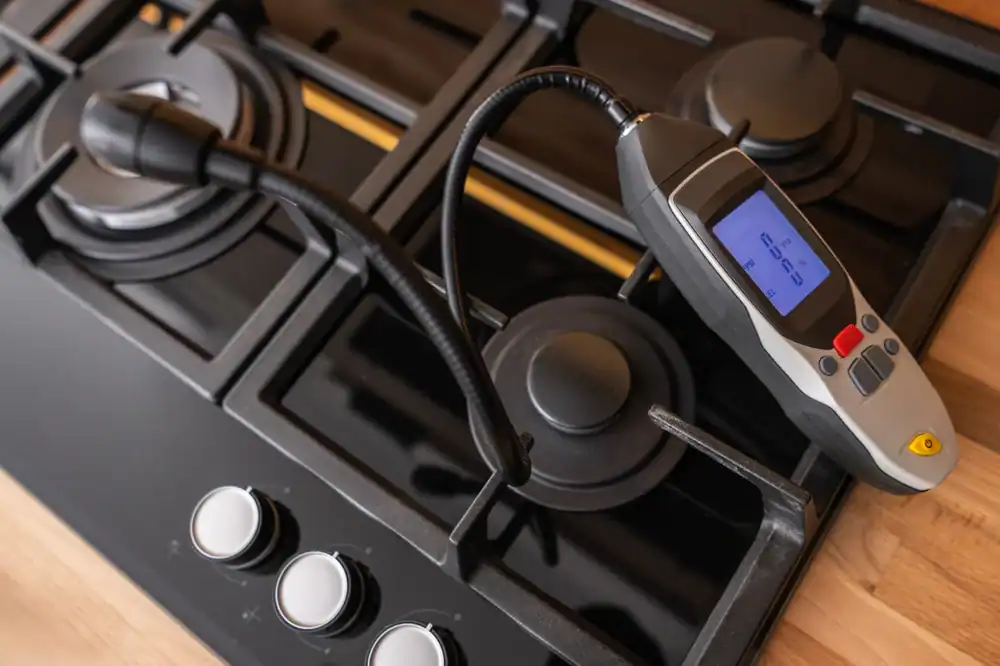
Once on-site, we use professional-grade gas detectors and infrared cameras to systematically check exposed gas piping, appliance connections, and any areas of concern you’ve flagged. Infrared cameras are particularly valuable in Grasmere’s older housing stock — they can identify temperature anomalies behind walls and in concealed spaces that no consumer-grade detector or visual inspection would catch.
If a leak is found, you’ll know exactly where it is and what the repair involves before any work begins. We state pricing transparently upfront, with no hidden fees added after the fact.
If your property is a multi-unit building subject to Local Law 152 — which applies to all NYC buildings except one- and two-family homes — we handle the inspection documentation, any required repairs, and the NYC DOB filing as a single-vendor process. You don’t have to coordinate multiple contractors or chase paperwork under a compliance deadline. And if National Grid is involved on the utility side, we know exactly what documentation they need and how to coordinate the restoration of service.

Ready to get started?
National Grid handles the distribution lines up to your meter. Everything from that point into your Grasmere home — the supply lines, the flexible connectors, the boiler gas connections, the gas range hookups — is your responsibility, and it requires a NYC Licensed Master Plumber to inspect or repair legally. That’s the work we’re licensed and equipped to do.
Our gas leak detection visits cover a full sweep of your building-side gas system: exposed piping, appliance connections, shutoff valves, and any areas flagged during the call. If the inspection turns up a problem, we explain repair options clearly before anything is authorized.
For Grasmere homeowners whose properties experienced effects from Hurricane Sandy’s storm surge in 2012 — the East Shore was among the hardest-hit areas on Staten Island — it’s worth knowing that ground movement and flooding can stress underground gas connections in ways that don’t show up for years. A professional inspection using infrared cameras is the only way to know for certain.
Beyond emergency calls, we also handle Local Law 152 gas piping inspections for multi-unit building owners in Grasmere, Local Law 157 natural gas detector installation (NYC’s compliance deadline is January 1, 2027), DOB violation removal, gas line repair and replacement, boiler gas connections, and gas stove installation. When gas leak damage occurs, we work directly with insurance companies — which matters when you’re protecting a high-value East Shore property. One call covers the full picture.
No — and this is one of the most important distinctions for Grasmere homeowners to understand. National Grid’s rebuild of the Grasmere Gate Station at Mosel Avenue and Sable Avenue modernized the utility-side infrastructure that distributes gas to roughly 80,000 to 100,000 customers in the area. That project, which wrapped up in mid-2026, replaced aging mechanical equipment on National Grid’s side of the system. It has no effect on the gas piping inside your home.
Everything from the meter into your property — the supply lines, the flexible connectors behind your stove or dryer, the gas connections at your boiler — is building-side infrastructure, and it’s your responsibility as the property owner. In Grasmere, where the median home was built around 1970, that building-side piping is often just as old as the gate station was before National Grid replaced it. A professional gas leak inspection from a NYC Licensed Master Plumber is the only way to assess the condition of your home’s internal gas system. National Grid’s upgrade doesn’t cover it, and it doesn’t trigger any automatic inspection of your building-side lines.
Don’t wait for the smell to become constant before you act. An intermittent gas odor is still a gas odor, and the fact that it comes and goes doesn’t mean the leak is minor or resolved — it can mean the opposite. Gas accumulates and disperses depending on ventilation, airflow, and how the leak is positioned relative to your living spaces. In older Grasmere homes with varying floor plans and basement configurations, gas can collect in pockets that only become detectable under certain conditions.
There’s also the issue of odor fade. The odorant added to natural gas — mercaptan — can dissipate through physical and chemical processes, meaning a slow leak from an aging connection may produce less and less smell over time even as the leak continues. If you’ve noticed a rotten egg or sulfur-like smell even once, the right move is to ventilate the space, avoid using any appliances or switches, leave the building, and call National Grid’s emergency line at 1-800-892-2345 if you believe there’s an active risk. Once the immediate situation is assessed, contact a NYC Licensed Master Plumber to inspect the building-side gas system. A professional inspection with gas detectors and infrared cameras will tell you definitively whether there’s a problem and where it is.
No. Under New York City law, all gas piping work — including repairs, installations, and inspections — must be performed by or under the direct supervision of a NYC Licensed Master Plumber. A building super, no matter how experienced or capable, cannot legally authorize or perform gas line repairs in New York City. This applies everywhere in the five boroughs, including Grasmere and the broader Staten Island East Shore.
If a building super identifies a suspected gas issue, the correct step is to contact a licensed plumber immediately — not to attempt a fix or even a closer inspection without proper equipment. Unlicensed gas work can result in significant DOB violations, fines, and in some cases, gas service being shut off to the entire building until the work is properly addressed by a licensed professional. If you’re a renter and your building management is slow to respond to a gas concern, you have the right to escalate to the NYC Department of Buildings. The legal requirement exists for good reason — gas system errors have real consequences, and the licensing standard is there to protect everyone in the building.
Local Law 152 requires that all New York City buildings — with the exception of one- and two-family homes — have their exposed gas piping inspected by a NYC Licensed Master Plumber once every four years. The inspection must be documented and filed with the NYC Department of Buildings within 60 days of completion. Failure to comply carries a civil penalty of $5,000, so the deadline isn’t something to let slide.
For Grasmere property owners, the relevant community district is Staten Island Community Board 2, which covers the East Shore. The inspection cycle is tied to your community district, so the specific year your building is due depends on which district it falls under — your NYC DOB records will confirm this. If the inspection turns up issues, those repairs must also be completed by a licensed plumber before the filing can be submitted. We handle the full process: the inspection itself, any required repairs, and the DOB certification filing. If you own a multi-unit building in Grasmere and aren’t sure where you stand on the inspection cycle, it’s worth finding out before a missed deadline becomes a $5,000 problem.
It depends on your specific policy and the circumstances of the leak, but in many cases, homeowner’s insurance does cover gas leak-related damage — particularly when the leak has caused physical damage to the property. What most standard policies don’t cover is routine maintenance or inspections performed proactively. The distinction matters: if a gas leak has caused damage to your home’s structure, appliances, or finishes, that’s typically a covered event. The cost of the detection visit itself may or may not be reimbursable depending on your insurer and policy terms.
In Grasmere, where median home values are approaching $1.2M, the financial stakes of a gas leak — both in terms of property damage and the cost of displacement during repairs — are significant. We work directly with insurance companies when gas leak damage has occurred, which reduces the administrative burden on you during what’s already a stressful situation. If you’re filing a claim, having a licensed professional’s inspection report and documentation of the leak source and repair is essential. That paperwork is part of what a proper gas leak detection visit produces — not just a fixed pipe, but a documented record of what was found and what was done.
For most single-family homes in Grasmere — the raised ranches, Cape Cods, Tudor cottages, and Colonial Revivals that make up the bulk of the neighborhood’s housing stock — a thorough gas leak detection visit typically takes one to two hours. That covers a full sweep of exposed gas piping, appliance connections, shutoff valves, and any areas of specific concern. If the home has a basement boiler room, a finished lower level, or older concealed piping, the inspection may take a bit longer to do properly.
If a leak is found, the time to repair depends on its location and severity. Many repairs — a degraded flexible connector, a loose fitting at a gas range, a valve that’s no longer sealing correctly — can be completed the same day. More involved repairs, like replacing a section of supply line or addressing a corroded connection in a harder-to-access area, may require a follow-up visit. Either way, you’ll know what’s involved and what it costs before any repair work is authorized. For Grasmere homeowners whose homes are older — particularly those built in the 1940s through 1960s — it’s worth scheduling the inspection during fall before heating season begins, since boiler connections that sat dormant all summer are among the most common sources of gas issues when the system fires back up.
Other Services we provide in Grasmere