

When your gas line is properly sized, permitted, and installed by a licensed master plumber, you stop guessing. That new professional range actually performs the way it’s supposed to. Your tankless water heater doesn’t underdeliver. And you’re not sitting on an unpermitted installation that surfaces as a liability when you go to sell a home worth what Grasmere homes are worth.
The median home in Grasmere was built around 1970. That means the gas infrastructure inside most of these houses is the same age — black iron pipe that was sized for the appliance loads of a different era. If you’ve upgraded your kitchen or you’re planning to, the existing line may not be able to handle the demand. It’s a sizing calculation that takes about ten minutes to run and can save you from a range that never gets hot enough or a water heater that can’t keep up.
For condo owners at Hills at Grasmere or Stonegate, there’s another layer. Work in those communities needs to be coordinated with building management, documented for the association’s records, and done by someone who understands how to move through that process without creating headaches for the HOA. That’s a different job than a standard single-family install, and it’s one worth doing with a contractor who’s handled it before.
We’ve been doing this since 1983 — over 40 years of gas line work across New York City, including Staten Island and Grasmere specifically. That’s long enough to know National Grid’s authorization process, the DOB permit system, and what aging residential infrastructure actually looks like when we open up a wall in a home built in the late 1960s.
This isn’t a company that crossed the bridge for the first time last year. The Staten Island market, the building stock along Hylan Boulevard, the two-family homes near Clove Road, the condo developments closer to the Verrazzano — these aren’t unfamiliar territory. The licensed master plumber on staff is the one doing the work and signing the certifications, not a name on a license while someone else handles the job.
We provide written estimates before anything starts, documented safety testing when it’s done, and we can actually explain what we found and why.
It starts with an assessment. Before any new pipe goes in, we evaluate the existing gas infrastructure — line size, condition, total BTU load of everything connected to it. For a lot of Grasmere homes built around 1970, this step matters more than people expect. What’s in the wall was sized for appliances that no longer exist, and adding a high-demand appliance to an undersized line creates problems that show up later.
Once the scope is clear, a DOB permit gets filed through DOB NOW — the city’s required online portal for all gas work. No permit, no legal installation, full stop. After the permit is approved, the physical work happens: we run pipe, make fittings, and pressure-test every joint at the standard required by the NYC Fuel Gas Code before anything is connected to a live gas supply. On Staten Island, that also means coordinating with National Grid for any new service connection or capacity upgrade — that’s a separate authorization from the DOB permit, and we manage it on your behalf.
When the job is complete, you get documentation — the permit record, the pressure test results, and the LMP certification. For Grasmere homeowners with properties in the low-$800,000s, that paper trail matters. It protects your insurance coverage, satisfies building management requirements if applicable, and doesn’t become a problem at closing.

Ready to get started?
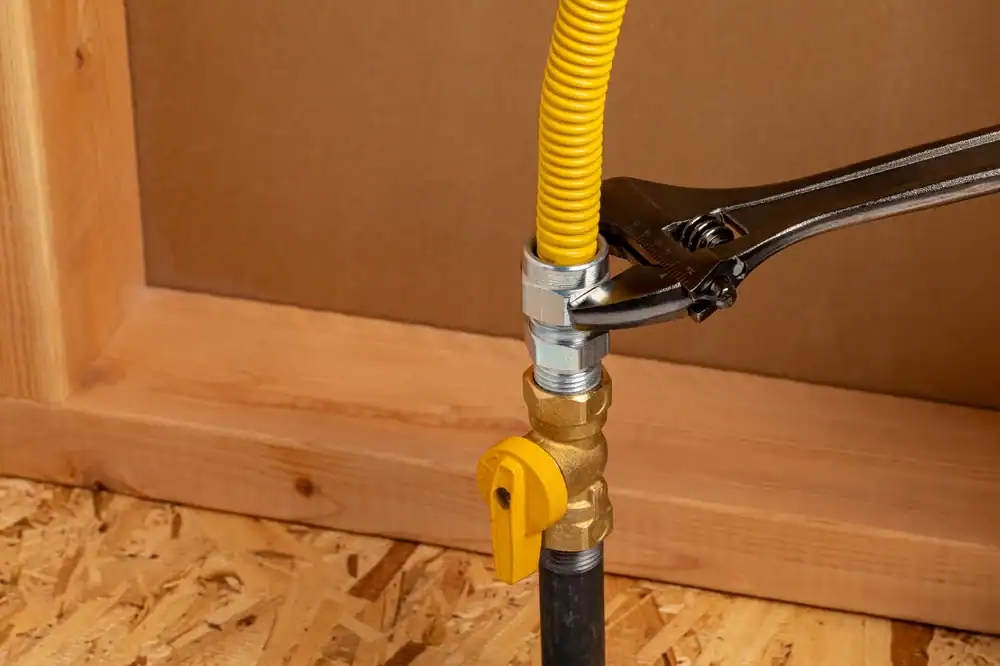
Our gas line installation covers the full scope — not just the pipe. That means the load calculation, the DOB permit filing, the physical installation using properly rated materials, pressure testing, National Grid coordination where required, and written documentation delivered when the job is done. For appliance hookups specifically, we install a dedicated manual shutoff valve in the same room for each connected appliance, which is required under the NYC Fuel Gas Code regardless of appliance type.
Grasmere residents commonly need gas line work for a few specific scenarios: upgrading to a professional-grade range in a kitchen renovation, adding a gas dryer where none existed before, installing a tankless water heater to replace an aging tank unit, or replacing corroded sections of aging black iron pipe that are showing their age in a 50-plus-year-old home. Each of these has different sizing requirements. A tankless water heater, for example, can demand 150,000 BTU or more — that often requires a larger-diameter line than what currently serves the space, even on a short run.
For buildings subject to Local Law 152 — which covers virtually all NYC buildings except one- and two-family homes — we provide the full compliance package: the LMP inspection, any required repairs, and GPS-2 certification filed electronically through DOB NOW. The Hills at Grasmere condo complex and Stonegate at Grasmere both fall under this requirement. Missing the filing deadline means penalties up to $10,000, and the inspectors book up as deadlines approach. Getting ahead of it is always the better move.
Yes — all gas line work in New York City requires a permit filed through DOB NOW, the city’s online portal for building permits. There are no exceptions for small jobs, appliance hookups, or minor repairs. The permit must be filed by a Licensed Master Plumber registered with the NYC Department of Buildings, and the work must pass a pressure test before gas service can be activated. This applies equally in Grasmere and everywhere else on Staten Island.
On the utility side, if your project involves a new gas service connection or an increase in capacity, National Grid — the gas utility serving Staten Island and Grasmere — requires a separate authorization in addition to the DOB permit. These are two different processes, and both need to be completed before the work is considered fully approved. We handle both sides of that coordination so you’re not navigating two separate bureaucracies on your own.
Pricing depends on the scope of the job. For most single-appliance installations — a new gas range, a dryer hookup, or a water heater connection — costs typically range from $500 to $2,000. Whole-home gas line installations or larger re-piping projects generally run $1,300 to $3,500. For work priced by the linear foot, the range is $12 to $25 per linear foot depending on the complexity of the run and the type of pipe required.
Those ranges account for the actual installation labor and materials. Permit fees, utility coordination costs, and any additional work required by the existing infrastructure — like replacing a corroded section of aging pipe in a Grasmere home built in the 1970s — can affect the final number. That’s why a written, itemized estimate before work begins matters. You should know the full cost before anyone touches anything, not after. We provide that upfront.
Not always — and this is one of the most common surprises homeowners run into during a kitchen upgrade or appliance replacement. A high-BTU professional range can demand 60,000 BTU or more. A tankless water heater can require 150,000 to 199,000 BTU. Whether your existing line can handle that load depends on the pipe diameter, the total length of the run, the number of other appliances sharing the line, and the gas pressure at the meter.
In a Grasmere home built around 1970, the gas lines were sized for the appliances of that era — not today’s high-demand equipment. It’s not a given that the existing infrastructure is adequate, and assuming it is without running the numbers is how you end up with an expensive range that never reaches full heat or a tankless unit that can’t keep up with demand. The assessment takes a fraction of the time the installation does, and it tells you exactly what you’re working with before any money is spent on new pipe.
Local Law 152 requires gas piping inspections every four years for virtually all New York City buildings, with the primary exception being one- and two-family homes. If your building doesn’t fall into that exception — a condo, a three- or four-family, a mixed-use building, or any commercial property — you’re on the LL152 inspection cycle. In Grasmere, that means condo developments like Hills at Grasmere and Stonegate at Grasmere are subject to these requirements, as are the neighborhood’s two-to-four family properties.
The inspection must be performed by a Licensed Master Plumber or a Registered Journeyman Plumber under direct LMP supervision. After the inspection, a GPS-2 certification form must be filed electronically through DOB NOW. If violations are found during the inspection, they need to be repaired before the GPS-2 can be filed. Non-compliance penalties can reach $10,000 per building. We handle the full process — inspection, any required repairs, and the GPS-2 filing — so building owners and property managers aren’t piecing it together on their own.
The timeline varies depending on the scope of the job and how quickly the permit clears through DOB NOW, but a realistic picture for most residential installations in Grasmere looks like this: the DOB permit filing and approval typically takes a few business days. The physical installation itself — running pipe, making connections, pressure testing — usually takes one to three days depending on complexity. If National Grid authorization is required for a new service connection or capacity upgrade, that adds additional time for the utility’s inspection and meter activation.
Gas service cannot be activated until all of these steps are completed and cleared — the permit, the pressure test, and the utility authorization. A contractor who tells you they can get gas on the same day as the installation without pulling permits is cutting corners that create real problems later, including the possibility that National Grid refuses to activate service to unpermitted work. The full process done correctly typically runs about one to two weeks from first call to gas activation for a standard residential job.
A National Grid gas shutoff — whether it’s triggered by a suspected leak, a failed inspection, or a Local Law 152 violation — is not a quick fix. The path to restoration involves identifying and repairing the underlying issue, having a Licensed Master Plumber certify the work, filing the appropriate documentation with the DOB, and then coordinating with National Grid for their inspection and meter reactivation. Depending on what triggered the shutoff and the condition of the existing gas infrastructure, this process can take anywhere from a few days to a couple of weeks.
In Grasmere, where most homes rely on gas for heat and hot water, a shutoff during the heating season is a genuine emergency. The 2024–2025 winter put record cold-weather demand on Staten Island’s gas distribution system — the very reason National Grid is currently rebuilding the Grasmere Gate Station from the ground up. That kind of pressure on the system makes it more important to have a contractor who knows the National Grid restoration process and can move through it efficiently. We offer 24/7 emergency availability and have a documented track record of same-day and next-day response when it matters most.
Other Services we provide in Grasmere