
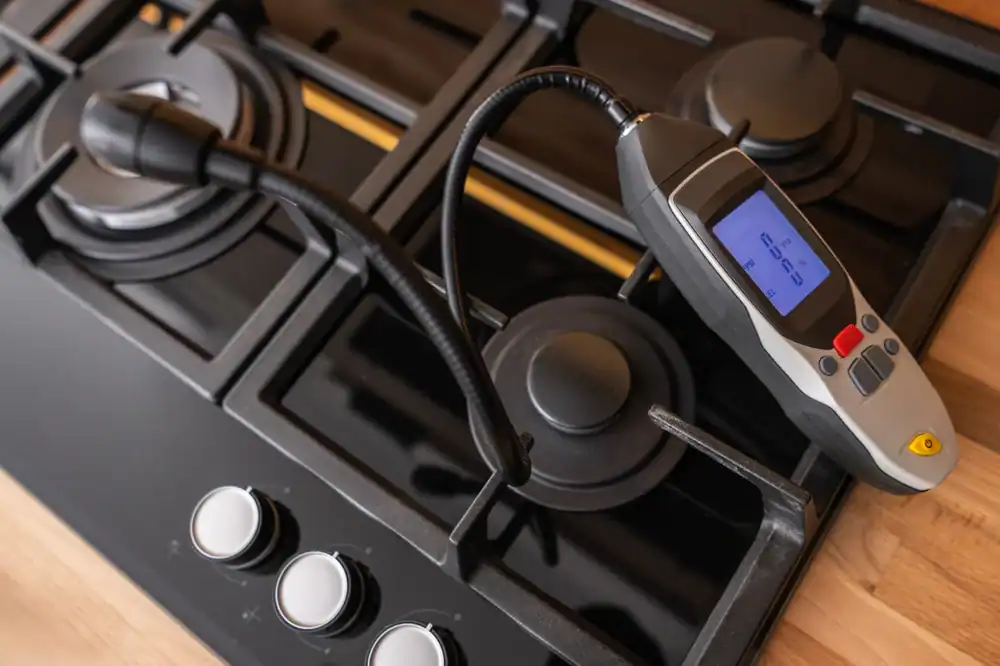

When a Greenridge homeowner calls about a gas smell, the conversation almost always starts the same way: “It comes and goes, so I figured it was nothing.” That hesitation is understandable — but it’s also one of the more dangerous assumptions you can make. Natural gas has an added odorant that can actually dissipate over time, a phenomenon called odor fade. The smell disappearing doesn’t mean the leak stopped. It can mean the opposite.
What a professional gas leak detection visit gives you is certainty. Not a guess, not a consumer-grade alarm from a hardware store that beeps and leaves you with zero answers — but a real inspection using professional-grade gas detectors and infrared cameras that can find what’s hiding behind walls, under floors, and in tight mechanical spaces without tearing anything apart.
For Greenridge specifically, that matters more than it might in a newer neighborhood. The housing stock here spans pre-1939 historic homes and a major wave of post-Verrazzano construction from the 1960s and 70s. Those homes are now 50 to 60 years old, and the gas systems installed during that era — flexible connectors behind ranges, supply lines to boilers and water heaters, fittings at meter connections — are hitting the end of their expected service life.
A thorough inspection tells you exactly where you stand, so you’re not finding out during an emergency. We use equipment sensitive enough to catch leaks your nose would never detect, and thermal imaging that reads temperature differentials behind finished walls — finding the source without unnecessary demolition.
We’ve been operating in the New York City market since 1983 — over 40 years of working on exactly the kind of homes that make up Greenridge. Aging single-family and semi-attached construction, National Grid service territory, and the full range of issues that come with gas systems that haven’t been touched since they were installed during the South Shore’s post-Verrazzano building boom.
This is a father-and-son operation. Bobby and Rob are the people responsible for the work — not a dispatch center, not a rotating cast of subcontractors. Every technician who touches a gas line is a NYC Licensed Master Plumber, which is the highest credential in the state and a legal requirement for any gas piping work in New York City, including Staten Island. Technicians are also drug-tested and vetted, which matters when you’re letting someone into your home in a tight-knit community like Greenridge.
Staten Island is an explicit part of our service area — not a stretch claim, not a “we’ll try to get out there.” If you’re near Arthur Kill Road or anywhere in Community Board 3’s South Shore territory, you’re squarely in our range.

The first thing to understand is the difference between what National Grid does and what we do — because in Greenridge, this distinction trips people up constantly. National Grid is your gas utility for Staten Island. When you smell gas and call them, they’ll respond and check the utility-side infrastructure up to your meter. If the problem is on the building side — your internal piping, your appliances, your connections — they’ll tell you it’s not their issue and leave. That’s not a failure on their part; it’s simply where their jurisdiction ends.
We pick up exactly where they leave off. When we arrive, the process starts with a systematic assessment of your gas system using professional-grade detection equipment. This includes electronic gas detectors sensitive enough to identify leaks that your nose would never catch, and infrared cameras that can read temperature differentials behind walls and under floors — finding leaks without unnecessary demolition.
In a Greenridge home with 50-year-old piping, this kind of thorough inspection often turns up issues at the points most vulnerable to age: flexible connectors, meter connections, and supply lines to heating equipment. If a leak is found, you’ll know the scope and the fix before any work begins. Pricing is transparent and stated upfront — no surprises after the fact.
If repairs are needed, we handle everything, including any required NYC DOB filings and documentation your insurer may need. One call, complete resolution.

Ready to get started?
Gas leak detection is the starting point, but the service doesn’t stop there. We handle the full picture — from the initial inspection and leak pinpointing to repairs, gas line replacement, and any compliance documentation the job requires. For Greenridge homeowners, that last piece matters more than many people realize.
Local Law 157, finalized by the NYC DOB in February 2024, requires natural gas detectors in every NYC residence — including every single-family home in Greenridge. The compliance deadline is January 1, 2027. Unlike Local Law 152, which largely exempts the one- and two-family homes that dominate this neighborhood, Local Law 157 applies to everyone. Detectors must be installed within one foot of the ceiling and within ten feet of any gas appliance.
If you haven’t addressed this yet, a gas inspection visit is a practical time to get clarity on what your home needs to be compliant. For any multi-family or mixed-use buildings in the Eltingville and Greenridge area, Local Law 152 gas piping inspections are also a live obligation — and the $5,000 civil penalty for non-compliance is not a warning, it’s the actual fine.
We’re licensed to perform these inspections and certified to make any repairs that come out of them, so building owners aren’t juggling multiple vendors. When gas leak damage has occurred, we also work directly with insurance companies — handling the coordination so you’re not stuck managing paperwork during an already stressful situation.
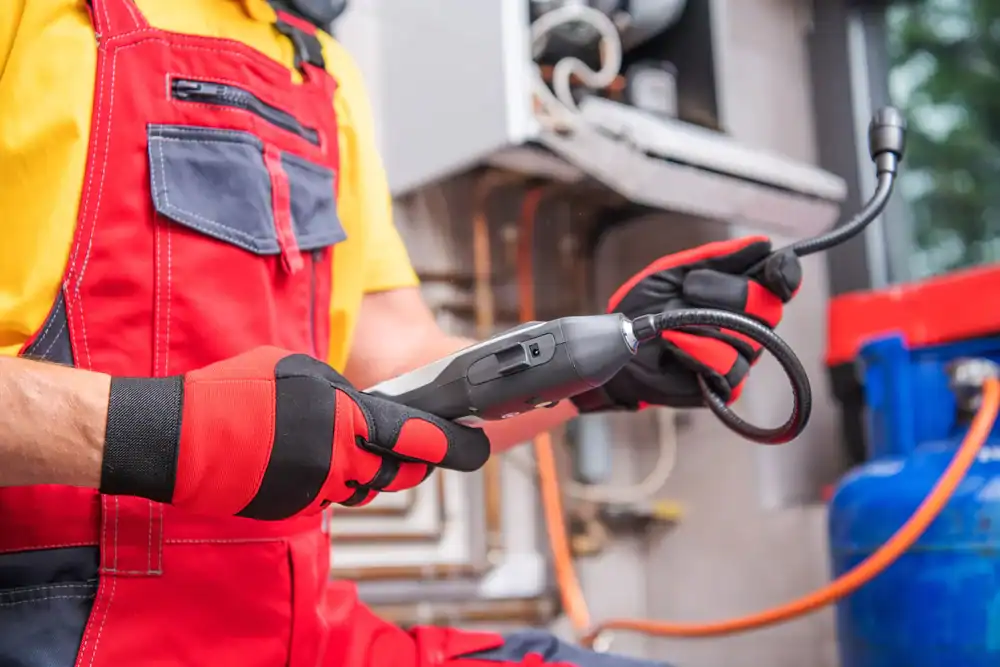
Yes, and this is one of the most common situations we hear about from Greenridge homeowners. National Grid’s responsibility covers the utility infrastructure up to your meter — the distribution lines and the connection point where gas enters your building. Once they’ve confirmed that side is clear, their jurisdiction ends.
The piping inside your home, the connections at your appliances, your boiler supply lines, your flexible connectors — all of that is on the building side, and National Grid does not inspect or repair it. We inspect the internal gas system that National Grid doesn’t touch.
In Greenridge homes built during the 1960s and 70s South Shore building boom, the internal piping is often the same age as the house itself. A clear reading from National Grid at the meter doesn’t tell you anything about what’s happening ten feet inside your kitchen wall. If you smelled gas, the building-side inspection is the logical next step — not a redundant one.
You can’t reliably judge severity by smell alone. The odorant added to natural gas, called mercaptan, can dissipate through a process called odor fade. This means a leak can be present and growing without producing a consistent or strong smell.
Intermittent odors — the kind that come and go and make you wonder if you imagined it — are often dismissed for months before something forces the issue. What professional detection equipment does is remove the guesswork. Electronic gas detectors can identify concentrations well below what the human nose detects, and infrared cameras can locate the source without you having to smell anything at all.
In an older Greenridge home where piping runs through finished walls and tight mechanical spaces, that kind of precision matters. If you’ve noticed a smell even once — especially near your stove, boiler, or water heater — that’s enough of a reason to have it checked.
Yes. This is a point of genuine confusion for a lot of South Shore homeowners because Local Law 152, which mandates periodic gas piping inspections, largely exempts one- and two-family homes — which covers the majority of the housing stock in Greenridge. So many homeowners assume the newer gas safety laws don’t apply to them either.
Local Law 157 is different. It requires natural gas detectors in all NYC residences, and that includes every single-family and two-family home in Greenridge. The NYC DOB finalized the implementation rules in February 2024, and the compliance deadline is January 1, 2027.
Detectors must be placed within one foot of the ceiling and within ten feet horizontally of any gas appliance. If your home has a gas stove, a gas boiler, or a gas water heater — and most Greenridge homes do — this law applies to you. Getting a gas inspection done now is a practical way to address both your safety and your compliance obligation at the same time.
There’s a meaningful difference between a consumer-grade gas detector from a hardware store and the equipment we bring to a job. Consumer detectors are designed to alert you when gas concentrations reach a threshold — they’re useful for that purpose, but they can’t tell you where the leak is coming from, how significant it is, or whether it’s behind a wall versus at a visible connection point.
We use professional-grade gas detectors that are sensitive enough to identify leaks well below what you’d smell, and infrared cameras that detect temperature differentials caused by escaping gas in spaces you can’t see or access without demolition. In a Greenridge home where gas lines run through finished walls, under floors, and into tight mechanical rooms, the infrared capability is particularly valuable — it means a thorough inspection doesn’t require tearing anything apart to find the source.
The documentation produced by a professional inspection is also what insurers and the NYC DOB require if repairs or compliance filings are needed.
We commit to a 30 to 60 minute response time for true emergencies. Staten Island is an explicit part of our service area — not an afterthought — so that response time is realistic for Greenridge and the surrounding South Shore communities, not a claim built around Manhattan geography.
For non-emergency inspections, scheduling is straightforward. If your situation is urgent — you’ve smelled gas, your service has been shut off, or National Grid has flagged a building-side issue — calling directly gets you the fastest answer on timing. In most cases, detection visits are non-invasive and can be completed in a single visit. If repairs are needed, the goal is same-day resolution where possible so you’re not left without gas service any longer than necessary.
If a leak is identified, you’ll know the exact location, the likely cause, and what the repair involves before any work begins. Our policy is transparent pricing stated upfront — no hidden fees, no scope that expands after the fact without your knowledge.
For a Greenridge homeowner in a 50 or 60-year-old home, the most common concern at this point is scope: “Is this going to turn into a full pipe replacement?” Sometimes the answer is yes, and sometimes it’s a straightforward fitting repair. Either way, you’ll have the full picture before you commit to anything.
Once repairs are completed, we handle all required NYC DOB filings and compliance documentation. If the leak caused damage and you’re filing an insurance claim, we work directly with insurance companies — producing the documentation insurers need and coordinating on your behalf so that piece of the process isn’t entirely on you. The goal at the end of every job is restored service, documented compliance, and a homeowner who knows exactly what was done and why.
Other Services we provide in Greenridge