


Most Oakwood Beach homeowners have never had a professional gas inspection. Not because they don’t care — because nobody’s ever told them they needed one. But when your home was built in the 1950s or 1960s, the gas system inside those walls is just as old. Original black iron piping and early flexible connectors weren’t designed to last 70 years.
In a neighborhood that sits directly on Raritan Bay, where salt air accelerates corrosion on everything metal, that matters more than it would somewhere inland. What a proper inspection gives you is clarity. You stop guessing whether that occasional smell is real or just the neighbor’s cooking. You know, specifically, what’s going on inside your gas system — and if something’s wrong, you know exactly what it is and what it takes to fix it.
For Oakwood Beach homeowners especially, there’s another layer to this. The Environmental Defense Fund used Google Street View vehicles with methane detectors to map natural gas leaks across Staten Island and found roughly one leak per mile driven — a finding that National Grid itself publicly acknowledged. That’s the underground distribution system beneath your street. The building-side piping inside your home is your responsibility, and it’s a separate system entirely. Knowing what’s happening on your side of the meter is the part only a Licensed Master Plumber can tell you.
We’ve been operating since 1983. That means we were serving Oakwood Beach long before Superstorm Sandy reshaped the neighborhood, long before Local Law 152 existed, and long before the National Grid leak map made the evening news. This isn’t a company that discovered Staten Island recently and added it to a service area list.
Bobby and Rob are the people behind the work. When you call, you’re dealing with a father-and-son team that has worked on the kind of homes that define Oakwood Beach — postwar colonials off Guyon Avenue, older bungalows closer to the water, mid-century ranches throughout Oakwood Heights. Every technician is a NYC Licensed Master Plumber, drug-tested and vetted. That matters when someone’s coming into your home.
We handle the full picture: the detection, the repair, the permit filing, the DOB coordination, and any Local Law 152 compliance paperwork your building requires. One call, one team, no runaround.

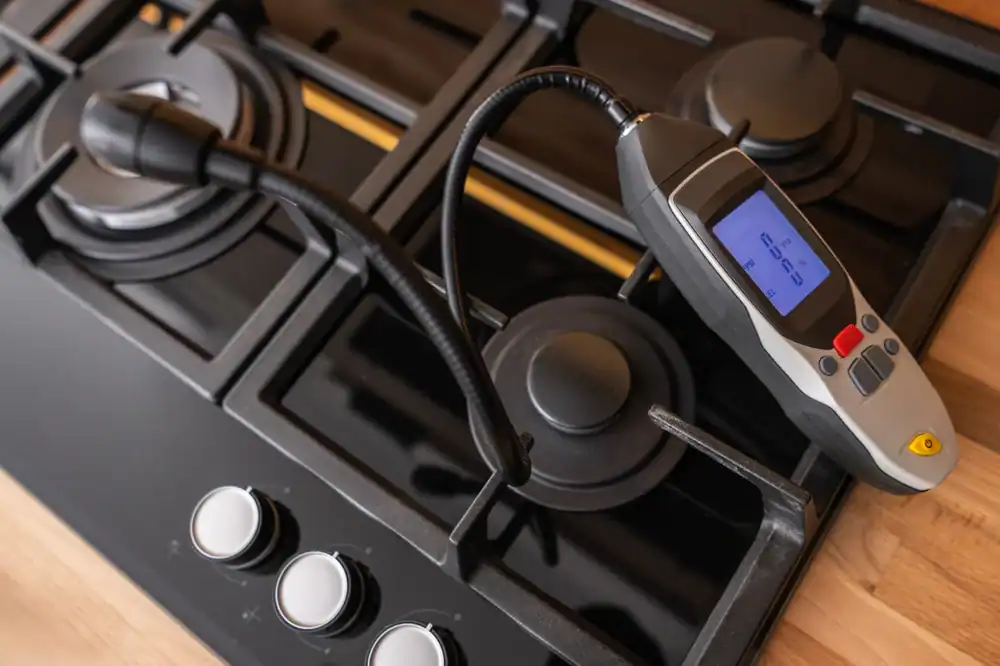
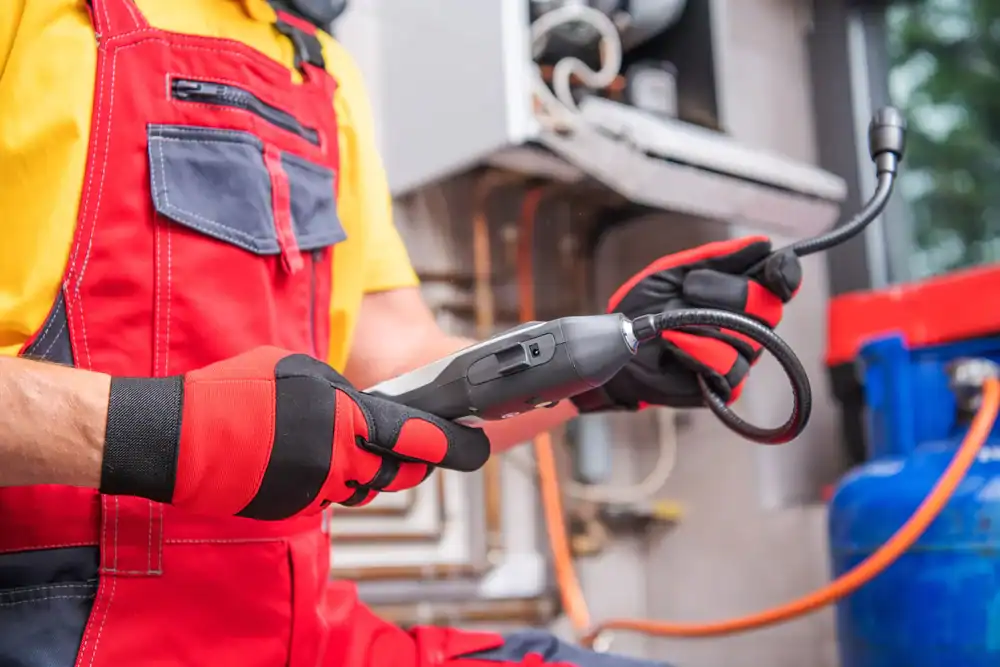
When one of our technicians arrives, the first thing we do is a full assessment of your gas system — not just the obvious spots. We use professional-grade gas detectors and infrared cameras to check connections, fittings, flexible connectors behind appliances, and any exposed piping throughout the home. Infrared cameras are particularly useful in older Oakwood Beach homes because they can identify issues behind walls and under floors without tearing anything apart.
If a leak is found, you get a clear explanation of where it is, what caused it, and what the repair involves — before any work begins. Pricing is stated upfront. There are no hidden fees added after the fact. If the repair requires a permit filed with the NYC Department of Buildings, that’s handled as part of the process. For Staten Island properties, that also means coordinating with National Grid when service has been interrupted, since they’re the utility serving this borough.
For Oakwood Beach homes that took on floodwater during Sandy, or properties close to the water where salt air has been working on metal fittings for years, the inspection goes deeper. Corrosion doesn’t always show itself on the surface. The equipment we use finds what a visual check or a consumer-grade detector from a hardware store simply can’t.
Ready to get started?
Gas leak detection with us isn’t a single step — it’s the full sequence. Detection, diagnosis, repair, and compliance documentation are all handled by the same licensed team. For Oakwood Beach and Oakwood Heights residents, that means you’re not calling one company to find the problem and another to fix it.
We cover gas line inspection and repair, emergency gas leak response, gas piping replacement for older or corroded lines, boiler and water heater gas connection checks, gas stove and range installation, backflow prevention, and Local Law 152 gas piping inspections for applicable buildings. If your building falls under NYC’s Local Law 152 requirements — which applies to most buildings beyond one- and two-family homes — the inspection is performed by a Licensed Master Plumber and all required filings go directly to the NYC DOB. Missing that deadline carries a $5,000 civil penalty, and the rotating inspection schedule by community district means your window is specific and fixed.
For homes in Oakwood Beach that are approaching or past the 60-year mark, a gas line inspection isn’t a precaution — it’s overdue. With Local Law 157 requiring natural gas detectors in all NYC residences by January 1, 2027, now is a practical time to address both at once.
National Grid handles the utility-side infrastructure — the gas mains running beneath the streets of Oakwood Beach and the service line coming into your building up to the meter. When there’s a suspected leak, they’ll respond to assess that portion of the system and can shut off service if they determine there’s a risk. But their responsibility stops at the meter. Everything on the building side — the piping inside your walls, the connections to your appliances, the flexible connectors behind your stove — is yours, and National Grid cannot legally repair it.
That’s where a Licensed Master Plumber comes in. Once National Grid has addressed their side (or cleared it), a Licensed Master Plumber is required to inspect, repair, and document any building-side issues before gas service can be restored. In Staten Island, that utility is National Grid — not Con Edison, which is a distinction that matters when you’re trying to get your gas back on quickly and need to know exactly who to call for what.
It’s a fair question, and the honest answer is: it depends on whether anyone has ever looked. Homes built in the 1950s and 1960s — which make up a significant portion of Oakwood Beach housing stock — were originally plumbed with gas systems that are now 60 to 70 years old. Black iron piping from that era can develop corrosion, micro-fractures, and loose fittings over decades of use. Flexible connectors behind appliances have a much shorter service life and may have been replaced at some point, or may not have been.
In Oakwood Beach specifically, the proximity to Raritan Bay adds another factor. Salt air accelerates corrosion on metal fittings and exposed piping — particularly for homes within a few blocks of the water. If your home has never had a professional gas inspection by a Licensed Master Plumber, you’re essentially operating on the assumption that a 60-year-old system is still performing the way it was designed to. That assumption is worth testing, especially since slow leaks don’t always produce a smell you’d notice.
Not necessarily, and this is one of the more dangerous assumptions people make. Natural gas has an odorant added to it — mercaptan — specifically so you can detect it by smell. But that odorant can dissipate through a process called odor fade, where physical or chemical conditions cause the smell to diminish even when gas is still present. So the absence of a smell is not the same as the absence of a leak.
Intermittent smells are also common with slow leaks that build up in enclosed spaces and then disperse when a window is opened or air circulates. The smell comes and goes, and it’s easy to rationalize it away — especially if it happens infrequently. The only way to know for certain is a professional inspection with equipment that can detect gas concentrations below what the human nose can register. If you’ve noticed even an occasional gas smell in your Oakwood Beach home, that’s reason enough to have it checked.
Local Law 152 requires that all NYC buildings — with the exception of one- and two-family homes — have their exposed gas piping inspected by a Licensed Master Plumber on a rotating four-year cycle. The schedule is organized by community district, and Staten Island’s South Shore falls within Community Board 2. Building owners need to confirm their specific inspection window with the NYC DOB, but the consequence for missing it is a $5,000 civil penalty, and the certification must be filed within 60 days of the inspection.
What makes us useful for this is that we’re licensed to perform the inspection and certified to make any repairs that come out of it — so you’re not managing two separate vendors or chasing paperwork between them. The inspection, any required repairs, the DOB filing, and the final certification are all handled by the same team. For property owners in Oakwood Beach managing multi-unit buildings or mixed-use properties, that’s a meaningful simplification.
Yes, and it’s a concern that doesn’t get enough attention. Saltwater intrusion is highly corrosive to iron and steel — the materials most commonly used in residential gas piping. Homes in Oakwood Beach and Oakwood Heights that took on floodwater during Sandy were exposed to that corrosive environment at the connections, fittings, and any sections of piping that were submerged. The damage doesn’t always show up immediately. Corrosion progresses over time, and a fitting that looked fine in 2013 may have developed a slow leak by now.
Ground movement is another factor. Repeated flooding and soil saturation — which Oakwood Beach has experienced across multiple storm events, including the 1992 nor’easter and Sandy — can shift the ground around underground service lines, creating stress at connection points. More than a decade has passed since Sandy. If your home was affected and your gas system has never been professionally inspected since then, a Licensed Master Plumber with the right detection equipment is the only way to know what’s actually happening inside those lines.
For true emergencies, we commit to a 30 to 60 minute response time. Oakwood Beach sits at the southeastern end of Staten Island, and we’re direct about this: we actually serve Staten Island. It’s not a footnote in our service area — it’s part of our operating territory.
If you’re dealing with an active gas smell, the first step is always to leave the building, avoid using any switches or appliances, and call National Grid at 718-643-4050 to report it. Once the utility has responded and assessed their side, a Licensed Master Plumber needs to address the building-side system before gas can be safely restored. That’s when we step in — to inspect, repair, document, and coordinate whatever is needed to get your home back to normal as quickly as possible.
Other Services we provide in Oakwood Beach