
When your gas line is repaired correctly, you stop guessing. You stop wondering if that faint smell is something or nothing. You stop putting off the call because you’re not sure what it’ll cost or whether whoever shows up actually knows what they’re doing. That uncertainty goes away.
For Oakwood Beach homeowners, the stakes are different than they are for someone living inland. Most homes here were built between the 1940s and 1990s and have been exposed to decades of salt air, coastal humidity, and freeze-thaw cycling that loosens threaded pipe joints over time. Black iron gas piping corrodes faster in coastal environments. A pipe that might hold up for 50 years somewhere dry can develop problems in half that time along the Raritan Bay shoreline.
If your home survived the 2012 Sandy storm surge — or was rebuilt and elevated afterward — your gas infrastructure has a history that most plumbers won’t think to ask about. Saltwater immersion accelerates corrosion in ways that aren’t always visible on the surface. Getting that system inspected and pressure-tested isn’t overcaution. It’s the right call for where you live.
We’ve been doing this work on Staten Island since 1983 — that’s four decades of Oakwood Beach homes, aging gas systems, and the kind of local knowledge that only comes from actually being here. Bobby and Rob are a father-and-son team. When you call, you’re reaching the people who will actually show up.
We know National Grid’s protocols for Staten Island service shutoffs and restorations because that’s the utility that serves you here. Navigating that process correctly is what separates a repair that wraps up in a day from one that drags into next week.
Oakwood Beach — from the Heights down through the coastal blocks near Tysens Lane and Cedar Grove Beach — is the kind of neighborhood where people know each other and word travels fast. Our reputation has been built in communities exactly like this one, one honest job at a time.
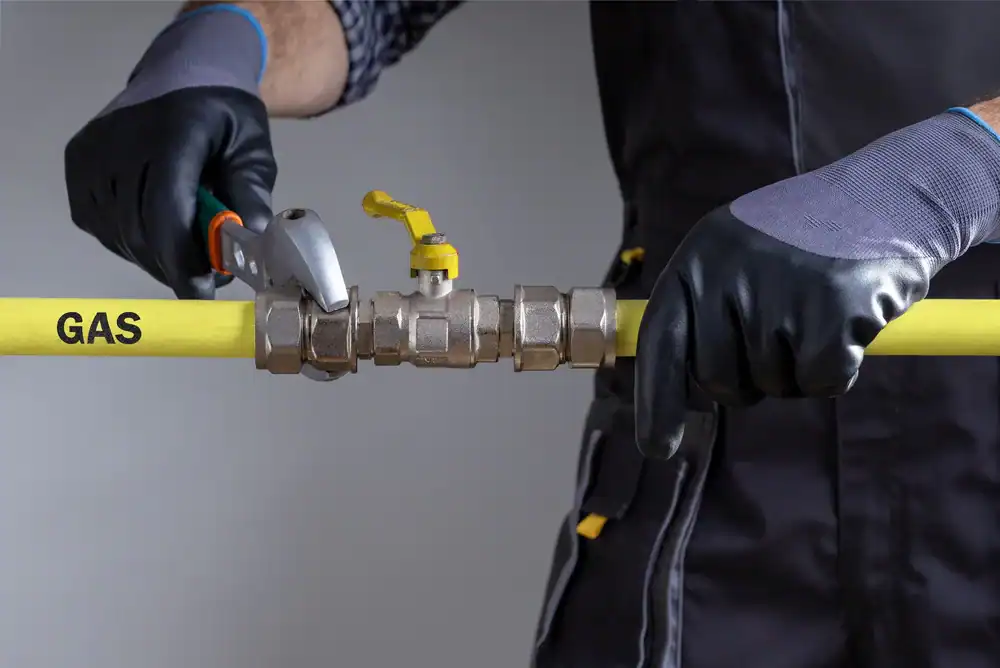
It starts with a call. We schedule a visit, take a look at your gas system, and give you a written estimate before any work begins. You’ll know what you’re paying before we pick up a tool.
Once work is approved, we pull the right permits through the NYC Department of Buildings. In New York City — including Staten Island — most gas line work requires a DOB permit filed by a Licensed Master Plumber with a Gas Work Qualification endorsement. This isn’t optional, and skipping it creates violations that follow the property. We handle the permit side so you don’t have to figure it out yourself.
After the repair or replacement is complete, we pressure-test the entire system. This confirms the whole line holds before gas service is restored — not just the section we worked on. For homes in Oakwood Beach that may have had gas lines reconfigured after Sandy-era elevation projects, that full-system pressure test matters more than it does in a home that’s never been touched. Once everything checks out, we coordinate with National Grid to restore service so there’s no gap where you’re left waiting and wondering what comes next.

Ready to get started?
Gas line repair covers a wider range of work than most people expect. A corroded gas pipe replacement in a home that’s been sitting on the south shore since the 1950s looks different from a gas line rerouting job for a kitchen renovation. Emergency gas line service after a National Grid shutoff involves a different sequence than a scheduled Local Law 152 inspection.
We handle all of it — leak repairs, full pipe replacements, gas pressure testing, rerouting for appliance upgrades or remodels, and LL152 compliance from inspection through DOB filing.
For Oakwood Beach homes, corroded gas pipe replacement comes up more often than in inland neighborhoods. The combination of age, coastal air, and in some cases the legacy of Sandy-era flooding creates pipe conditions that need more than a patch. When replacement is the right call, we use code-compliant materials and pull the proper permits so the work is done legally, documented correctly, and won’t come back as a violation when you sell or refinance.
Emergency calls get the same rate as scheduled work. There’s no after-hours surcharge here — the rate doesn’t change because it’s late or because it’s a weekend. If your gas gets shut off by National Grid after an inspection or a reported leak, we can move quickly, complete the repair, and coordinate with the utility to get your service restored without you having to navigate that process alone.

Yes, and it’s more common than people realize in Oakwood Beach. When the 2012 storm surge moved through — one of the highest surges recorded anywhere in New York City during Sandy — gas lines, meters, and appliance connections were submerged in saltwater for hours. Saltwater is corrosive to black iron gas piping in a way that doesn’t always show up immediately. The damage works from the outside in, slowly compromising the pipe wall over years.
If your home was in the flood zone and the original gas lines were never replaced or inspected post-Sandy, those pipes are now over a decade past that exposure event. That’s enough time for corrosion to progress to the point where fittings loosen or small leaks develop. A pressure test and visual inspection by a Licensed Master Plumber is the only way to know for certain what condition your system is actually in.
National Grid won’t restore gas service on Staten Island until a Licensed Master Plumber completes the required repairs and files the proper documentation with the NYC Department of Buildings. Calling National Grid directly to ask them to restore service before that’s done won’t move things forward — the utility is waiting on the plumber’s side to be resolved first.
Once we complete the repair and the system passes a pressure test, the DOB filing gets handled and National Grid is notified. They then schedule their own inspection or restoration appointment. The timeline from that point depends on National Grid’s schedule, but having a plumber who knows how to coordinate with the utility — and who understands Staten Island’s National Grid protocols specifically — makes a real difference in how fast things move. Delays usually happen when the plumber leaves the homeowner to figure out the utility side alone. That doesn’t happen here.
For most gas line work in New York City, yes — a permit is required. This applies to Oakwood Beach the same as anywhere else in the five boroughs. The permit has to be filed by a Licensed Master Plumber who holds a Gas Work Qualification endorsement from the NYC Department of Buildings. That endorsement is separate from a standard plumbing license and requires specific training and experience in gas piping work. Not every plumber who advertises gas line repair actually holds it.
Skipping the permit isn’t a shortcut — it’s a liability. Unpermitted gas work shows up as a violation that attaches to the property. When you go to sell, refinance, or if the DOB audits the building, that violation becomes your problem. We handle permit filing as part of every job, so you’re not left managing that paperwork on your own.
It can, and it’s worth having looked at if it hasn’t been recently. When a home is lifted and set on new piers or an elevated foundation, the gas line configuration changes. There’s typically a new riser, a new flexible connection at the appliance level, and a transition point where the original buried lateral meets the new elevated entry. Those transition points are a specific stress location — the pipe geometry changed, and over time, that creates potential for fittings to work loose or connections to develop small leaks.
Homes elevated in the 2013 to 2017 period are now approaching or past the ten-year mark on those post-Sandy gas line configurations. That’s a reasonable point to have a Licensed Master Plumber do a pressure test and walk the system. If everything’s holding, you’ll know. If something needs attention, you’ll know that too — before it becomes an emergency rather than a scheduled repair.
The honest answer is that it depends on what’s actually wrong. A straightforward gas pipe leak repair is a different scope than replacing a corroded section of buried pipe or rerouting a line for a kitchen renovation. What we can tell you is that you’ll get a written estimate before any work starts — so you’re not committing to a number you haven’t seen yet.
What’s also worth knowing is that emergency calls don’t cost more here. A lot of plumbing companies add significant surcharges for after-hours or weekend calls. We don’t. The rate is the same whether it’s a Tuesday afternoon or a Saturday night. You get a fair rate regardless of when the problem happens.
Age alone isn’t the only factor, but it’s a meaningful one — especially in a coastal neighborhood like Oakwood Beach. Gas lines in homes built between the 1940s and 1970s are typically black iron pipe, which is durable under normal conditions but vulnerable to corrosion when exposed to moisture, salt air, and the temperature cycling that comes with Staten Island winters. In Oakwood Beach, those environmental stressors are more intense because of the proximity to the Raritan Bay shoreline.
Signs that a gas line may need replacement include a persistent smell of gas near appliances or the meter, a drop in gas pressure at appliances, or visible rust or corrosion on exposed pipe sections. But corrosion on buried or wall-concealed pipe doesn’t always show visible symptoms until it’s already a problem. That’s why a pressure test is the most reliable diagnostic — it tells you whether the system is holding or losing pressure, which is the actual question that matters. If your home’s gas infrastructure hasn’t been inspected in the past several years and the pipes are original to a mid-century build, scheduling that inspection is a straightforward, low-cost way to get a real answer.
Other Services we provide in Oakwood Beach