

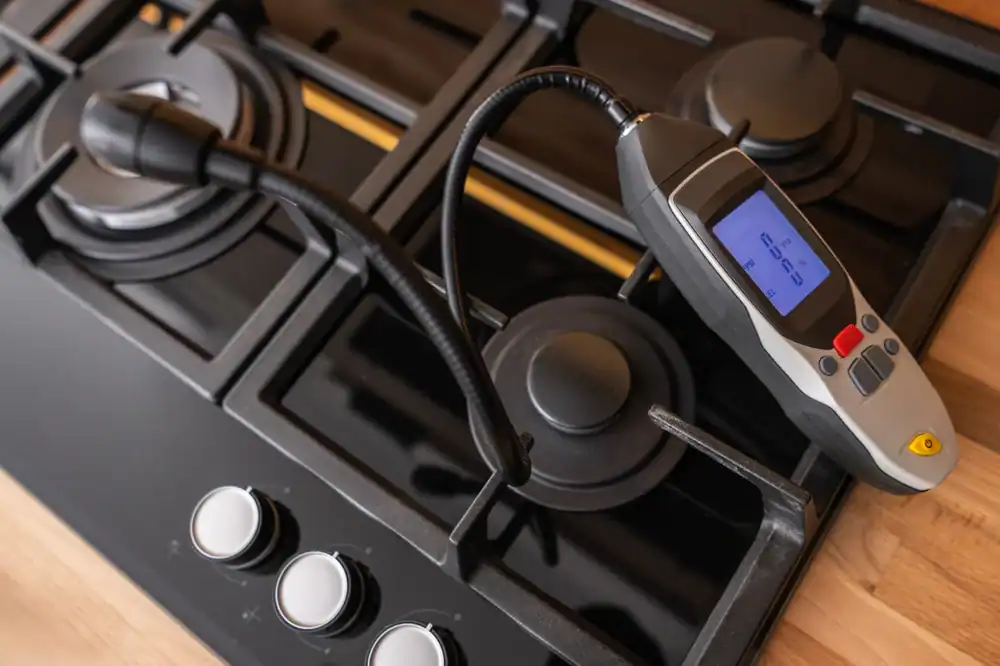
Most Oakwood Heights homes were built during the postwar bungalow boom — seasonal beach houses converted to year-round residences by returning servicemen who saw them as affordable alternatives to city apartments. The gas piping in those homes was installed before anyone was thinking about 60-year service life. If you’ve owned your Oakwood home long enough to have already replaced a boiler or updated the electrical, the gas lines are probably next on that list — except nobody’s told you yet.
A professional gas leak detection visit doesn’t just confirm whether something is leaking right now. It tells you the condition of your building-side gas system — the piping, connections, valves, and flexible connectors behind your appliances that National Grid will never come inside to check. When they respond to a reported leak in Oakwood, they handle the street-side infrastructure and leave. What’s inside your home is your responsibility, and it takes a Licensed Master Plumber to properly assess it.
For homeowners who commute into Manhattan via the Staten Island Railway from the Oakwood Heights station, there’s an added layer to consider. You’re away from home for ten or more hours a day. A slow leak that builds while you’re on the ferry is the most dangerous kind — because no one’s there to smell it.
We’ve been operating since 1983 — that’s over 40 years working on gas systems in homes exactly like yours, in Oakwood and throughout Staten Island. Bobby and Rob are a father-and-son team, and every technician who comes to your door is a NYC Licensed Master Plumber, drug-tested and vetted before they set foot in anyone’s home.
Staten Island is listed as a primary service area — not a stretch-reach borough we occasionally cover. We hold Master Plumber licenses specifically for Staten Island, which matters when the work requires pulling permits, coordinating with the NYC Department of Buildings, or navigating a National Grid gas shutoff and getting your service restored.
If something goes wrong, you’re not calling a dispatch center. You’re reaching the people whose names are on the business.

When you call about a suspected gas leak, the first thing that happens is a real conversation — not a form submission. We commit to a 30 to 60-minute response time for true emergencies, which matters when you’ve come home to a smell you can’t place and you’re standing on Hylan Boulevard trying to figure out who to call.
Once on-site, our technician uses professional-grade gas detectors and infrared cameras to locate the source. This isn’t a visual inspection and a shrug — infrared cameras can find leaks behind walls and in areas that are completely inaccessible to the human eye. The detectors identify gas concentrations that your nose might miss entirely, especially in Oakwood homes where aging piping or post-Sandy saltwater exposure may have created slow, diffuse leaks rather than the sharp rotten-egg smell most people expect.
If a leak is confirmed, you’ll get a clear explanation of what was found, where it is, and what it takes to fix it — with pricing stated before any work begins. No hidden fees, no scope creep revealed after the fact. If the repair requires a DOB permit or filing, we handle that too. For multi-unit building owners in Oakwood with Local Law 152 compliance deadlines on the horizon, the inspection and any required repairs can be handled as a single engagement, with the certification filed directly with the NYC Department of Buildings.

Ready to get started?
Gas leak detection in Oakwood isn’t one-size-fits-all. The housing stock in Oakwood Heights — predominantly built between 1940 and 1969 — presents a very different set of conditions than newer construction. Galvanized steel piping, aging flexible connectors behind gas ranges and dryers, and valves that haven’t been serviced in decades are common findings. In the lower-lying areas near Oakwood Beach, homes that experienced Sandy’s 14-foot storm surge in 2012 have an additional layer of concern: saltwater intrusion accelerates metal corrosion at a rate that can take years to produce a detectable leak. If your home was flooded during Sandy and you haven’t had a professional gas line inspection since, that’s a gap worth closing.
Beyond emergency response, we also handle Local Law 152 gas piping inspections for qualifying multi-unit buildings in Oakwood — the NYC mandate that requires a Licensed Master Plumber to inspect exposed gas piping on a rotating community district schedule, with a $5,000 civil penalty for non-compliance. And with Local Law 157 requiring natural gas detectors in all NYC residences by January 1, 2027, we can assess your current setup and handle installation if needed.
Whether you’re smelling something you can’t explain, coming up on a compliance deadline, or simply living in a 1950s Oakwood Heights home that’s never had its gas system professionally checked — this is the scope of what a proper inspection covers.
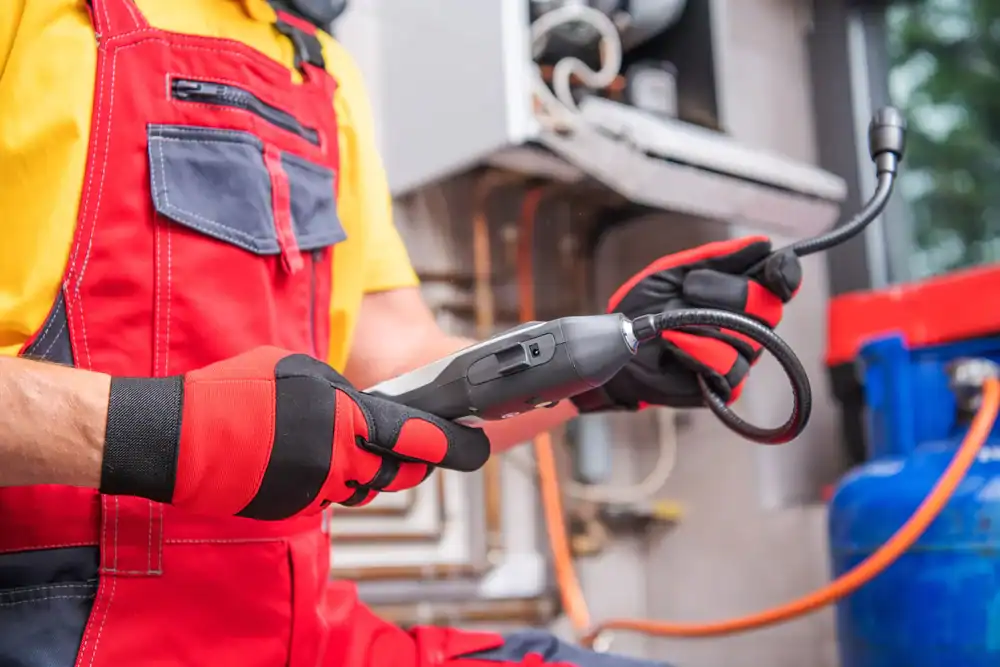
National Grid handles the distribution side — the main lines running under your street and the service line connecting to your building. When they respond to a reported gas leak in Oakwood, they’ll make the utility-side infrastructure safe and, if necessary, shut off your gas at the meter. But they do not repair building-side piping, appliance connections, flexible connectors, or internal gas lines. That work falls entirely on the homeowner, and it legally requires a Licensed Master Plumber to perform.
This is one of the most common points of confusion for Oakwood residents. National Grid comes out, says the street side is clear, and leaves — and the homeowner assumes everything is fine. It may not be. If your gas was shut off by National Grid or you’ve had a reported leak, a Licensed Master Plumber needs to inspect and certify the building-side system before National Grid will restore service. We handle exactly that process at RB Mechanical Plumbing and Heating, including any required DOB filings to get your gas back on.
Saltwater is corrosive to metal at a rate that freshwater simply isn’t. When Oakwood Beach experienced a 14-foot storm surge during Hurricane Sandy in October 2012, homes throughout the lower-lying portions of Oakwood were flooded with saltwater that saturated the ground around gas distribution lines and building connections. Metal gas piping exposed to that kind of intrusion doesn’t fail immediately — it corrodes gradually, over years, in ways that may not produce a noticeable smell until the leak is already significant.
If your Oakwood home was flooded during Sandy and you repaired and returned to it without a comprehensive post-flood gas system inspection, you’ve been living with an unknown for over a decade. A professional inspection using gas detectors and infrared cameras can assess the current condition of your system and tell you definitively whether there’s a problem. That’s a much better position to be in than finding out the hard way.
The odorant added to natural gas — called mercaptan — is what gives it that rotten-egg smell. But mercaptan can dissipate through a process called odor fade, particularly in older piping systems or in cases where a leak is slow and diffuse. The absence of smell is not the same as the absence of a leak. This is especially relevant in Oakwood Heights homes with aging gas infrastructure, where a slow leak at a corroded fitting or degraded flexible connector might never reach the concentration your nose would register.
Beyond odor fade, there are other signs worth paying attention to: a hissing sound near gas lines or appliances, dead patches in your yard above where gas lines run, or an unexplained increase in your National Grid bill. If your pilot light keeps going out or appliances are burning with an orange or yellow flame instead of blue, those are also worth investigating. A professional gas detector can identify gas concentrations well below the threshold your nose would catch — which is why a professional inspection is the only way to know for certain.
Local Law 152 is a New York City mandate requiring that exposed gas piping in most NYC buildings be inspected by a Licensed Master Plumber once every four years. The law applies to all buildings except one- and two-family homes, so if you own a multi-unit property in Oakwood — a garden apartment building, a three-family, or larger — you’re likely subject to it. Inspections are scheduled by community district on a rotating cycle, and missing your deadline carries a $5,000 civil penalty.
The inspection itself must be performed by a Licensed Master Plumber or a qualified gas operator working under LMP supervision. After the inspection, a certification must be filed with the NYC Department of Buildings within 60 days. If the inspection turns up issues that require repair, those repairs must also be completed by a Licensed Master Plumber before the certification can be filed. We at RB Mechanical Plumbing and Heating are licensed to perform the inspection and make any required repairs — so you’re not coordinating between two separate contractors or chasing down a filing on your own.
We commit to a 30 to 60-minute response time for true gas emergencies. That’s a specific number, not a vague promise — and it matters in a neighborhood like Oakwood where a lot of residents are away from home during the day and may come back to a situation that needs immediate attention.
If you smell gas when you get home, the first step is to leave the building without using any electrical switches, open flames, or your phone until you’re outside. Call National Grid to report the leak and then call a Licensed Master Plumber. National Grid will address the utility side; we handle everything inside your home. Having both calls made quickly is what gets your gas restored and your home safe as fast as possible. Don’t wait to see if the smell goes away on its own — odor fade is real, and a leak that stops smelling hasn’t necessarily stopped leaking.
The Environmental Defense Fund, working with Google Earth Outreach and with National Grid’s explicit endorsement, published a map showing hundreds of documented underground gas leak locations across Staten Island’s distribution network. National Grid’s own pipeline safety leadership publicly supported the release of that data. The gas leak risk in this borough isn’t hypothetical — it’s mapped and publicly acknowledged by the utility itself.
Those mapped leaks are on the distribution side, which is National Grid’s responsibility. What’s inside your Oakwood home — the piping, the appliance connections, the flexible connectors behind your stove — isn’t on any map. It’s yours to maintain. In Oakwood Heights, where the majority of homes were built between 1940 and 1969 and many started life as seasonal bungalows, the gas systems are old enough that a professional inspection isn’t precautionary in any abstract sense. It’s the same practical maintenance mindset that leads a homeowner to replace a 25-year-old boiler before it fails in January. You don’t wait for a problem you can already see coming.
Other Services we provide in Oakwood