

Most people don’t think about their gas line until something goes wrong — an appliance underperforms, a building fails an inspection, or National Grid shows up with a shutoff notice. By then, the problem is already costing you time and money. Getting ahead of it, with a properly sized and permitted gas line, is what keeps that from happening.
Old Place is not a typical residential neighborhood. The commercial strip along Forest Avenue, the multi-unit housing at Goethals Homes, and the mixed-use development coming to this part of the North Shore all create gas infrastructure demands that go beyond a standard homeowner hookup. Whether you’re a business operator who can’t afford a day without gas service or a building manager staring down a Local Law 152 deadline, the stakes here are real and specific.
When the work is done correctly — sized right, permitted through the NYC DOB, coordinated with National Grid, and documented from start to finish — you get something that most people don’t realize they were missing: certainty. You know the line is legal, the appliances will perform, and the paperwork is in order if anyone ever asks.
RB Mechanical Plumbing and Heating has been doing this since 1983. That’s over four decades of navigating NYC’s building codes, DOB permit systems, and utility requirements — including the National Grid processes that govern every gas connection on Staten Island. This isn’t a company that learned the ropes on your job.
Old Place sits in a part of Staten Island where the work is rarely simple. You’ve got commercial tenants on Forest Avenue, multi-unit residential buildings subject to Local Law 152, and a development pipeline that’s going to demand new gas infrastructure. We’ve served residential, commercial, and industrial clients throughout NYC, and that range of experience matters when the job in front of you doesn’t fit a single category.
A Licensed Master Plumber is on staff for every job — not a subcontractor, not a name on a license. That means someone is personally accountable for the work, the permit, and the documentation you receive when it’s done.
It starts with an assessment. Before any pipe goes in, we evaluate the existing infrastructure and calculate the full BTU load of every connected appliance. This matters more than most people realize — a professional-grade range, a tankless water heater, or a commercial kitchen running multiple burners simultaneously all demand more from a gas line than a standard residential setup. Sizing it wrong means the appliances underperform and the installation fails inspection.
Once the load calculation is done, we file the DOB gas piping permit through DOB NOW — the city’s required online portal. No paper submissions, no shortcuts. For new or upsized service in Old Place, that also means coordinating with National Grid for authorization before the meter can be activated. National Grid’s Staten Island office is right on Forest Avenue, but navigating their authorization process still takes an experienced hand to move it along without unnecessary delays.
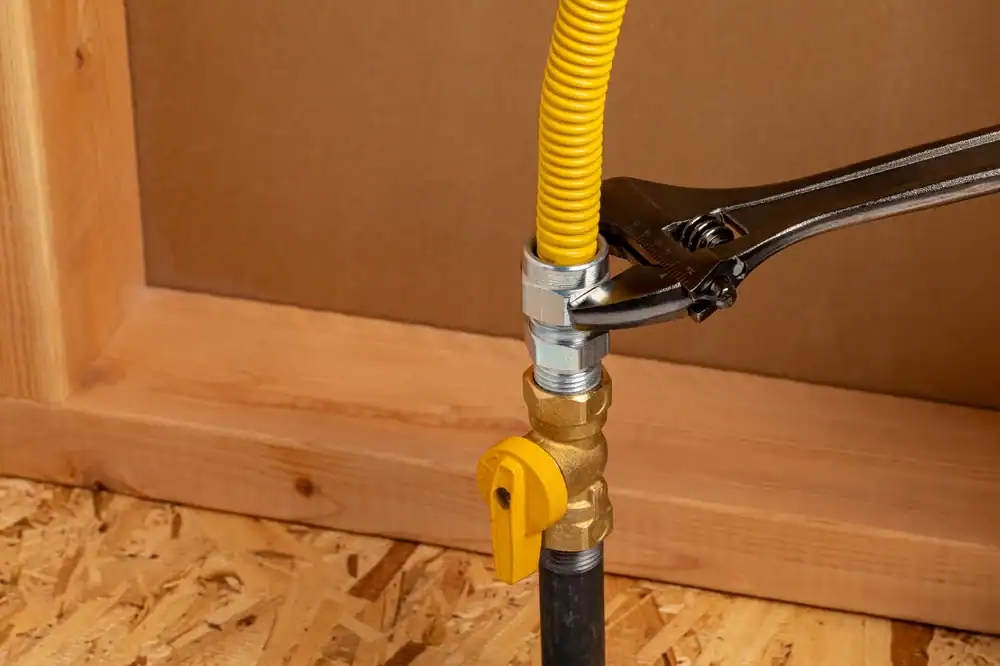
Installation uses black iron pipe or listed CSST systems depending on the application, and every completed line is pressure-tested at 1.5 times working pressure before gas service goes live. After that, you receive written documentation of the safety test results, permit records, and LMP certification — the paper trail that protects you for insurance, building management, and any future inspection.
Ready to get started?
Every gas line installation through RB Mechanical Plumbing and Heating covers the full scope: load calculation, DOB permit filing, pipe installation, pressure testing, National Grid coordination, and written documentation delivered to you at the end. You’re not managing pieces of this yourself while hoping they connect — it’s handled as one complete job.
For commercial properties along the Forest Avenue corridor in Old Place, that includes sizing for multi-appliance commercial demand, not just a single residential hookup. A restaurant or commercial kitchen running several high-BTU appliances at once needs a gas line calculated for the combined load, with dedicated shutoff valves for each appliance and a system that meets NYC Fuel Gas Code for commercial use. The DOB permit and National Grid authorization process for a commercial space also differs from a residential job, and that’s not the place to be learning on the fly.
For multi-unit residential buildings in Old Place — including properties subject to NYC Local Law 152 — we provide the complete compliance cycle: LMP inspection, violation identification and repair, and GPS-2 certification filed electronically with the NYC DOB. The penalty for missing an LL152 deadline runs up to $10,000, and finding a plumber who can inspect, repair, and file the GPS-2 all in one engagement is not as common as building managers assume.
Pricing for gas line work runs $12 to $25 per linear foot depending on pipe type and complexity, with single-appliance hookups typically ranging from $500 to $2,000 and whole-building installations ranging from $1,300 to $3,500. We provide written estimates before any work begins.

In New York City, only a Licensed Master Plumber registered with the NYC Department of Buildings can legally install, repair, or alter a gas line. This applies everywhere in the five boroughs — including Old Place. It’s not a suggestion or a best practice; it’s state law, and it covers every property on Forest Avenue, every unit in a multi-family building, and every commercial space in the 10303 ZIP code.
This matters because unlicensed gas work carries real consequences. The NYC DOB won’t issue a permit for work done by an unlicensed contractor, National Grid won’t activate gas service to an unpermitted installation, and your building’s insurance coverage can be voided if work was done without proper licensing. When you’re vetting a plumber for gas work in Old Place, ask for their LMP license number and verify it through the DOB’s public lookup — any reputable contractor will give it to you without hesitation.
Gas line installation in Old Place runs $12 to $25 per linear foot, depending on the complexity of the job and the type of pipe being used. For a single-appliance hookup — connecting a stove, water heater, or dryer — most jobs fall in the $500 to $2,000 range. Whole-home or whole-building installations generally run $1,300 to $3,500, though commercial jobs with higher BTU demands and longer pipe runs can go beyond that.
A few things can affect where your job lands in that range. The length of the run from the meter to the appliance, whether walls or ceilings need to be penetrated, the size of the line required for your appliance load, and the DOB permit fee all factor in. For commercial properties on Forest Avenue, multi-appliance sizing and the commercial permitting process add complexity that a simple residential hookup doesn’t carry. The right answer is a written, itemized estimate before any work starts — that’s how you avoid surprises.
Yes, and both are required — not one or the other. All gas line work in New York City requires a permit filed through DOB NOW, the city’s online portal. There are no exceptions for small jobs or single-appliance hookups. The permit has to be in place before installation begins, and the work has to pass inspection before gas service can be activated.
On top of the DOB permit, any new gas service connection or upsized capacity in Old Place also requires authorization from National Grid, which is the gas utility for all of Staten Island. National Grid has a walk-in office at 2031 Forest Avenue — right in the neighborhood — but getting their authorization involves a separate process from the DOB permit, and the two have to be coordinated to avoid delays. A plumber who handles only the DOB side and leaves you to navigate National Grid on your own is leaving you with half the job done.
Local Law 152 is a New York City mandate that requires gas piping inspections in most buildings every four years. The law applies to virtually every building in NYC except one- and two-family homes — so multi-unit residential buildings, mixed-use properties, and commercial buildings in Old Place are all covered. The inspection has to be performed by a Licensed Master Plumber or a Registered Journeyman Plumber under direct LMP supervision.
After the inspection, the LMP files a GPS-2 certification electronically with the NYC DOB through DOB NOW to confirm the building’s gas piping system has been inspected and is compliant. If violations are found during the inspection, they have to be repaired before the GPS-2 can be filed. Missing the filing deadline carries penalties up to $10,000, and the clock doesn’t stop while you’re looking for a plumber to do the repairs. For building managers and property owners in Old Place, the safest approach is working with an LMP who handles the full cycle — inspection, repairs, and GPS-2 filing — rather than piecing it together from multiple contractors.
For a straightforward single-appliance hookup, the installation itself typically takes a few hours. But the full timeline — from permit filing to the moment gas service is active — is longer, and it’s the part most people don’t account for when they’re planning a kitchen renovation or appliance upgrade.
The DOB permit filing through DOB NOW takes time to process. National Grid’s authorization for new or upsized service on Staten Island adds another step that runs on the utility’s schedule, not yours. Once the installation is done and pressure-tested, National Grid still needs to inspect and activate the meter before gas flows. Realistically, a job that involves new service or a significant line extension can take several days from start to gas-on, depending on permit processing time and National Grid’s inspection queue. A plumber who gives you a clear timeline upfront — and actively manages the National Grid coordination rather than leaving you to follow up — is the difference between a smooth process and a week of uncertainty.
Not necessarily — and this is one of the most common and costly assumptions people make. A gas line that was sized for a standard residential stove may not have the capacity to supply a professional-grade range, a tankless water heater, or a commercial kitchen running multiple pieces of equipment at once. Gas line sizing is based on the total BTU demand of all connected appliances, the length of the pipe run, and the diameter of the line — and if any of those numbers have changed since the line was originally installed, the existing infrastructure may be undersized.
In Old Place, this comes up frequently on the Forest Avenue commercial corridor, where business owners take over existing spaces and inherit gas infrastructure that was sized for a previous tenant’s lighter load. A restaurant bringing in commercial kitchen equipment into a space that previously housed retail is a common scenario where the existing line simply won’t cut it. Before any new appliance goes in — residential or commercial — the right move is a proper load calculation to confirm the existing line can handle it. If it can’t, extending or upsizing the line is straightforward work for a Licensed Master Plumber, and it’s far less expensive than dealing with underperforming equipment or a failed DOB inspection after the fact.
Other Services we provide in Old Place