


When your gas line gets installed correctly, you stop thinking about it. No flickering pilot lights, no appliance underperforming, no utility shutoff notices landing in your mailbox. That’s the outcome — gas infrastructure that does its job quietly, reliably, and on the right side of the NYC Fuel Gas Code.
For properties in Port Ivory and the surrounding North Shore, that outcome matters more than it does inland. The salt air off Newark Bay and the Arthur Kill accelerates corrosion on black iron gas pipe faster than anything you’d see in Grasmere or New Springville. A line that might hold up for decades in an inland Staten Island neighborhood can deteriorate years sooner here.
Getting it installed with the right materials, tested at the right pressure, and documented properly from day one means you’re not dealing with a leak, a violation, or a National Grid shutoff down the road. Whether you’re running gas to a single appliance in a modest Forest Avenue home or bringing a warehouse up to Local Law 152 compliance in the Port Ivory industrial corridor, the outcome is the same — a permitted, pressure-tested, fully documented installation that holds up to inspection, to the elements, and to time.
We’ve been doing gas line work in New York City since 1983. That’s four decades of navigating DOB permit systems, coordinating with utilities, and working across residential, commercial, and industrial properties — which matters more in Port Ivory than almost anywhere else in the city.
Port Ivory is one of Staten Island’s most distinctly mixed addresses. You’ve got a working waterfront anchored by the Howland Hook Marine Terminal, older industrial buildings repurposed for logistics and freight, and a residential fringe of modest homes that have been here for generations. Most plumbers serve one of those worlds. We serve all three.
Every gas line project is handled by a Licensed Master Plumber on our staff — not a subcontractor brought in to sign paperwork. That’s the person who pulls your permit through DOB NOW, performs the pressure test, and files the GPS-2 certification if your building requires it. The accountability is direct, and the person signing off on your work is the same person who did it.
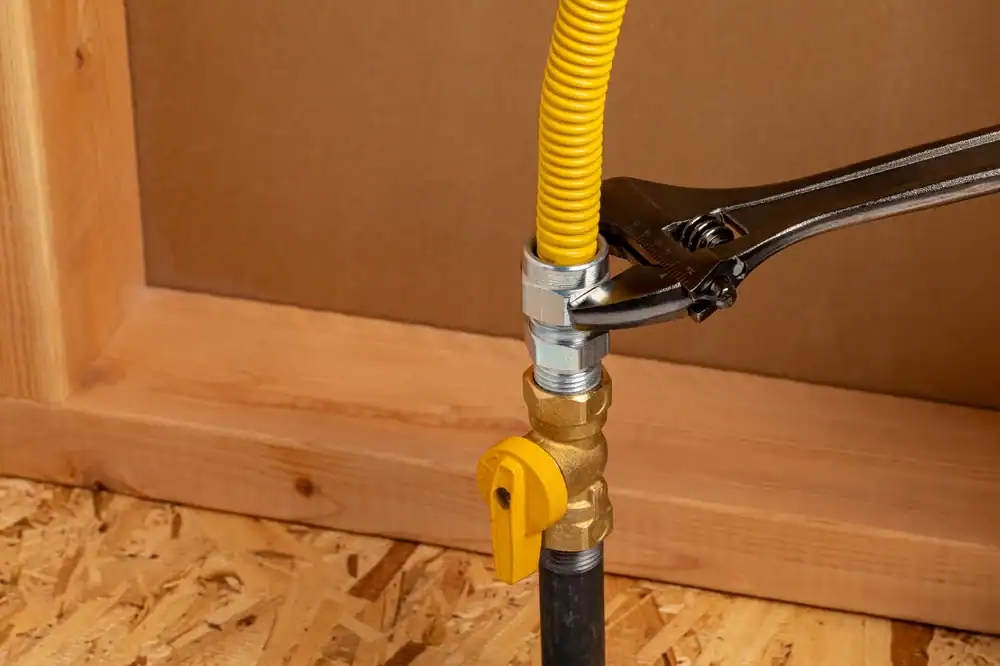
It starts with a site assessment. Before any pipe gets cut or any permit gets filed, the work scope needs to be defined — what appliances are being served, what the BTU load looks like, how long the run is, and what the existing infrastructure can handle. For older structures in the Port Ivory corridor, that assessment sometimes turns up aging pipe that needs to come out before new work goes in. Better to know that upfront than after the job is half done.
Once the scope is set, the DOB permit gets filed through DOB NOW. All gas line work in New York City requires this — no exceptions for small jobs, no workarounds for existing lines. After the permit is approved, installation begins. We select materials based on the application — black iron pipe for most interior runs, with CSST used where appropriate and properly bonded to the building’s grounding system per NYC code. Every joint gets pressure-tested at 1.5 times working pressure before the gas is ever turned on.
The final step is National Grid coordination. All of Staten Island is served by National Grid, and any new service or upsized capacity requires their authorization in addition to the DOB permit. We handle that coordination directly — you don’t make a single call to the utility. When the work is done, you get written documentation of everything: the permit, the pressure test results, and any certification filings. That paperwork matters for insurance, for building management, and for anyone who owns or manages a property in a compliance-heavy environment like Port Ivory.
Ready to get started?
Gas line installation covers more ground than most people realize going in. It’s not just running pipe from point A to point B. It’s calculating the full BTU load of every appliance on that line — your range, your water heater, your boiler, your generator — and sizing the pipe to handle all of it simultaneously, not just the one you’re adding today.
Undersized lines are one of the most common causes of appliance underperformance, and they’re also a code violation. Every installation we perform is sized to the full demand of the system.
For residential customers in the Port Ivory area — whether you’re on Forest Avenue or in the adjacent Mariners Harbor and Arlington blocks — pricing runs $12 to $25 per linear foot depending on pipe type and project complexity. Single appliance hookups typically fall between $500 and $2,000. Whole-home installations generally run $1,300 to $3,500. We provide written estimates before any work starts, and those numbers don’t change without your approval.
For commercial and industrial properties in the Port Ivory corridor, the scope is different — larger pipe diameters, higher BTU loads, National Grid commercial service authorization, and in most cases, Local Law 152 compliance requirements. Buildings with gas service in Staten Island Community Board 1 are subject to the four-year LL152 inspection cycle. If your building is overdue or has received a violation notice, our service includes the full package: LMP inspection, violation remediation, and GPS-2 certification filing with the DOB.
Missing that deadline means penalties up to $10,000 — the filing is not optional, and it’s not something a non-licensed contractor can do for you.
Yes — every gas line installation in New York City requires a permit filed through DOB NOW, regardless of the size or scope of the job. There’s no threshold below which a permit becomes optional. This applies whether you’re adding a gas line for a single kitchen appliance in a Forest Avenue home or replacing a main riser in a commercial building off Western Avenue. The permit has to be filed before work begins, and the installation has to be inspected and documented before gas service is activated.
This is one of the areas where cutting corners creates serious downstream problems. If work is done without a permit and National Grid discovers it during a service call or meter inspection, they can refuse to activate gas service — or shut it off entirely. Getting that resolved after the fact is significantly more expensive and time-consuming than doing it right the first time. Every project we take on in Port Ivory includes the permit as part of the process, not as an add-on.
Staten Island is served exclusively by National Grid for natural gas — not Con Edison, which handles Manhattan and parts of the other boroughs. This distinction matters practically because the authorization process, inspection requirements, and service restoration procedures are specific to National Grid’s systems and protocols. If you’re adding new gas service, upsizing an existing meter, or restoring gas after a shutoff, National Grid is the utility you’re coordinating with, and their process is separate from the DOB permit.
We handle National Grid coordination as part of every installation. That means scheduling the utility inspection, managing the authorization for new or upsized service, and making sure the meter activation happens in the right sequence after the DOB permit and pressure test are complete. If you’ve had gas shut off — whether due to a Local Law 152 violation or a suspected leak — the restoration path runs through both DOB and National Grid, and knowing that sequence in advance saves days of unnecessary delay.
Local Law 152 requires gas piping inspections every four years for virtually all NYC buildings with gas service — the main exception is one- and two-family homes. If you own or manage a multifamily building, a commercial property, or an industrial facility in Port Ivory, LL152 almost certainly applies to you. Buildings in Staten Island Community Board 1 — which covers Port Ivory and the surrounding North Shore — follow the NYC DOB’s community district inspection schedule.
The inspection has to be performed by a Licensed Master Plumber or a Registered Journeyman Plumber under LMP direct supervision. After the inspection, the LMP files a GPS-2 certification electronically through DOB NOW. If violations are found, they have to be remediated and the GPS-2 can’t be filed until the building is compliant. Missing the filing deadline means penalties up to $10,000. We handle the full cycle — inspection, any required repairs, and GPS-2 filing — so there’s no gap between finding a problem and getting it resolved on record.
The honest answer is that you can’t know without a proper load calculation, and assuming it’s fine is how people end up with appliances that underperform or, worse, a line that fails a pressure test after a new appliance is connected. Gas line sizing depends on several variables: the total BTU demand of every appliance connected to that line, the length of the run from the meter to the farthest appliance, the pipe diameter, and the working pressure.
A line that was sized for a standard 30-inch range may not be adequate for a high-BTU professional model or a tankless water heater, which can demand 150,000 BTU or more on its own. In Port Ivory’s older building stock — and in the adjacent Mariners Harbor and Arlington blocks where the housing tends to be aging frame construction — it’s common to find gas lines that were originally installed for a different load profile than what the property uses today. Before any new appliance hookup, we evaluate the existing infrastructure to confirm it can handle the full system demand. If it can’t, that’s a conversation that happens before the work starts, not after.
Port Ivory sits directly on Newark Bay and the Arthur Kill, and the salt air that comes off both waterways is harder on metal infrastructure than most property owners realize. Black iron pipe — the standard material for interior gas lines — is susceptible to surface corrosion in coastal environments, and that corrosion accelerates at fittings, joints, and anywhere the pipe coating is compromised.
A gas line in a waterfront industrial building or a home close to the shoreline can reach the end of its useful life years sooner than the same pipe installed in an inland neighborhood. If you haven’t had your gas piping inspected in several years and your building is in the Port Ivory area, it’s worth getting it looked at — not as a precaution, but as a maintenance reality. Electronic leak detection equipment picks up deterioration that’s not visible to the naked eye, and pressure testing at 1.5 times working pressure confirms whether the system is still holding. Catching a corroded section before it becomes a leak is significantly less disruptive than dealing with a National Grid emergency shutoff in the middle of winter.
The physical installation itself — running the pipe, making connections, installing shutoff valves, and pressure testing — typically takes anywhere from a few hours to a full day depending on the length of the run and the complexity of the project. A straightforward appliance hookup in a residential home is on the shorter end. A commercial installation in one of Port Ivory’s older warehouse buildings, where you may be dealing with longer runs, larger pipe diameters, and infrastructure that needs to be assessed before new work goes in, takes longer.
What extends the overall timeline is the permitting and utility coordination process, not the physical work. The DOB permit needs to be filed and approved before installation begins, and National Grid authorization for new or upsized service adds another step after the installation is complete. For most residential projects, the full sequence from permit filing to gas activation runs a few days to about a week under normal conditions. For commercial projects with LL152 compliance requirements, or situations where violations need to be remediated before a GPS-2 can be filed, the timeline is longer. We walk through the realistic timeline before any work starts so there are no surprises about how long you’ll be waiting for gas service.
Other Services we provide in Port Ivory