

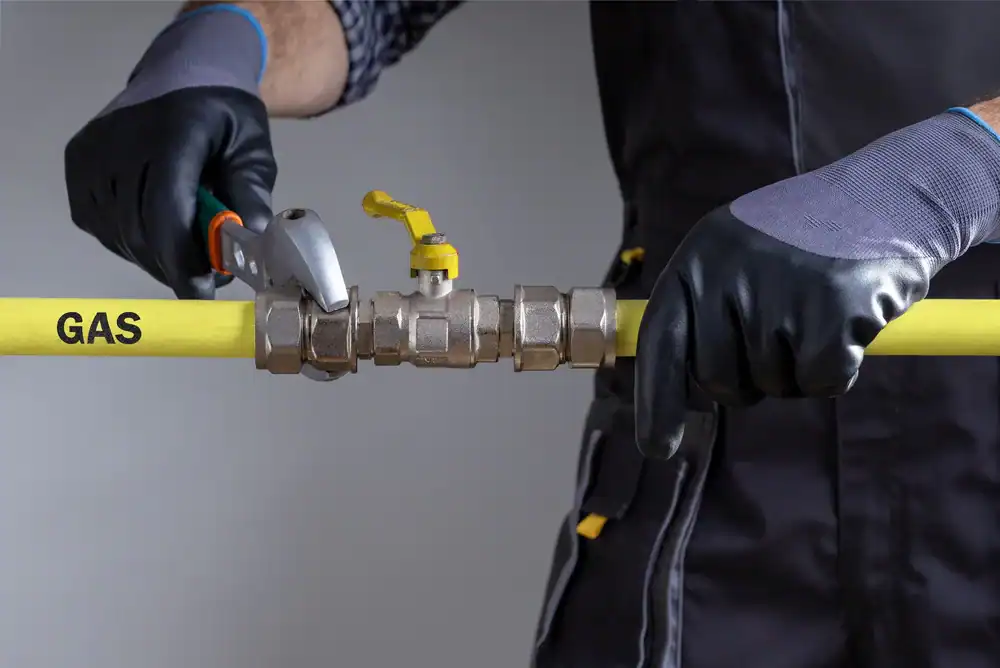
A gas line that’s been working for decades isn’t necessarily a gas line that’s working well. In Old Place, where the ground under most residential properties is filled-in marshland, buried gas service lines face a different kind of stress than pipes sitting on stable mid-island soil. Fill land settles unevenly. It saturates after rain. It shifts with temperature swings. And when it moves, it puts cumulative pressure on fittings and joints that were installed in the 1950s or 1960s and haven’t been looked at since.
On top of that, properties along Forest Avenue and Goethals Road North sit in one of the highest-traffic corridors on Staten Island. The constant ground vibration from heavy trucks heading to and from the Howland Hook Marine Terminal via I-278 is a slow but real stressor on older threaded black iron pipe joints. You can’t see it happening — but it adds up over years.
When you get gas line work done right, you stop guessing. You know what’s there, what condition it’s in, and what needs to happen next. No more wondering if the faint smell you noticed last winter was something or nothing. No more hoping the system that’s been in the ground since before you owned the property is still holding pressure the way it should.
We’ve been doing this since 1983. Bobby and Rob — father and son — have worked on gas systems across Staten Island’s North Shore long enough to know exactly what aging infrastructure in neighborhoods like Old Place tends to look like. We’re not a multi-borough operation figuring out the island’s quirks on the fly. We’re based here.
That matters when you’re dealing with a gas issue near the Goethals Bridge corridor, where traffic on Forest Avenue can complicate access and where the fill-land conditions of Old Place create underground problems that don’t show up on a generic diagnostic checklist. We understand what the ground under your property is actually doing, and we know how to work with it.
Every job comes with a written estimate before any work starts. Our licensing is current and verifiable on the NYC DOB website, and includes the Gas Work Qualification endorsement required to file permits for gas piping work in New York City. And unlike most companies, there’s no after-hours surcharge — the rate at 2 AM is the same as the rate at 2 PM.

When you call, the first thing that happens is a real conversation — not a form submission or a callback queue. You describe what you’re seeing or smelling, and based on that, we determine whether this is an emergency that needs same-day response or a repair that can be scheduled with a proper inspection window. For active gas leaks, our 24/7 availability means exactly that.
Once on site, we start with a thorough assessment of the gas system — checking pressure, inspecting visible pipe runs, testing fittings, and looking at the points most likely to fail given the age of the system and the specific conditions in Old Place. For properties on fill land near the Arthur Kill waterfront, that means paying close attention to any buried sections and exterior connections where salt air and soil movement tend to do the most damage over time.
If repairs are needed, you get a written estimate with a clear scope of work before anything is touched. All gas line work in NYC requires a permit filed by a Licensed Master Plumber with a Gas Work Qualification endorsement — we pull that permit, complete the work to code, and pressure-test the repair before closing out the job. After that, we coordinate directly with Con Edison on the restoration process, so you’re not left navigating the utility’s sign-off requirements on your own. That step alone is where a lot of homeowners get stuck when they use a plumber who doesn’t know how the process works end to end.
Ready to get started?
Gas line repair covers a wider range of work than most people realize until they’re in the middle of a problem. For Old Place specifically, the most common issues tend to fall into a few categories: corroded gas pipe replacement on aging black iron systems installed in the post-WWII era, gas pressure testing after a Con Edison shutoff or following a repair, gas pipe leak repair at joints and fittings that have been stressed by ground movement or vibration over the years, and gas line rerouting when kitchen renovations or appliance upgrades require moving existing supply lines.
For multi-unit buildings in Old Place — including apartment properties on Goethals Road North — Local Law 152 compliance is a separate and mandatory layer. NYC requires all buildings to have gas piping inspected every four years by a Licensed Master Plumber. The 2024–2028 compliance cycle is active right now. Buildings that missed the first cycle are receiving Notices of Deficiency from the DOB, and non-compliance fines can reach $10,000 per year. Con Edison has the authority to shut off gas service to buildings that remain out of compliance.
We handle the full LL152 cycle — inspection, written report, DOB filing, and any remediation required before closeout — so building owners in Old Place aren’t managing multiple vendors or trying to decode the DOB’s paperwork requirements on their own. Whether it’s an emergency gas leak repair at midnight or a scheduled gas pressure test ahead of a compliance filing, the scope of work is always documented in writing before anything starts.
Old Place was built on filled-in marshland — ground that behaves very differently from the glacial till and bedrock that underlies most of mid-island Staten Island. Fill land settles unevenly over time, saturates during heavy rain events, and shifts with freeze-thaw cycles. For buried gas service lines and underground connections, that means ongoing ground movement that can stress fittings, open micro-fractures at joints, and accelerate corrosion in ways that simply don’t happen at the same rate in more stable neighborhoods.
Add to that the constant ground vibration from heavy truck traffic on I-278 and Forest Avenue — one of Staten Island’s busiest freight corridors, serving the Howland Hook Marine Terminal — and you have a combination of stressors that most gas systems in Old Place have been absorbing for decades. A system that was installed correctly in 1960 and has never been inspected since is not a system you can assume is fine. It’s a system that’s been under cumulative stress for 60-plus years without anyone checking whether it’s still holding up.
Leave the building immediately and don’t stop to turn off appliances, flip light switches, or grab belongings on the way out. Once you’re outside and clear of the building, call Con Edison’s emergency line and then call a licensed plumber. Do not re-enter the building until the utility has cleared the scene and a licensed professional has assessed the source.
This matters in Old Place specifically because a lot of the residential properties here — particularly older homes along Forest Avenue and units in multi-family buildings near Goethals Road North — have gas systems that haven’t been formally inspected in years. The smell of gas is the odorant added to natural gas so you can detect it; it can register at less than one part per million. If you’re smelling it, there’s a real issue, not a phantom. The source may not be obvious from the outside, which is why the diagnostic work after the utility clears the scene requires a plumber who knows how to trace and pressure-test an aging system, not just check the most visible connection.
Yes — almost all gas line work in New York City requires a permit filed with the NYC Department of Buildings. This isn’t optional, and it’s not a formality. Unpermitted gas work creates violations that stay attached to the property, can surface during a sale or refinance, and in some cases can result in the building being red-tagged by the utility.
The permit has to be filed by a Licensed Master Plumber who holds a Gas Work Qualification endorsement — a separate credential required under NYC Local Law 150 of 2016. Not every plumber who advertises gas work in the 10303 area holds this specific endorsement. When you’re evaluating anyone for gas line work in Old Place, ask for their Master Plumber license number and confirm their GWQ endorsement on the NYC DOB website before work begins. We handle all permitting as part of the job — you don’t have to navigate the DOB filing process yourself.
Con Edison controls when your gas service gets restored after a shutoff or after repair work is completed. A lot of homeowners assume that once the plumber finishes the job, the gas comes back on automatically — it doesn’t. The utility has its own sign-off process, and if the plumber you hired doesn’t understand how to coordinate that process correctly, you can end up waiting days for restoration even though the repair itself is done.
This is one of the more frustrating parts of gas line work in NYC, and it’s especially relevant in Old Place where a gas shutoff in a multi-unit building can leave multiple households without heat or hot water simultaneously. We’ve been coordinating with Con Edison on gas restoration for over 40 years. We know what documentation is required, how to submit it correctly, and how to minimize the gap between completed repair and restored service — which makes a real difference when you’re the one waiting.
Local Law 152 is a New York City law that requires all buildings — not just large commercial properties — to have their gas piping inspected every four years by a Licensed Master Plumber. The inspection has to be completed, a written report delivered within 30 days, and the results filed with the DOB. If deficiencies are found, they have to be corrected and a follow-up filing submitted.
Old Place falls within NYC Community Board 1, and all buildings in the area are subject to LL152. The second compliance cycle runs from 2024 through 2028, and buildings that missed the first cycle’s deadlines are now receiving Notices of Deficiency from the DOB. Non-compliance fines can reach $10,000 per year, and Con Edison has the authority to shut off gas service to buildings that remain out of compliance. For building owners managing multi-unit properties in Old Place — including apartment buildings near Goethals Road North — this is not a distant regulatory concern. The deadline is active, and the penalties for missing it are concrete.
The cost of gas line repair depends on what the diagnostic finds. A gas pressure test typically runs $75 to $150. Repairs and pipe replacement are generally priced at $15 to $25 per linear foot for the pipe work itself, with additional costs if the line is buried and excavation is required — that can add $1,000 to $1,500 to the total depending on depth and access. Emergency repairs on buried or inaccessible lines can reach $1,800 to $2,300 or more in complex situations. Before any work starts, you’ll receive a written estimate with a clear scope so you know what you’re agreeing to.
On the after-hours question — we do not charge a surcharge for emergency calls. The rate is the same whether you call on a Tuesday afternoon or a Saturday night. That policy matters in a neighborhood like Old Place, where a lot of households are working-family budgets and a gas emergency doesn’t care what time it is. Most plumbing companies add 50 to 100 percent for after-hours service. Our position is straightforward: charging more when someone is already dealing with a gas problem isn’t fair, so we don’t do it.
Other Services we provide in Old Place