

Most homeowners in Graniteville, Bulls Head, and Travis — the residential neighborhoods that border Bloomfield — have never had a professional gas inspection. Their homes were built in the 1950s, 60s, and 70s. The gas lines in those homes are the same age.
Add in the fact that Bloomfield sits along the Arthur Kill waterway, and you’ve got salt air and coastal humidity working against those aging pipes year-round. Corrosion accelerates in that environment in a way it simply doesn’t in inland neighborhoods. Flexible connectors behind stoves, fittings at appliance hookups, older valves — they don’t fail all at once. They fail slowly, quietly, and often without a smell you’d notice.
What a professional gas leak detection visit gives you is certainty. Not “I didn’t smell anything so we’re probably fine.” Actual certainty — from equipment that can find a leak behind a wall or under a floor, documented in a report that holds up with National Grid, your insurance company, and the NYC Department of Buildings.
We’ve been operating in the New York City market since 1983. That’s over 40 years of gas line work, boiler inspections, and compliance filings across Manhattan and Staten Island — including the West Shore corridor that runs through Bloomfield, Travis, and Graniteville.
Every technician who comes to your door is a NYC Licensed Master Plumber. Not a journeyman working under someone else’s license. Not a subcontractor dispatched from a call center. A licensed master plumber — the credential the city actually requires for gas piping work — who has been drug-tested and vetted before they ever set foot in your home or building.
Bobby and Rob run this operation. We’re the names behind the work. When something goes right, or when something needs to be made right, there are actual people accountable for it. For homeowners in Bloomfield and the surrounding communities where reputation and word-of-mouth still mean something, that matters.

When you call, the first thing that happens is a real conversation — not a form, not a chatbot. You describe what you’re experiencing, and based on that, we dispatch a response. For genuine emergencies, the target is 30 to 60 minutes. If you’re on the West Shore near South Avenue or off the Route 440 corridor, that’s a realistic window.
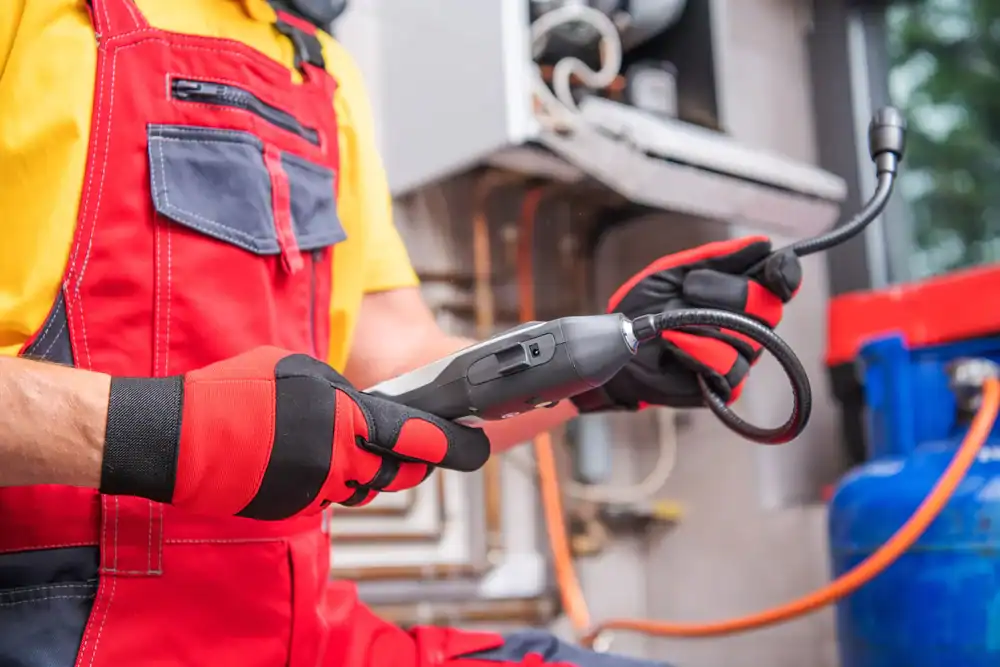
On arrival, we do a full assessment using professional-grade gas detectors and infrared cameras. This isn’t a visual check and a sniff test. Infrared cameras can identify temperature anomalies behind walls and under floors that indicate gas accumulation in spaces you can’t see. The detectors identify gas presence at concentrations well below what the human nose picks up — which matters because of a documented phenomenon called odor fade, where the mercaptan odorant added to natural gas can dissipate over time, leaving a real leak with no detectable smell.
If a leak is found, you get a clear explanation of what was found, where it is, and what the repair involves — with transparent pricing stated before any work begins. If the building requires a DOB filing, a Local Law 152 certification, or coordination with National Grid to restore service, we handle that as part of the same workflow. You’re not left to navigate the paperwork on your own after the fact.

Ready to get started?
Gas leak detection with RB Mechanical Plumbing and Heating covers the full scope of what a residential or commercial property owner in Bloomfield and the surrounding area actually needs. Our inspection uses professional-grade gas detectors and infrared cameras to locate leaks that visual inspection can’t find. But the service doesn’t stop at finding the problem.
For residential homeowners in the neighborhoods surrounding Bloomfield — particularly those in older housing stock along the West Shore — that often means same-visit repair of the identified issue, documentation for insurance purposes if damage has occurred, and coordination with National Grid on anything that touches the utility side of the system. We work directly with insurance companies when gas leak damage is involved, which means you’re not left translating between a plumber’s report and an adjuster’s requirements on your own.
For commercial properties and building owners in Bloomfield’s corporate corridor — including the office buildings along South Avenue and facilities in the logistics zone — Local Law 152 compliance is part of what we handle. That means the inspection, any required repairs, the DOB filing, and the certification all handled under one roof. The civil penalty for missing a Local Law 152 deadline is $5,000 per building. Having a single licensed master plumber who can handle the entire compliance chain — not just the inspection — is the practical solution. We’re licensed to inspect and certified to repair, which means there’s no gap in the chain and no second vendor to coordinate.
If you smell gas inside your home, don’t try to find the source yourself. Leave the building immediately, leave the door open on your way out, and don’t touch any light switches, appliances, or your phone until you’re outside. Once you’re clear of the building, call 911 and then National Grid — they’re the gas utility for Staten Island and they’ll respond to the utility-side emergency.
Here’s the part most people don’t realize: after National Grid clears the scene, they’ve only confirmed that the utility-side infrastructure — the main line to your building, the meter — is not the source. Everything from the meter inward is building-side piping, and that’s not something National Grid repairs. That’s where we come in as a NYC Licensed Master Plumber. If you’ve had a gas smell and National Grid came out and said they didn’t find anything, that’s not a full clearance. It means the utility side is clear. The building side still needs to be checked by a licensed plumber before you can be confident the issue is resolved.
Intermittent gas odor is one of the most commonly misread warning signs. People dismiss it because it doesn’t persist, and they assume that if it were serious, it would be constant. A slow leak can release gas in bursts depending on pressure fluctuations, ventilation, and how the gas is moving through the space. It can smell strong for a few minutes and then seem to disappear entirely.
There’s also a documented phenomenon called odor fade, where the mercaptan odorant added to natural gas — the chemical that creates the rotten egg smell — can dissipate through physical and chemical processes over time. This is especially relevant in older homes with aging appliances, where the gas may be accumulating in enclosed spaces without the odorant remaining detectable. Professional-grade gas detectors identify gas presence at concentrations well below the threshold of human smell, which is exactly why a “the smell went away” conclusion isn’t the same as a professional clearance. If you’ve noticed an intermittent gas smell in your Bloomfield home, that’s a reason to have it checked — not a reason to wait and see.
Yes. Local Law 152 is a citywide requirement that applies to all five boroughs, including Staten Island. It mandates that exposed gas piping in most NYC buildings — everything except one- and two-family homes — be inspected by a NYC Licensed Master Plumber once every four years. Bloomfield and the surrounding areas fall under the Staten Island community district rotation schedule, and the inspection deadlines cycle through on a fixed calendar. Missing the deadline carries a $5,000 civil penalty per building.
For commercial property owners and building managers in Bloomfield’s South Avenue corporate corridor or the logistics facilities along Gulf Avenue, this is a real compliance obligation — not a theoretical one. The scale of those buildings means the inspection scope is larger, and the penalty exposure for non-compliance is the same regardless of building size. We at RB Mechanical Plumbing and Heating are licensed to perform the Local Law 152 inspection and certified to make any repairs identified during it, which means you’re dealing with one vendor for the entire compliance workflow rather than coordinating between an inspection company and a separate repair contractor.
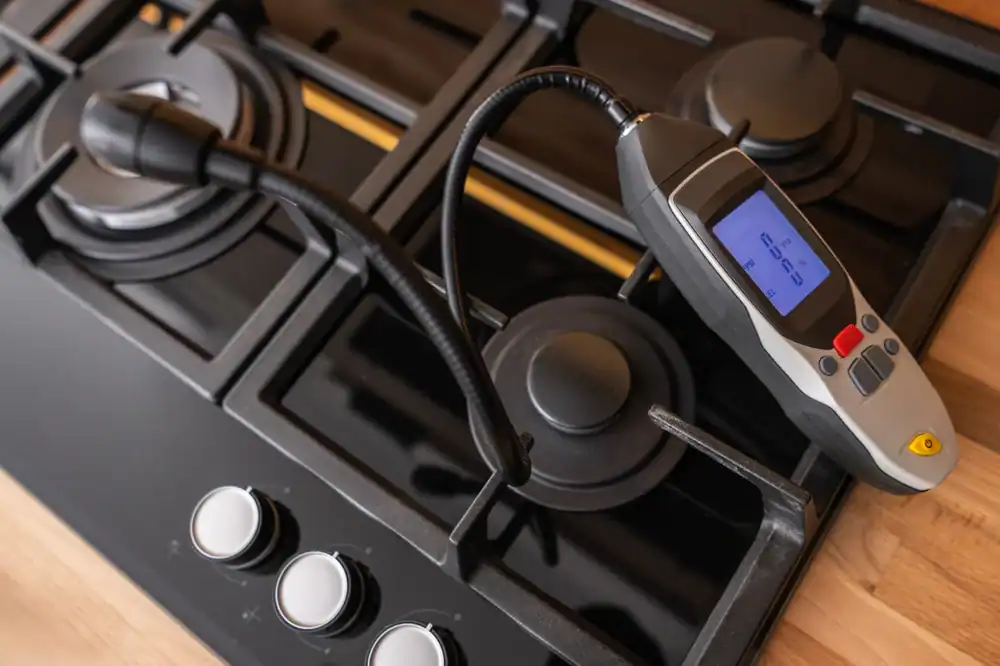
Consumer-grade gas detectors you’d buy at a hardware store are designed to alert you when gas concentration in the air reaches a certain threshold. They’re useful for that specific purpose, but they have significant limitations. They can’t tell you where the leak is coming from. They can’t detect a leak that’s occurring in an enclosed space — inside a wall cavity, under a floor, or in a section of piping that isn’t open to the room. And they produce no documentation that’s usable for insurance claims, DOB filings, or compliance certifications.
Professional gas leak detection uses calibrated equipment — including gas detectors that operate at far lower concentration thresholds and infrared cameras that identify temperature anomalies associated with gas accumulation behind surfaces you can’t see. The result is a specific location, an assessment of severity, and a documented report. For homeowners in older West Shore homes where gas lines run through wall cavities and under floors that were never designed for easy access, that difference in detection capability is significant. A store-bought alarm going quiet doesn’t mean the leak is gone. It means the concentration in the room dropped below the alarm threshold — which is a different thing.
It depends on your policy and the nature of the damage, but in many cases, homeowner’s insurance does cover damage caused by a gas leak — including repair costs, damage to property, and in some situations, temporary displacement. The key word is “damage caused by” — the leak itself and the repair to the gas line are typically separate from the property damage claim, and policies vary in how they handle each component.
What makes a meaningful difference in how smoothly a claim proceeds is documentation. An insurance adjuster needs a clear record of what was found, where, what caused it, and what was done to fix it. We work directly with insurance companies when gas leak damage has occurred, which means the documentation produced during the detection and repair visit is formatted and communicated in a way that supports the claims process rather than leaving you to translate between a plumber’s notes and an adjuster’s requirements. If you’re dealing with a gas leak situation in Bloomfield or the surrounding West Shore area and you think insurance may be involved, that coordination capability is worth factoring into who you call.
The residential neighborhoods immediately surrounding Bloomfield — Graniteville, Bulls Head, Travis, Mariners Harbor — are predominantly mid-20th century housing stock. Homes built in the 1950s through the 1970s have gas infrastructure that is now 50 to 70 years old. That means original flexible connectors behind stoves and dryers, original fittings at appliance hookups, and in some cases original galvanized or older steel piping that has never been replaced or professionally assessed.
The West Shore location adds another layer. Proximity to the Arthur Kill waterway means these homes are exposed to elevated coastal humidity and salt air year-round — conditions that accelerate corrosion of metal gas components at a faster rate than you’d see in inland Staten Island neighborhoods. A fitting that might last decades in a drier environment can degrade significantly faster here. Most of these homes are owner-occupied, which means the financial and safety responsibility for the gas system falls directly on the homeowner. A professional gas inspection isn’t a luxury for this housing stock. Given the age of the infrastructure and the coastal environment it’s been sitting in, it’s the responsible baseline.
Other Services we provide in Bloomfield