

A lot of Grymes Hill homeowners bought a beautifully restored Victorian or a Tudor Revival on Howard Avenue and never thought twice about what generation of gas piping runs behind the plaster. That’s not a knock — it’s just not something most people think about until they smell something they can’t explain, or until the heat kicks on in October for the first time in months and something doesn’t feel right.
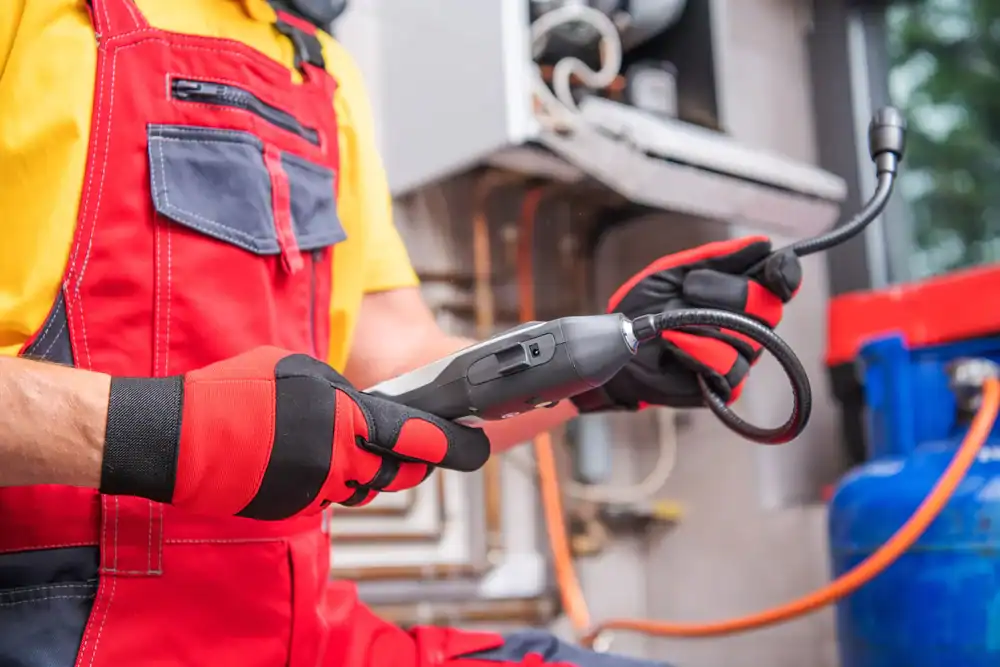
Here’s what changes after a proper gas leak detection visit: you know exactly what’s happening inside your gas system. Not a guess. Not a “probably fine.” An actual assessment using professional-grade gas detectors and infrared cameras that can find leaks hidden behind walls, under floors, and in crawl spaces — without tearing apart original woodwork or plaster that took decades to preserve.
For homes on the Grymes Hill hillside, this matters more than it does in a flat, post-war neighborhood. Buried gas lines on steep grades are subject to ground movement, frost heave, and the physical stress of elevation changes that pipes in flat terrain never deal with. Add in the serpentine rock geology underneath the hill and you have conditions that accelerate wear on aging infrastructure in ways that aren’t visible from the outside. Knowing what’s actually there gives you the ability to act before something forces your hand.
We’ve been doing this work in New York City since 1983. That’s over 40 years of gas piping, boiler systems, and emergency leak repairs across Manhattan and Staten Island — including the older, more complex properties that newer operations haven’t seen enough of to really understand.
Bobby and Rob — the father-and-son team behind RB Mechanical — have worked on the kind of homes that line Howard Avenue and wind up through the Grymes Hill hillside. Pre-war construction, layered renovations, gas systems that were retrofitted into structures built for coal or wood heat. We know what aging infrastructure looks like and what it takes to assess it accurately.
Every technician we send is a NYC Licensed Master Plumber — not a journeyman working unsupervised, not a subcontractor. They’re drug-tested and vetted, which matters when you’re letting someone into a home worth $750,000 or more, or when building management at a managed Grymes Hill property needs to verify who’s coming through the door.
When you reach out to us — whether it’s a smell you noticed this morning or a heating system that’s been acting up since you turned it on in the fall — the first thing that happens is a real conversation. Not a form, not a callback queue. You describe what you’re experiencing, and a licensed professional helps you understand whether this is an immediate emergency or a scheduled inspection situation.
If it’s urgent, our response target is 30 to 60 minutes. For a Grymes Hill address — up Howard Avenue, through the winding roads of the hillside — that’s a specific commitment, not a vague promise. Once on-site, our technician uses professional-grade gas detectors and infrared cameras to locate the source of the problem. In a home with plaster walls and original flooring, that non-invasive detection capability is the difference between finding a leak and tearing apart a room to look for one.
If a leak is found, you get a clear explanation of what it is, where it is, and what it takes to fix it — with transparent pricing stated before any work begins. No hidden fees, no inflated quotes after the fact. If the repair requires a permit or DOB filing, we handle that too. For Grymes Hill’s multi-unit or mixed-use buildings navigating Local Law 152 compliance, that full-cycle capability — inspection, repair, filing, certification — means one call covers the whole process. National Grid handles the utility side of your gas system; we handle everything inside your building.

Ready to get started?
Gas leak detection in Grymes Hill isn’t the same job it is in a flat, newer neighborhood. National Grid’s own infrastructure data shows the average gas main in its Staten Island territory is 57 years old, with a meaningful share of services installed before 1960. In a neighborhood where many homes were built in the 1800s and 1920s — some of the oldest private residential structures on the island — the gas piping inside those walls may be far older than the current owner realizes. Our detection process is built to handle that reality, not assume everything is fine because nothing has failed yet.
Beyond emergency response, there’s a compliance side to this that Grymes Hill property owners need to be aware of. Grymes Hill falls within Staten Island Community District 1. The Local Law 152 gas piping inspection cycle for CD1 ran through December 31, 2024. Multi-unit buildings that missed that deadline are currently exposed to a $5,000 civil penalty from the NYC Department of Buildings. We’re licensed to perform those inspections and make any required repairs, then handle the DOB filing and certification — so building owners and property managers aren’t left chasing paperwork or coordinating between multiple vendors.
Looking ahead, Local Law 157 requires natural gas detectors to be installed in all NYC residences by January 1, 2027. Detectors must be placed within one foot of the ceiling and within ten feet of any gas appliance. A gas leak detection visit is a natural opportunity to assess where you stand on that requirement before the deadline arrives. And if a gas leak has caused damage to your property, we work directly with insurance companies — reducing the administrative burden during an already difficult situation.

The first thing to do is get out. Don’t turn lights on or off, don’t use your phone inside the house, and don’t try to locate the source yourself. Once you’re outside and away from the building, call 911 and then call National Grid — they’re the gas utility serving Grymes Hill and all of Staten Island, and they’ll respond to secure the utility side of the situation.
Once National Grid clears the scene, that’s where we come in. National Grid handles the distribution system — the mains and the service line up to your meter. They do not repair building-side piping. If the issue is inside your Grymes Hill home, a NYC Licensed Master Plumber needs to assess and repair it before your gas service can be restored. One thing worth knowing: the odorant added to natural gas can dissipate over time through a process called odor fade. If the smell came and went, that doesn’t mean the leak resolved itself — it may mean the odorant faded while gas continued to accumulate. Don’t assume a disappearing smell is a clean bill of health.
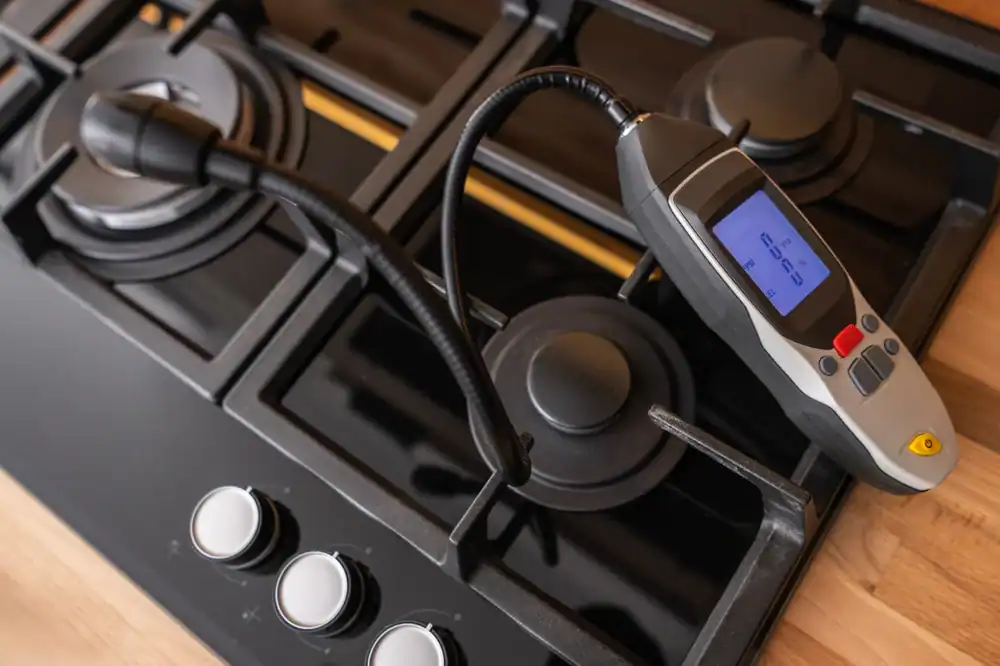
Professional-grade gas detectors work by sampling the air for methane concentrations at levels far below what the human nose can detect. A technician moves the detector systematically through the space — along pipe runs, near appliances, around connections and fittings — to identify where concentrations are elevated. This gives a precise location rather than a general area.
Infrared cameras add a layer that’s especially valuable in Grymes Hill’s older homes. Gas escaping from a pipe behind a plaster wall or under original hardwood flooring creates a thermal signature that an infrared camera can detect without any demolition. For a homeowner with a Victorian or Colonial Revival on Howard Avenue — where the original architectural details are part of what makes the property worth what it is — that non-invasive capability matters. You find out what’s happening without having to tear apart a room to look for it. Consumer-grade detectors from a hardware store can alert you to the presence of gas, but they can’t pinpoint the source, assess severity, or produce the documentation you’d need for a DOB filing or an insurance claim.
No — and this is one of the most common points of confusion for Staten Island homeowners. National Grid is responsible for the gas distribution system: the mains running under the street and the service line that runs from the main to your meter. When they respond to a gas leak report, they’re assessing and securing that portion of the system. Once they determine the issue is on the building side — meaning inside your home, past the meter — their involvement ends.
Everything from the meter into your Grymes Hill home is your responsibility, and any repair work on that side of the system must be performed by or under the direct supervision of a NYC Licensed Master Plumber. This isn’t optional — it’s a legal requirement in New York City. Unlicensed gas work can result in DOB violations, fines, and the loss of gas service for your entire building until a licensed plumber resolves the issue. If National Grid has already been out to your property and left without restoring service, that’s typically a signal that the problem is building-side and needs a licensed plumber to address it.
Local Law 152 is a New York City law that requires exposed gas piping in most buildings — everything except one- and two-family homes — to be inspected by a Licensed Master Plumber once every four years. The inspections are scheduled on a rotating cycle by community district. Grymes Hill falls within Staten Island Community District 1, and the most recent CD1 inspection cycle ran from January 1 through December 31, 2024.
If you own or manage a multi-unit building, mixed-use property, or any structure in Grymes Hill that isn’t a single- or two-family home, and you didn’t complete a Local Law 152 inspection before the end of 2024, you’re currently exposed to a $5,000 civil penalty from the NYC Department of Buildings. Buildings that completed their 2024 inspection are on the next CD1 cycle, which will run in 2028. We’re licensed to perform these inspections, make any repairs that are identified, and handle the DOB filing and certification — so you’re not left coordinating between an inspector and a separate repair contractor.
It’s not a coincidence. Gas heating systems — boilers, furnaces, gas-fired heaters — sit completely idle through the warmer months. During that dormant period, connections can loosen, flexible connectors behind appliances can degrade, and corrosion on older fittings can progress without any pressure or heat cycling to make it obvious. When you fire the system up for the first time in October or November, those weakened points get stressed again, and that’s when leaks tend to show up.
In Grymes Hill, this pattern is more pronounced than in newer neighborhoods because of the age of the housing stock. A gas boiler in a 1920s Colonial on Howard Avenue is working with connections and fittings that have been through decades of heating seasons. Some of those homes were originally oil-heated and converted to gas at some point, meaning the building-side piping may be a mix of different ages and materials. The fall startup is the highest-risk moment for that kind of system. Having a gas inspection done in late September or early October — before you need the heat — is a straightforward way to catch problems before they become emergencies.
Yes, and it’s more relevant here than in most Staten Island neighborhoods. Grymes Hill includes managed residential properties and gated communities like The Enclave where building management controls who accesses the property. Co-op boards and property managers in the area routinely require that service providers carry verifiable credentials before they’re permitted entry — a Certificate of Insurance, a verifiable license, and in some cases confirmation that technicians have been vetted.
Our technicians are drug-tested and vetted, every one of them holds or works under a NYC Licensed Master Plumber credential, and we carry full insurance with a COI available on request. That’s not a formality — it’s what gets you past the gate and through the building management process without delays when you’re dealing with a gas issue that needs to be addressed quickly. For homeowners in premium Grymes Hill properties, knowing exactly who is coming to your door — and that they’ve been properly screened — is part of what makes the difference between a service call that goes smoothly and one that creates additional headaches before the work even starts.
Other Services we provide in Grymes Hill