
A lot of Grymes Hill homeowners discover the hard way that their existing gas line wasn’t built for the appliances they’re installing now. You buy a professional-grade range, a tankless water heater, or a high-output boiler — and then find out the line feeding it is undersized, corroded, or simply not up to current NYC code. That’s not a minor inconvenience. It means your appliance underperforms, your contractor can’t finish the job, and you’re stuck waiting.
When the gas line is properly sized and installed, everything works the way it’s supposed to. Your range hits full heat. Your water heater delivers on demand. Your heating system runs efficiently through a Grymes Hill winter — and at 310 feet above sea level, with wind exposure that most of Staten Island doesn’t deal with, that matters more than people realize until their heat goes out in January.
Beyond performance, there’s the compliance piece. Many of the homes on this hill were built before 1939. That infrastructure has history — and not all of it is code-compliant by today’s standards. A properly permitted, inspected, and documented gas line installation protects your property, your insurance coverage, and your ability to sell without surprises.
We’ve been doing this in New York City since 1983. That’s over four decades of navigating pre-war building infrastructure, DOB permit systems, Con Edison requirements, and the specific complexity that comes with working in some of the city’s oldest housing stock — exactly the kind of homes that line Howard Avenue and the winding streets of Grymes Hill.
There’s a Licensed Master Plumber on staff for every job — not a subcontractor arrangement, not a name on a license while someone else does the work. The LMP is on-site, accountable, and signs off on everything. That matters in NYC, where gas work without a licensed master plumber isn’t just a code violation — it’s a criminal offense, and no utility company will activate gas to unpermitted work.
Our Yelp presence is anchored specifically in Staten Island, and our pricing examples call out Staten Island installations by name. This isn’t a Manhattan company that occasionally crosses the bridge. Grymes Hill is part of the territory we know.
It starts with an assessment. Before any pipe gets touched, we evaluate your existing gas infrastructure — what’s there, what condition it’s in, and whether it can support what you’re adding. In a Grymes Hill home built before World War II, that evaluation often turns up aging black iron pipe that’s been patched over the decades, undersized runs that made sense for a 1930s kitchen but can’t handle a modern high-BTU appliance, or fittings that are simply past their useful life. You get a clear picture of what’s needed and a written, itemized estimate before anything begins.
From there, we handle the DOB permit filing through DOB NOW — the city’s all-digital permit portal. You don’t log into anything or make calls to any government office. Once the permit is in place, the installation happens: new pipe run, properly sized for the full BTU load of every appliance on the line, with each appliance getting its own dedicated shutoff valve. After installation, the line is pressure-tested at one and a half times working pressure, which is what the NYC Fuel Gas Code requires before gas service can be activated.
The final step is Con Edison coordination. New service, upsized capacity, or post-inspection restoration all require utility authorization before the meter is active. We manage that process too. When the job is done, you receive written documentation — the permit record, pressure test results, and LMP certification. For Grymes Hill homeowners with significant property values, that paper trail is worth keeping.

Ready to get started?
Gas line sizing isn’t a guess. It’s a calculation — total BTU demand of every appliance on the line, the length of the longest pipe run, the diameter required to deliver adequate pressure at the farthest point. A standard residential gas line might be fine for a basic stove, but a professional-grade range can demand 40,000 to 60,000 BTU or more per burner. A tankless water heater can pull 150,000 to 199,000 BTU on its own. If the line isn’t sized for that load, the appliance will never perform the way it’s supposed to — and in some cases, it’ll trigger safety shutoffs that make it barely usable.
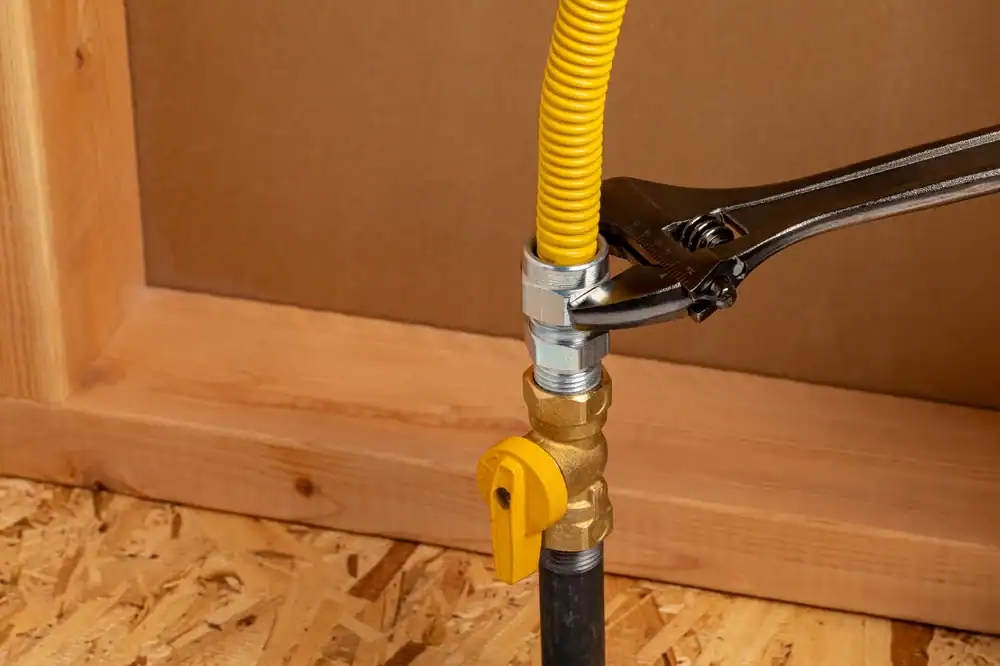
For Grymes Hill homeowners investing in high-end kitchen renovations or heating system upgrades, we handle the full scope: new gas line installation for stoves, ranges, water heaters, boilers, dryers, and generators; appliance gas hookup with dedicated shutoff valves; gas line replacement for aging or non-compliant pipe; and Local Law 152 inspections with GPS-2 certification filing for multifamily buildings, condominiums like Sunrise Tower, and institutional properties. Pricing runs $12 to $25 per linear foot depending on pipe type and complexity, with most single-appliance installations in Staten Island ranging from $500 to $2,000 and whole-home installations running $1,300 to $3,500.
Grymes Hill’s serpentinite bedrock and steep, non-grid terrain also affect how exterior or below-grade runs are planned. Routes that work on a flat South Shore lot don’t translate directly to a hillside property with retaining walls and grade changes. We plan around the actual site — not a generic template.

It depends on what’s already there — and the honest answer is that many Grymes Hill homes do. A significant share of the housing stock on this hill was built before 1939, and the gas lines installed in those homes were sized for appliances that had a fraction of the BTU demand of a modern professional-grade range. A Wolf or Viking range can pull 40,000 to 60,000 BTU per burner. If your existing line was sized for a standard residential stove, it likely can’t deliver that load without a pressure drop that causes the appliance to underperform or trigger safety shutoffs.
The only way to know for certain is to have a Licensed Master Plumber assess the existing line — its diameter, its length, its condition, and the total BTU load of everything connected to it. We do that evaluation before recommending any new work. If the existing line is adequate, we’ll tell you. If it needs to be upsized or replaced, you’ll get a written estimate before anything begins.
In New York City, only a Licensed Master Plumber registered with the NYC Department of Buildings can legally install, alter, repair, or maintain gas lines. This applies everywhere in the five boroughs, including Staten Island. It’s not a suggestion or a best practice — it’s the law, codified in the NYC Fuel Gas Code and the city’s Administrative Code. Unlicensed gas work is a criminal offense in NYC, and Con Edison will not activate gas service to any work that wasn’t permitted and performed by a licensed professional.
This matters practically because some homeowners try to hire a general contractor or handyman for gas hookups, particularly for appliance installations that seem straightforward. Beyond the legal exposure, unpermitted gas work can void your homeowner’s insurance and create serious problems at resale when a buyer’s inspector or attorney pulls the permit history. We have a Licensed Master Plumber on staff — not a subcontractor — for every gas line job we take on.
For a single appliance hookup — a new gas line run to a range, dryer, or water heater — most installations take anywhere from a few hours to a full day, depending on how far the line needs to run and what’s in the way. A longer run through walls or ceilings, or a job that requires routing around the structural quirks of an older home, takes more time than a short run in a newer build with open access.
In Grymes Hill specifically, the age of the housing stock and the irregular terrain add variables that don’t show up on a flat-lot job. A pre-war home on a steep grade with finished walls, original plaster, and a non-standard floor plan takes more planning and more care than a 1990s ranch. The DOB permit process runs parallel to the installation — we file through DOB NOW before work begins, so the permit timeline doesn’t delay the job itself. After installation, Con Edison authorization is required before gas is activated, which adds time that varies by utility backlog. Most projects move from permit to gas-on within one to three days for straightforward installations.
Local Law 152 requires gas piping inspections every four years for virtually all NYC buildings except one- and two-family homes. That means multifamily residential buildings, mixed-use buildings, condominiums, and commercial or institutional properties are all covered — and Grymes Hill has all of these, from apartment complexes near the Wagner College campus to the Sunrise Tower Condominiums to the institutional buildings associated with the university itself.
The inspection must be performed by a Licensed Master Plumber or a Registered Journeyman Plumber under direct LMP supervision. After the inspection, the LMP files a GPS-2 certification electronically through DOB NOW to confirm the building’s gas piping system is compliant. If violations are found during the inspection, they need to be corrected and certified before the GPS-2 can be filed. Missing the deadline carries penalties up to $10,000. We handle the full process — inspection, any required repairs, and GPS-2 filing — so building owners and property managers aren’t left coordinating between multiple contractors to get to compliance.
A Con Edison gas shutoff — whether triggered by a failed Local Law 152 inspection, a suspected leak, or a reported violation — doesn’t get resolved with a single phone call. The process involves identifying and repairing whatever caused the shutoff, having a Licensed Master Plumber certify the repairs, filing the appropriate documentation with the DOB, and then scheduling a Con Edison inspection before the meter is reactivated. Depending on the severity of the violation and the utility’s inspection backlog, this can take anywhere from a few days to a few weeks if it’s not managed by someone who knows the process.
For Grymes Hill homeowners, a winter shutoff is a genuine emergency. The neighborhood sits at the second-highest elevation in all five NYC boroughs, and wind exposure at that height makes a heating failure feel significantly worse than it would at sea level. We offer 24/7 emergency availability and have a documented track record of same-day response. We also handle the Con Edison coordination directly — which is the part of the process that tends to drag when homeowners try to manage it themselves.
We publish our pricing openly, which most contractors in this space don’t do. Gas piping runs $12 to $25 per linear foot, depending on the complexity of the project and the type of pipe required. Most single-appliance installations on Staten Island — a new line to a range, water heater, or dryer — run between $500 and $2,000. Whole-home installations, which involve running new gas piping to multiple appliances or replacing aging infrastructure throughout the house, typically run $1,300 to $3,500.
In Grymes Hill, a few factors can push a project toward the higher end of those ranges. The age of the housing stock means more existing infrastructure to work around — finished walls, original plaster, non-standard framing — which adds labor time. The hill’s steep grades and serpentinite bedrock make any exterior or below-grade routing more involved than a flat-lot job. And older homes often have more total pipe to replace when the existing lines are undersized for modern appliances. Every project starts with a written, itemized estimate before any work begins, so you know exactly what you’re looking at before anything gets scheduled.
Other Services we provide in Grymes Hill