
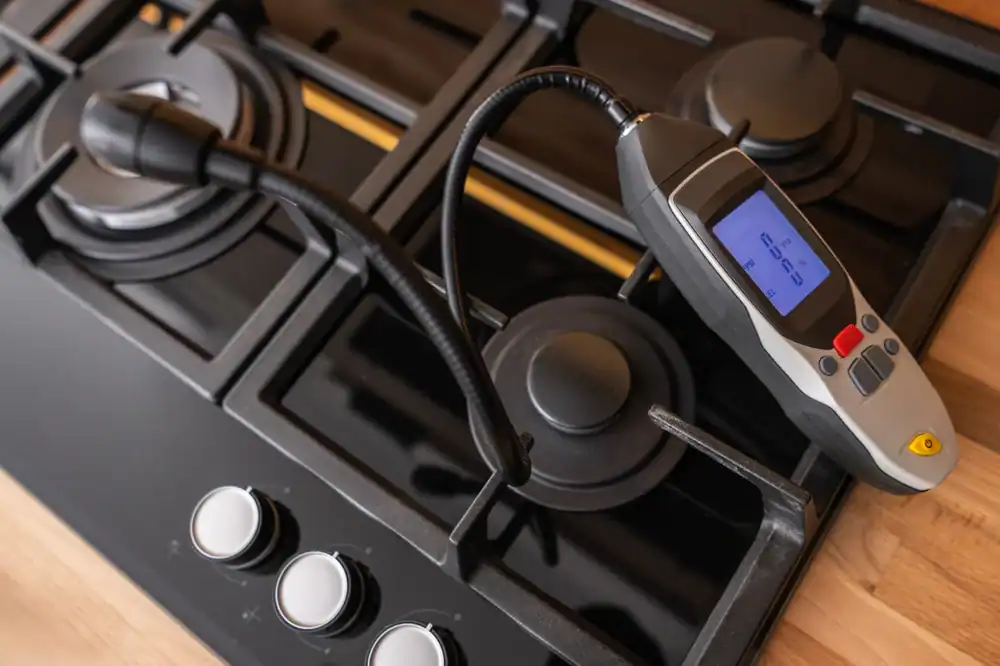

When your gas system was installed in 1974, it was built to last. But “last” has a limit, and a lot of Heartland Village homes are approaching or past it. Flexible connectors behind stoves, supply lines to boilers, fittings at water heaters — these components don’t announce when they start to fail. They just quietly do.
Getting a proper gas leak detection done means you stop guessing. You find out whether the system is holding pressure the way it should, whether any connections have degraded, and whether your appliances are still safely tied in. That’s not a worst-case scenario conversation — it’s just what responsible ownership looks like for a home of this age.
For the two-family homes that make up a large portion of Heartland Village, there’s a second layer to this. You’re not just responsible for your unit. You’re responsible for the whole building — including the gas system serving the unit above or below you. A single inspection covers both, and it gives you documentation you can actually use if a question ever comes up with a tenant or an insurer.
We’ve been working in the New York City market since 1983. That’s not a footnote — it means we’ve been doing gas work on the same era of infrastructure that’s now aging inside Heartland Village homes. We’ve seen these systems at every stage of their lifecycle, and we know exactly what to look for in a 1970s or 1980s gas installation.
Every technician who touches a gas line is a NYC Licensed Master Plumber — the highest credential available for this work in New York State. We’re also drug-tested and vetted, which matters when you’re letting someone into your home or into a unit your tenant lives in. Heartland Village is National Grid territory, not Con Edison, and we know the difference — including how to coordinate with National Grid when a shutoff or restoration is part of the job.
We’re a father-and-son team. Bobby and Rob are named individuals, not a dispatch center. When something gets done, there’s a person accountable for it.

The first thing that happens is a call. You describe what you’re noticing — a smell that comes and goes, a hissing sound, a National Grid notice, or just a home in Heartland Village that’s 50 years old and has never had its gas lines looked at. From there, we give you a transparent price before any work begins. No showing up and then quoting after the fact.
When our technician arrives — within 30 to 60 minutes for true emergencies in Heartland Village, given the neighborhood’s access to I-278 via Richmond Avenue — we bring professional-grade gas detectors and infrared cameras. The infrared cameras are specifically useful in homes like the ones throughout this neighborhood, where gas lines run behind finished walls and under floors that haven’t been opened in decades. A visual check alone won’t find a slow leak in a concealed fitting. Our equipment will.
If a leak is found, you’ll know exactly where it is, what caused it, and what the repair involves before anything is touched. If the building is a multi-unit property subject to Local Law 152 — which applies to condos and apartment buildings in Staten Island Community Board 2, with the most recent inspection window running through 2025 — we handle the repair, the DOB filing, and the compliance certification as a single workflow. You don’t have to coordinate anything separately.

Ready to get started?
Our gas leak detection service covers the full building-side system — every appliance connection, every fitting, every length of exposed piping. In Heartland Village, where the housing stock is predominantly 1970s and 1980s construction, that means paying close attention to the components most likely to show age: flexible connectors, union joints, and the supply lines running to boilers that may have sat dormant all summer before being fired up again in October.
For condo buildings and townhome complexes in Heartland Village — and there are a significant number of them — Local Law 152 compliance is part of the conversation. The neighborhood falls within Staten Island Community Board 2, which was assigned the 2025 LL152 inspection window. Buildings that missed that deadline are now facing a $5,000 civil penalty exposure. We’re certified to perform the inspection, make any required repairs, and file the DOB certification. That’s the entire compliance workflow handled by our team.
Beyond detection and repair, our service also covers Local Law 157 natural gas detector installation, which is now required in all NYC residences by January 1, 2027. If you’re already scheduling a gas inspection in Heartland Village, adding detector installation at the same visit is the straightforward move. Pricing is transparent and provided upfront — no hidden fees, no surprises after the work is done.

The first step is to leave the building without stopping to turn appliances on or off, and without using your phone until you’re outside. Once you’re clear of the building, call National Grid’s emergency line — 1-800-892-2345 — and then call a Licensed Master Plumber. National Grid will respond to address the utility-side infrastructure, meaning the gas main and the service line running to your building. What they won’t do is repair the building-side piping — the gas lines inside your home, the connections to your appliances, or any fittings that have deteriorated over time.
That’s where we come in. In Heartland Village, where most homes were built between the late 1960s and early 1980s, the building-side gas system is often the same age as the house. National Grid clearing the utility side doesn’t mean the interior system is clean. Once National Grid has made their assessment, we can come in, run a full detection sweep with professional-grade equipment, identify the source, and walk you through the repair before anything is touched.
National Grid handles the distribution infrastructure — the underground mains, the service lines running from the street to your meter. Their responsibility ends at the meter. Everything from the meter into your home is building-side piping, and that is entirely outside National Grid’s scope of work. They will not repair it, and in many cases they will shut off gas service until a Licensed Master Plumber resolves the issue on the building side.
This is one of the more common points of confusion for Heartland Village homeowners. National Grid may come out, confirm there’s no utility-side issue, and leave — and the homeowner assumes the problem is resolved. But if the leak is in the interior piping, behind a wall, or at an appliance connection, it’s still there. An NBC New York investigation found that National Grid’s own system has hundreds of documented underground leaks on Staten Island, which speaks to the age and condition of the borough’s gas infrastructure broadly. Your building-side system deserves the same scrutiny. A Licensed Master Plumber is the right call for anything past the meter.
There’s no single universal rule for single-family homes, but the general guidance from licensed plumbers working in older NYC housing stock is that a professional gas inspection makes sense any time you’re doing a kitchen or bathroom renovation, any time an appliance is replaced, and any time you haven’t had one done in the last several years. For homes in Heartland Village built in the 1970s or early 1980s, the gas infrastructure is now 40 to 55 years old. Flexible connectors, which are the corrugated metal lines that run from the gas valve behind your stove or dryer to the appliance itself, have a finite service life and are a well-documented failure point in homes of this age.
Beyond single-family homes, multi-unit buildings in Heartland Village — condos, two-family homes that qualify, and rental buildings — are subject to Local Law 152, which mandates a gas piping inspection by a Licensed Master Plumber once every four years. Staten Island Community Board 2 buildings were assigned the 2025 inspection window. If your building hasn’t been inspected and certified, that’s an active compliance issue with a $5,000 civil penalty attached.
It depends on the policy and the circumstances, but many homeowner’s insurance policies do cover damage caused by a gas leak — including structural damage, appliance damage, and in some cases the cost of the repair itself — if the leak was sudden and accidental rather than the result of deferred maintenance. The key word is documentation. An insurer will want a written assessment from a Licensed Master Plumber that identifies the source, describes the damage, and outlines what was done to fix it.
We work directly with insurance companies when gas leak damage is involved. That means we can provide the documentation the insurer needs and coordinate the process on your behalf, which reduces the administrative burden on you during what is already a stressful situation. If you’re a homeowner in Heartland Village with a property valued in the range typical for the 10314 ZIP code, having that documentation trail is genuinely important — both for the current claim and for the property’s record going forward.
Yes, and this is worth understanding clearly because the two hazards are completely different and require different detection equipment. Natural gas — primarily methane — has an odorant called mercaptan added to it specifically so you can smell it. That rotten egg or sulfur smell is the warning system. Carbon monoxide, on the other hand, is a combustion byproduct that is completely odorless and colorless. You cannot smell it, see it, or taste it. A natural gas detector will not alert you to carbon monoxide, and a carbon monoxide detector will not alert you to a gas leak.
Both detectors are worth having in a Heartland Village home, particularly given the age of the heating systems in the neighborhood. Older boilers and furnaces that haven’t been serviced regularly are more likely to produce carbon monoxide as a byproduct of incomplete combustion. Local Law 157 specifically addresses natural gas detectors, requiring them in all NYC residences by January 1, 2027, with placement within one foot of the ceiling and within ten feet of gas appliances. Carbon monoxide detectors are covered under separate NYC requirements. If you’re scheduling a gas inspection, it’s a natural time to address both.
Local Law 152 requires all NYC buildings — with the exception of one- and two-family homes — to have their exposed gas piping inspected by a Licensed Master Plumber once every four years. The law applies to co-ops, condos, rental buildings, and mixed-use properties. If you own a unit in a garden condo complex or a townhome development in Heartland Village, your building’s condo association or management company is responsible for scheduling and filing the inspection — not individual unit owners, in most cases. But if the board hasn’t acted and the deadline has passed, the $5,000 civil penalty falls on the building.
Heartland Village is within Staten Island Community Board 2, which was assigned the January 1 through December 31, 2025 inspection window under the LL152 schedule. Buildings that completed and filed their inspection during that window are compliant until 2029. Buildings that did not are currently out of compliance. The filing requires submitting a Gas Piping System Periodic Inspection Certification to the NYC Department of Buildings within 60 days of the inspection. We handle the inspection, any required repairs, and the DOB filing — so the board or property manager isn’t left navigating that process alone.
Other Services we provide in Heartland Village