
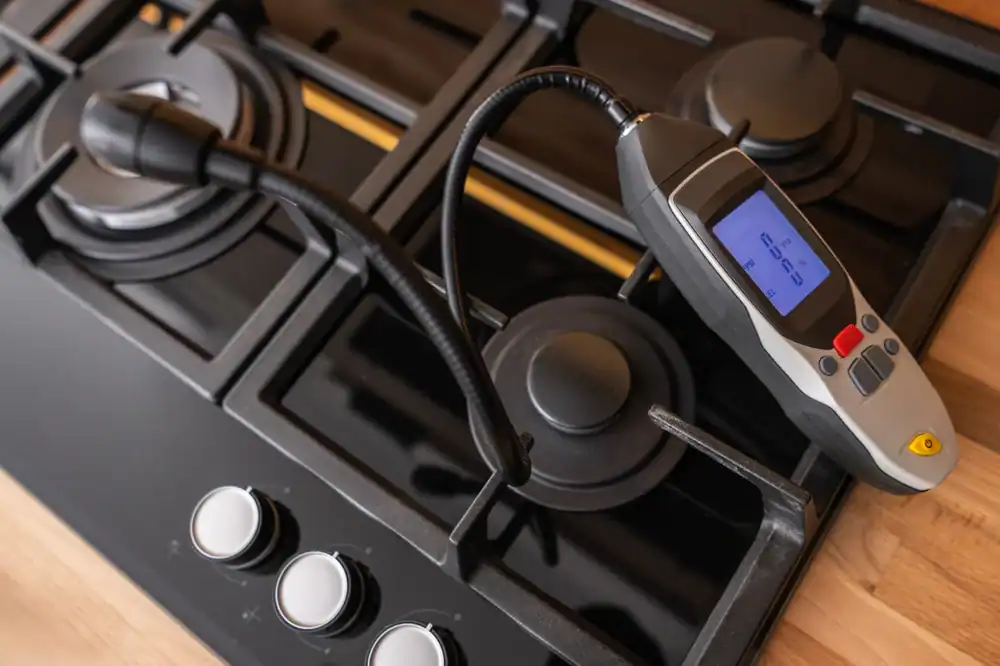

There’s a specific kind of stress that comes from not knowing. You caught a faint smell near the stove last week, or maybe the boiler room had an odd odor when you fired it up in October. You’re not sure if it’s something or nothing. That uncertainty is exactly what a professional gas leak detection visit resolves — not with a guess, but with equipment that can find what your nose can’t.
Rosebank’s housing stock skews older than most of Staten Island. About 17% of homes here were built before 1940, and the median construction year sits around 1972. That means a significant portion of the neighborhood is running gas systems that are 50 to 80-plus years old — original fittings, aging flexible connectors behind stoves, boiler connections that were installed before most of today’s safety standards existed. These systems don’t announce their age. They just quietly deteriorate until something gives.
And here’s something most people don’t think about: National Grid has been actively upgrading the Clifton Gate Station on Willow Avenue and Bay Street — right on Rosebank’s doorstep — since April 2024. A two-phase rebuild of the nearby Grasmere Gate Station, which serves roughly 80,000 to 100,000 East Shore customers, began in early 2025. Utility-side pressure changes during distribution upgrades are a documented trigger for loosening aging fittings on the building side of the meter. The timing for a professional inspection isn’t arbitrary — it’s specific to what’s happening in Rosebank right now.
We’ve been operating in the New York City market since 1983 — over 40 years of working on the exact types of homes that line the streets of Rosebank. Attached rowhouses, two-family buildings, pre-war single-family homes, and aging boiler systems that have been heating the same families for generations. We know this neighborhood because we’ve been part of it.
Bobby and Rob are the father-and-son team behind RB Mechanical Plumbing and Heating. There’s no dispatcher between you and the people doing the work. Every technician who handles your gas line is a NYC Licensed Master Plumber — the highest credential available for gas work in New York State, and the one the law actually requires. They’re also drug-tested and vetted, which matters when you’re granting access to your home or to a tenant’s unit in a two-family building.
Rosebank is a neighborhood where families have owned the same homes for two or three generations. We understand that dynamic — because we are that dynamic. We’ve been doing this long enough to know what a 1960s black iron gas line looks like, what a 50-year-old flexible connector behind a gas range is capable of, and what it takes to navigate National Grid’s process for restoring service after a shutoff on Staten Island.

When you call us, the first thing that happens is a real conversation. You describe what you noticed — a smell, a sound, a utility notice, or just a gut feeling about an old appliance. Based on that, a Licensed Master Plumber comes out equipped with professional-grade gas detectors and infrared cameras. These aren’t the detectors you find at a hardware store. They can trace a leak to its source even when it’s behind a wall, under a floor, or migrating through a shared utility chase in an attached building — which is a real scenario in Rosebank’s rowhouses and two-family homes.
Once on-site, we do a systematic inspection of your exposed gas piping, appliance connections, flexible connectors, meter set, and any areas of concern you flagged. If a leak is found, you get a clear explanation of what it is, where it is, and what fixing it involves — with pricing stated before any work begins. No surprises on the bill.
If a repair is needed, we handle it. If the situation requires National Grid to be contacted — whether that’s because service was shut off or because the utility side needs to be secured first — we coordinate that process too. For multi-unit buildings subject to NYC Local Law 152 gas piping inspection requirements, we handle the DOB filing and compliance certification as well. One call covers the full picture, from detection through documentation.

Ready to get started?
A gas leak detection visit from us isn’t a quick walk-through with a handheld sensor. It’s a thorough inspection of your gas system using professional-grade detectors and infrared cameras — equipment that can find leaks hidden behind walls, beneath floors, and in the shared spaces common in Rosebank’s attached and semi-attached housing stock.
The inspection covers your exposed gas piping, appliance connections (including the flexible connectors behind your stove and dryer), your boiler’s gas supply line, and your meter set. In a neighborhood where a meaningful share of homes were built before 1940 and many more date to the 1970s, those flexible connectors and original fittings are the most common failure points — and the ones most likely to be overlooked because they’ve never caused a visible problem before.
If your building has more than two units, we’re certified to perform Local Law 152 gas piping inspections and handle any required repairs, DOB filings, and compliance certifications. That’s relevant for Rosebank’s two-family homes and small apartment buildings, where the building owner is on the hook for both the inspection and the $5,000 penalty for missing the compliance deadline. For situations where National Grid has shut off gas service — which can happen after a utility inspection, a neighbor’s complaint, or a DOB violation — we manage the repair, the paperwork, and the coordination with National Grid to get your service restored. We also work directly with insurance companies when gas leak damage has occurred, which removes a significant burden from homeowners during an already stressful situation.

Yes, and this is actually one of the more common and more dangerous patterns. The odorant added to natural gas — called mercaptan — can dissipate over time through a process called odor fade. That means a real, active leak can stop smelling even while gas continues to accumulate. The smell going away is not the same as the problem going away.
In Rosebank specifically, where a significant number of homes have gas ranges and flexible connectors that haven’t been replaced in decades, an intermittent smell near the stove is often a sign that a connector or fitting is at the early stage of failure — not that everything is fine. A professional inspection with a calibrated gas detector will confirm whether there’s an active leak, locate the source precisely, and give you a clear answer rather than a guess. Don’t let the absence of smell be the reason you wait.
National Grid handles the utility distribution side of your gas system — the main lines running to your building and the service connection up to your meter. When they come out in response to a gas smell or a reported leak, they’re checking their infrastructure. If they don’t find a problem on their end, they leave. What they don’t inspect is the building-side piping — everything from your meter inward, including your gas lines, appliance connections, boiler supply, and flexible connectors.
That building-side system is entirely your responsibility as a property owner, and it requires a NYC Licensed Master Plumber to inspect and repair. The two systems are separate, and both can be clear — or one can have a problem the other can’t see. If National Grid cleared their side and you’re still concerned, the next step is having a licensed plumber inspect the interior piping. That’s not redundant — it’s the other half of the picture.
In attached and semi-attached housing — which makes up a significant portion of Rosebank’s residential stock — yes, this is a real risk. Gas migrates through shared walls, floor joists, basement connections, and utility chases. A leak originating in the unit next door or below you can accumulate in your space before your neighbor even notices it in theirs.
This is one of the key reasons a consumer-grade gas detector has limits. It can tell you that gas is present in your apartment, but it can’t tell you where it originated, whose piping is responsible, or how to document it for a landlord or insurance claim. Professional-grade equipment — including the infrared cameras we use — can trace a leak to its source even in shared-wall construction. If you’re in a two-family home or rowhouse in Rosebank and you’re smelling something you can’t locate, don’t assume it’s on your side. Get it checked properly.
Local Law 152 applies to most NYC buildings except one- and two-family homes. So if you own a standard two-family home in Rosebank and you live in one unit while renting the other, you are likely exempt from the mandatory inspection cycle. However, if your building has three or more units — including small apartment buildings, which are common in parts of Rosebank — you are subject to the law and must have your exposed gas piping inspected by a Licensed Master Plumber on a four-year rotating schedule tied to your community district.
Missing the deadline carries a $5,000 civil penalty, and the inspection must be filed with the NYC DOB within 60 days of completion. We’re certified to perform Local Law 152 inspections and handle any required repairs, DOB filings, and compliance certifications. If you’re a building owner and you’re not sure whether your property qualifies, it’s worth a quick call to confirm before the deadline passes.
These are two separate hazards that require separate detectors, and confusing them is a common mistake. Natural gas is primarily methane, and it has an odorant added to it — that’s the rotten egg or sulfur smell you’ve probably heard about. Carbon monoxide is a combustion byproduct produced by gas appliances, furnaces, and boilers when they’re not burning fuel completely. It is completely odorless and colorless, which makes it undetectable without a dedicated CO detector.
A natural gas detector will not alert you to carbon monoxide, and a CO detector will not detect a natural gas leak. You need both, installed in the right locations — natural gas detectors within a foot of the ceiling (since methane is lighter than air and rises), and CO detectors at breathing height. NYC Local Law 157 now requires natural gas detectors in all NYC residences, with a compliance deadline of January 1, 2027. If your home in Rosebank doesn’t have both types installed, now is a reasonable time to address it.
When National Grid shuts off gas service — whether due to a utility inspection, a reported leak, a DOB violation, or a neighbor’s complaint — getting it restored isn’t just a matter of calling them back. Before National Grid will turn service back on, the building-side issue that triggered the shutoff must be repaired and, in most cases, documented by a NYC Licensed Master Plumber. That means the plumber needs to identify the problem, make the repair, and in some situations file the appropriate paperwork with the NYC DOB before restoration can happen.
We handle this entire sequence. We diagnose the building-side issue, make the repair, manage any required DOB filings, and coordinate directly with National Grid to schedule the restoration. For Rosebank residents, the relevant utility contact for gas emergencies and restoration on Staten Island is National Grid at 718-643-4050. Having a licensed plumber who knows that process — and has navigated it with National Grid before — is what gets your heat and hot water back on as quickly as possible.
Other Services we provide in Rosebank