
A lot of Rosebank homeowners call about a new appliance hookup and find out midway through the conversation that the real question is whether their existing gas line is even adequate. It’s not a scare tactic — it’s just the reality of owning a home built in the 1920s or 1930s. Original gas piping was sized for appliances that no longer exist, and when you’re adding a high-BTU professional range or a tankless water heater, the line from your meter may not be adequate without upsizing first.
Rosebank’s location along the Upper New York Bay waterfront adds another layer. The salt air and coastal humidity that come with living near the Narrows accelerate corrosion in older metal piping faster than you’d see in an inland neighborhood. That’s not always visible from the outside, which is exactly why an assessment matters before any new installation begins.
When the work is done right — properly sized, permitted through the NYC Department of Buildings, pressure-tested, and documented — you’re not just getting a working gas line. You’re getting a system that’s been verified safe, meets current code, and comes with a paper trail that protects you at resale and with your insurer.
We’ve been doing this work in New York City since 1983. That means we were on Staten Island long before the current renovation wave hit neighborhoods like Rosebank — working in pre-war buildings, navigating older infrastructure, and handling the kind of jobs that newer contractors haven’t encountered yet.
There’s a Licensed Master Plumber on staff for every gas job. That’s not a credential we keep on file while someone else does the work — it’s the person who shows up, sizes the line, pulls the permit through DOB NOW, and signs off on the GPS-2 certification when the inspection is complete. In NYC, that’s the only legal way gas work gets done, and it’s the only way we do it.
For Rosebank homeowners and building owners dealing with aging infrastructure, the combination of real tenure and full-service compliance coverage — from the initial assessment through DOB permit filing and Con Edison coordination — means you’re not managing pieces of this process yourself. We handle it.
It starts with an assessment, not a quote. Before anything gets priced or scheduled, we evaluate the existing gas infrastructure in your home — pipe diameter, condition, total BTU load of all connected appliances, and whether the line from your meter can handle what you’re adding. In a neighborhood where many homes are over 100 years old, this step isn’t optional. It’s what keeps a straightforward hookup from turning into a problem after the fact.
Once the scope is clear, a DOB permit gets filed through DOB NOW — the NYC Department of Buildings’ all-digital portal. There’s no paper submission process anymore, and every gas line job in Rosebank requires this permit regardless of the size of the work. We handle the filing, so you’re not navigating a government portal on your own.
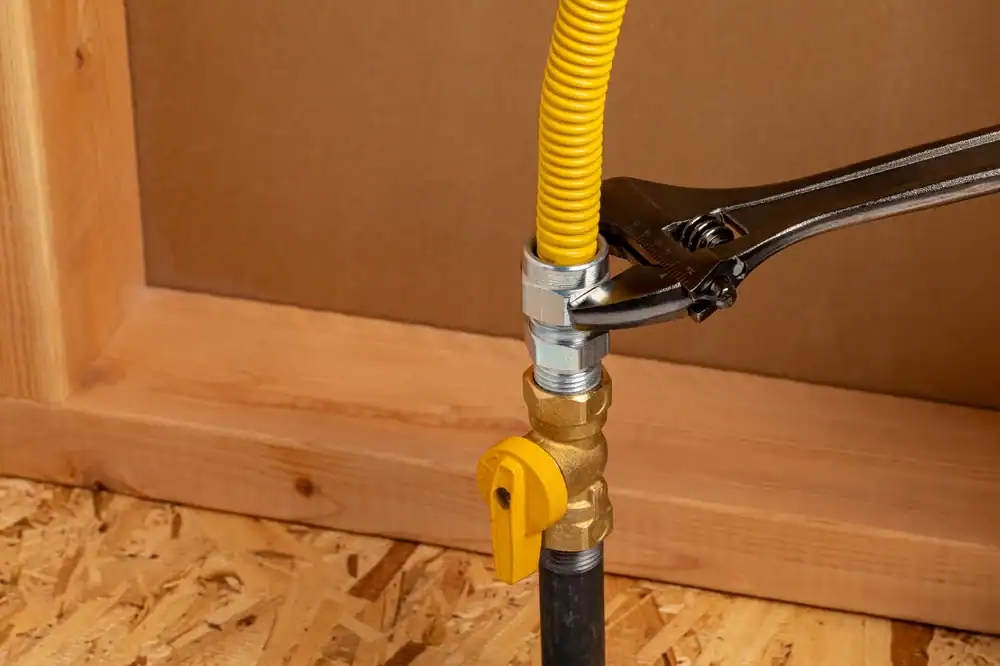
The installation itself follows: new pipe run or upsized line as needed, dedicated shutoff valve at the appliance, and pressure testing at 1.5 times working pressure before anything is activated. If the job involves new service capacity, Con Edison coordination happens in parallel. When it’s done, you receive written documentation of the safety test results and permit records — not just a verbal confirmation that everything checked out.

Ready to get started?
Gas line installation covers a wider range of situations than most people realize going in. On the residential side, the most common calls in Rosebank involve new appliance hookups — a professional-grade range going into a renovated kitchen, a gas dryer being added to a home that’s always run electric, or a tankless water heater replacing an older tank unit. Each of those requires a proper BTU load calculation to confirm the existing line is adequate, and in many of Rosebank’s older homes along Bay Street and the blocks off Hylan Boulevard, upsizing is part of the job.
For two-family homes and small multifamily buildings — which make up a meaningful share of Rosebank’s housing stock — Local Law 152 compliance is a recurring obligation. Buildings in Staten Island Community District 1 are subject to mandatory gas piping inspections every four years, and non-compliance carries penalties up to $10,000. We handle the full cycle: the LMP-conducted inspection, any repairs needed to bring the system into compliance, and GPS-2 certification filing with the NYC DOB. One contractor, one process, no coordination gap between the inspector and the repair side.
Pricing for single appliance hookups typically runs $500 to $2,000. Whole-home gas line installations range from $1,300 to $3,500. Linear footage is priced at $12 to $25 per foot depending on pipe type and complexity. Written estimates are provided before any work begins.

Not always, but it needs to be evaluated before assuming it’s fine. The gas piping in many Rosebank homes was installed decades ago and sized for appliances that are long gone. When you’re adding something like a high-BTU professional range or a tankless water heater — which can demand 150,000 BTU or more — the existing line from your meter may be too narrow to deliver adequate pressure to all connected appliances simultaneously.
The only way to know for certain is a proper load calculation: total BTU demand of every appliance on the line, pipe diameter, pipe length, and the longest run to the farthest appliance. If the math works, the existing line stays. If it doesn’t, the line gets upsized before the new appliance is connected. Skipping this step and just hooking up the appliance is how you end up with a range that won’t reach full flame or a water heater that underperforms — and a code violation on top of it.
Yes — every gas line job in Rosebank requires a permit filed with the NYC Department of Buildings, regardless of how small the scope seems. There are no exceptions for minor work or appliance-only hookups. The permit gets filed through DOB NOW, the city’s all-digital portal. Paper submissions are no longer accepted.
We handle the permit filing as part of the job. You don’t need to create a DOB NOW account, track the application, or coordinate with the city yourself. The Licensed Master Plumber on our staff is the one legally authorized to file gas piping permits in NYC, and we manage that process from submission through approval. If the job involves new service capacity or a meter change, Con Edison authorization runs in parallel — we handle that coordination too.
Local Law 152 requires gas piping inspections every four years for virtually all NYC buildings except one- and two-family homes. If you own a multifamily building, a mixed-use property, or a commercial building in Rosebank, it applies to you. Rosebank falls within Staten Island Community District 1, and all three Staten Island community districts fall within the LL152 inspection schedule.
The inspection must be conducted by a Licensed Master Plumber or a Registered Journeyman Plumber under direct LMP supervision. After the inspection, the LMP files a GPS-2 certification with the NYC DOB through DOB NOW confirming the building’s gas piping system is compliant. If violations are found during the inspection, they need to be repaired before that certification can be filed. Missing the deadline or failing to file carries penalties up to $10,000. We handle the full cycle — inspection, any necessary repairs, and GPS-2 filing — so building owners in Rosebank aren’t left managing multiple contractors to close out a single compliance cycle.
For a single appliance hookup where the existing line is adequate and no significant re-routing is needed, the work typically takes a few hours and gas service is restored the same day once the pressure test is complete. More involved jobs — upsizing a line, running pipe to a new location in the home, or coordinating a capacity increase with Con Edison — can take longer, and the full sequence from permit approval to gas activation may span a few days.
The part that catches people off guard is the Con Edison step. When new service capacity is involved, the utility company needs to inspect and authorize before the meter is reactivated — and that timeline is partly outside any contractor’s control. The way to minimize disruption is to start the process before you’re in a hard deadline situation. If you’re planning a kitchen renovation in Rosebank and the new range is arriving on a specific date, getting the permit filed and the line work scheduled well ahead of delivery is what keeps the project on track.
The cost depends on what the job actually involves. A single appliance hookup — connecting a new range or dryer to an existing, adequately sized gas line — typically runs between $500 and $2,000. If the line needs to be upsized or extended, pricing is based on linear footage at $12 to $25 per foot, depending on pipe type and how complex the run is. Whole-home gas line installations, which come up more often in Rosebank’s older properties undergoing full renovations, range from $1,300 to $3,500.
What affects the price on the higher end is usually the condition of the existing infrastructure. In a home that’s been standing since the 1930s, the pipe run from the meter to the kitchen may need to be fully replaced rather than extended. That’s not always predictable from a phone conversation — it becomes clear during the on-site assessment. We provide written, itemized estimates before any work begins, so you know exactly what you’re looking at before anyone picks up a tool.
It can, and it’s one of the less obvious risks of owning an older home in this part of Staten Island. Rosebank sits along the Upper New York Bay, directly below the Verrazzano-Narrows Bridge approach, and the ambient humidity and salt air that come with that waterfront location accelerate atmospheric corrosion in metal gas piping — particularly in older black iron pipe that’s been in place for decades. This is actually one of the four specific items that a Licensed Master Plumber is required to check during a Local Law 152 gas piping inspection: visible atmospheric corrosion on exposed piping.
The problem is that corrosion doesn’t always announce itself with a smell or a visible leak. It can thin pipe walls gradually until a fitting fails or a pinhole develops. For homeowners on the blocks closest to Bay Street or in lower-lying areas near the waterfront, having the exposed gas piping in your home assessed — especially if it’s original to the building — is a reasonable precaution. We use electronic gas detection equipment during every installation and can identify deterioration that a visual check alone would miss.
Other Services we provide in Rosebank