


When a gas system is aging, the problem rarely announces itself with a dramatic smell and a hissing sound. More often, it’s subtle — an intermittent odor near the stove, a boiler connection that’s been slowly deteriorating since the mid-1990s, a flexible connector behind the dryer that nobody has looked at in thirty years. By the time you notice something, the issue has usually been developing for a while.
Rossville’s housing stock was built out almost entirely in the decades following the West Shore Expressway’s completion — which means the neighborhood’s gas infrastructure is concentrated in a single aging cohort. Your neighbor two blocks over likely has pipes and connectors from the same era as yours. That’s not a coincidence; it’s a pattern, and it’s worth paying attention to.
For homes along the western edge of Rossville — closer to the Arthur Kill tidal flats and the Fresh Kills marshlands — there’s an added layer of risk. Salt air and soil moisture accelerate corrosion on buried gas lines and exterior meter connections in ways that simply don’t apply to inland neighborhoods. A professional gas leak detection visit gives you a clear picture of what’s actually going on, so you’re not guessing.
We’ve been operating in the New York City market since 1983. That’s not a marketing line — it means we were already licensed and working when most of Rossville’s current homes were being built. Bobby and Rob, the father-and-son team behind RB Mechanical Plumbing and Heating, have spent decades navigating NYC’s gas codes, DOB requirements, and utility protocols. When we show up to a home in Rossville, we’re not figuring things out on the fly.
Every technician we send to a Rossville home is a NYC Licensed Master Plumber — drug-tested and vetted before they ever knock on a door. That matters in a neighborhood of established homeowners who are personally responsible for their property and who care about who they’re letting inside. Staten Island is an explicit part of our service area, not an afterthought, and the 30 to 60 minute emergency response commitment applies here the same as it does anywhere else we serve.
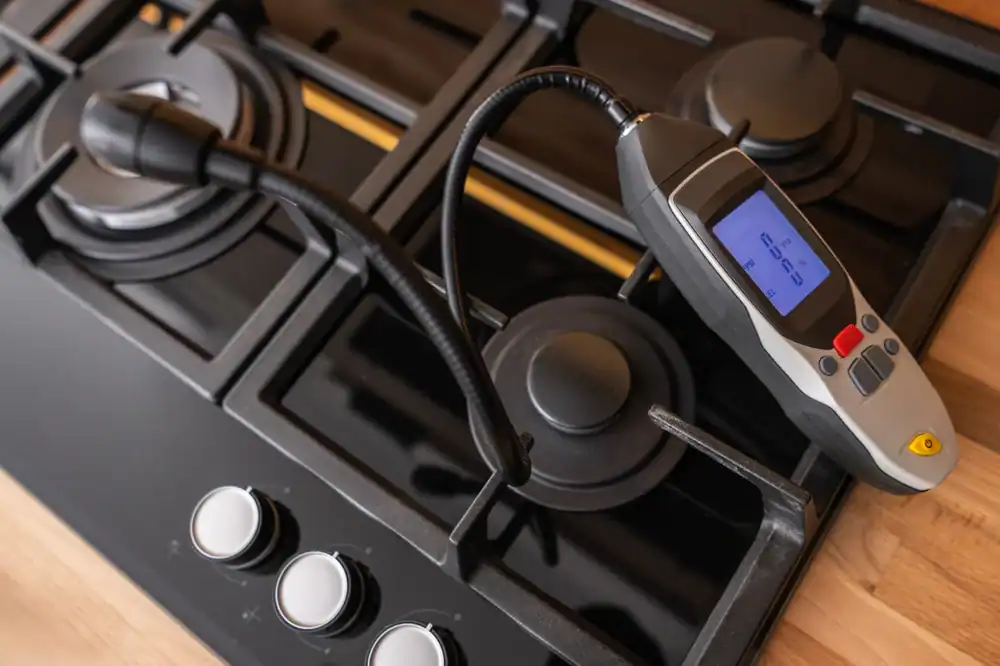
The visit starts with a conversation. Before any equipment comes out, our technician asks about what you noticed — when you smelled something, where it seemed to be coming from, whether it was constant or intermittent, and what appliances are on that gas line. That context shapes where the inspection focuses first.
From there, we use professional-grade gas detectors to sweep the accessible gas lines, connections, and appliances throughout your home. These aren’t consumer-grade detectors from a hardware store — they’re calibrated instruments that can identify gas concentrations well below what the human nose detects. For anything behind walls, under floors, or in areas with limited visibility, we bring in infrared cameras. This matters especially in Rossville homes built in the 1970s and 1980s, where original flexible connectors and valve assemblies may be concealed behind cabinetry or in utility closets that haven’t been opened in years.
If we find a leak, you get a straight explanation of what was found, where it is, and what needs to happen. Pricing is stated before any repair work begins — no surprises on the invoice. If the issue requires a DOB permit or filing, we handle that too. And because your gas utility in Rossville is National Grid — not Con Edison — we know exactly how to coordinate with them if the issue involves the service line or requires utility notification before restoration.

Ready to get started?
A gas leak detection visit from us isn’t just a pass with a detector and a handshake. We cover the full picture — appliance connections, exposed gas piping, flexible connectors, shutoff valves, and any accessible sections of the gas line running through your home. If something is found, the repair happens under the same roof of accountability: licensed, permitted, and documented.
For Rossville homeowners, one thing worth understanding is the National Grid distinction. A lot of Staten Island residents — especially those who relocated from Manhattan or Brooklyn — assume Con Edison handles their gas. It doesn’t. National Grid is the gas utility for Staten Island, and their responsibility ends at your property line. If National Grid responds to a gas smell and determines the issue is on the building side, they leave. At that point, you need a Licensed Master Plumber to diagnose and fix what’s inside your home. That’s exactly the gap we fill.
For any multi-unit residential buildings or condo properties in Rossville, Local Law 152 requires periodic gas piping inspections by a Licensed Master Plumber — with a $5,000 civil penalty for non-compliance. We handle the inspection, any necessary repairs, the DOB filing, and the certification. If gas leak damage has occurred, we also work directly with insurance companies, which takes a significant administrative burden off the property owner during an already stressful situation.

This is one of the most common points of confusion for Staten Island homeowners, and it’s worth getting straight before an emergency happens. National Grid is responsible for the gas distribution system — the mains running under the street and the service line up to your property line. When you call them about a gas smell, they’ll respond and check the utility-side infrastructure. If they find an issue on their end, they handle it. But if the problem is on the building side — inside your home, at an appliance connection, or in the internal gas piping — their job is done the moment they clear the meter. They cannot legally perform building-side gas repairs in New York City.
That’s where a NYC Licensed Master Plumber comes in. After National Grid leaves, a licensed plumber is the only person authorized to diagnose and repair internal gas piping in your home. We know exactly where that handoff point is and can step in immediately to handle whatever National Grid couldn’t touch. If you’ve already had National Grid out and they told you the issue is on your side, that’s your cue to call us — not wait and see.
Honestly, you often don’t — not without a professional inspection. The gas systems installed in Rossville during the 1970s, 1980s, and 1990s are now well into the age range where wear becomes a real factor. Flexible gas connectors behind stoves and dryers have a typical service life of 20 to 30 years. Boiler connections and shutoff valves from that era are approaching or past the 40-year mark. None of these components fail on a schedule, but they do degrade — and the degradation is usually invisible until something goes wrong.
A professional gas leak detection visit uses calibrated equipment to check for leaks at every connection point, valve, and appliance throughout your home. If everything is holding, you leave with documented confirmation and peace of mind. If something is showing early signs of wear or a slow leak, you find out before it becomes an emergency. For a neighborhood where the housing stock was built in a concentrated window of time, this kind of proactive check is just responsible homeownership.
Leave the house immediately — don’t stop to open windows, turn lights on or off, or grab your phone from a charger. Gas can accumulate quickly in enclosed spaces, and any electrical spark is a risk. Once you’re outside and away from the building, call 911 first. Then call National Grid’s Staten Island emergency line at 718-643-4050. Do not re-enter the building until the utility has cleared it.
Once National Grid has responded and determined the issue is on the building side — or if you’ve been cleared to re-enter but still have concerns — that’s when you call a licensed plumber. One important thing to keep in mind: if the smell came and went, that doesn’t mean the problem resolved itself. Odor fade is a documented phenomenon where the mercaptan odorant added to natural gas dissipates over time, making a real leak temporarily undetectable by smell alone. An intermittent gas odor still warrants a professional inspection, not a wait-and-see approach.
Local Law 152 applies to all NYC buildings except one- and two-family homes. If you own a single-family or two-family detached home in Rossville — which describes the majority of the neighborhood’s housing stock — you are exempt from the mandatory inspection requirement. However, if you own or manage a multi-unit residential building, a condo complex, or any commercial property in the area, Local Law 152 applies and you are required to have exposed gas piping inspected by a Licensed Master Plumber on a rotating four-year cycle tied to your community district.
The penalty for missing the inspection deadline is a $5,000 civil penalty, and the building owner is responsible for submitting the Gas Piping System Periodic Inspection Certification to the NYC DOB within 60 days of the inspection. We handle the full compliance workflow — the inspection itself, any required repairs, the DOB filing, and the final certification — so building owners and property managers in Rossville aren’t left coordinating multiple vendors or guessing at the paperwork.
No — and this is one of the most important things to understand about natural gas safety. The smell associated with natural gas comes from mercaptan, an odorant that’s added to the gas specifically so you can detect it. But mercaptan can dissipate through physical and chemical processes — a phenomenon called odor fade — which means the absence of smell does not mean the absence of a leak. Gas can still be accumulating in an enclosed space even after the odor has faded.
This matters especially in older Rossville homes where gas is moving through aging connections that may have small, slow leaks rather than sudden failures. A slow leak in a basement utility room or behind a kitchen cabinet may produce an intermittent smell that comes and goes depending on ventilation and air movement. If you’ve noticed a gas smell even once — and especially if it’s happened more than once — a professional inspection with calibrated detection equipment is the only way to confirm whether the system is actually clear. Don’t let a disappearing smell convince you the problem resolved itself.
Consumer gas detectors serve a real purpose — they alert you when gas concentrations in a room reach a level that’s potentially dangerous. But that’s essentially where their usefulness ends. They can tell you gas is present; they cannot tell you where it’s coming from, how severe the leak is, whether it’s behind a wall or under a floor, or whether the source is a slow connection leak versus a failed appliance valve. And they produce no documentation — which matters if you need to file an insurance claim or satisfy a DOB inspection requirement.
Professional gas leak detection uses calibrated instruments that can identify gas at concentrations far below what a consumer detector registers, and can pinpoint the source rather than just flag the presence. Infrared cameras add the ability to find leaks in concealed spaces — behind cabinetry, in crawl spaces, or along buried sections of line — that no handheld detector could locate. For a Rossville homeowner dealing with a 30- or 40-year-old gas system, that level of precision is what actually tells you whether you have a problem and exactly where it is. A consumer detector is a warning system. A professional inspection is a diagnosis.
Other Services we provide in Rossville