

There’s a specific kind of stress that comes with owning or renting in a Stapleton building that was built before World War II. You know the bones are old. You know the systems haven’t all been updated. And when you catch a faint smell near the stove or in the basement, you don’t always know if you’re overreacting or if something is genuinely wrong. That uncertainty is exhausting — and it’s exactly the kind of thing a professional gas leak inspection is designed to eliminate.
Approximately 70% of Stapleton’s buildings were constructed between 1901 and 1945, with another 12% built before 1900. That means the gas piping in most homes and apartment buildings on this part of the North Shore has been through a century or more of thermal cycling, corrosion, and wear. Add the waterfront humidity and salt air that come with living along Upper New York Bay, and you have conditions that accelerate pipe deterioration faster than you’d see in a drier, inland neighborhood. Getting your gas lines inspected isn’t a precaution for people who worry too much — it’s a reasonable response to the actual age and condition of the infrastructure you’re living with.
Once the inspection is done and any issues are addressed, the outcome is straightforward: you know what you have. If there’s a problem, it gets fixed. If there isn’t, you have documented confirmation that your gas system is sound. For landlords managing small multi-family buildings along Van Duzer Street or Bay Street, that documentation also satisfies Local Law 152 compliance requirements — which carry a $5,000 civil penalty for non-compliance. For homeowners in Stapleton Heights, it’s the kind of due diligence that protects a significant investment.
We’ve been doing this since 1983. That’s over 40 years of working on exactly the kind of pre-war, multi-family, aging-infrastructure buildings that define Stapleton and the North Shore of Staten Island. Bobby and Rob — the father-and-son team behind RB Mechanical Plumbing and Heating — aren’t dispatchers sending out whoever’s available. We’re licensed NYC Master Plumbers for both Manhattan and Staten Island, which means we’re credentialed specifically for the borough where your building sits.
Every technician who shows up is drug-tested and vetted. That matters when someone needs access to your apartment, your basement, or your building’s utility spaces. It matters even more in a neighborhood like Stapleton, where many properties are multi-unit and a single visit might require access to shared common areas or multiple floors.
We also handle everything on the compliance side — Local Law 152 inspections, DOB filings, violation removal, permit coordination. You don’t have to manage three different vendors to get one problem resolved. Pricing is stated upfront before any work begins, and there are no hidden fees.
When you call us about a suspected gas leak in Stapleton, the first thing that happens is a straightforward conversation about what you’re experiencing — where the smell is coming from, how often it’s noticeable, whether it’s near an appliance or coming from a wall or floor. If it’s an active emergency, our response time is 30 to 60 minutes. If National Grid has already been out and cleared the distribution side, that’s actually useful information — it tells us that the issue, if there is one, is on the building side of the meter, which is exactly where our work begins.
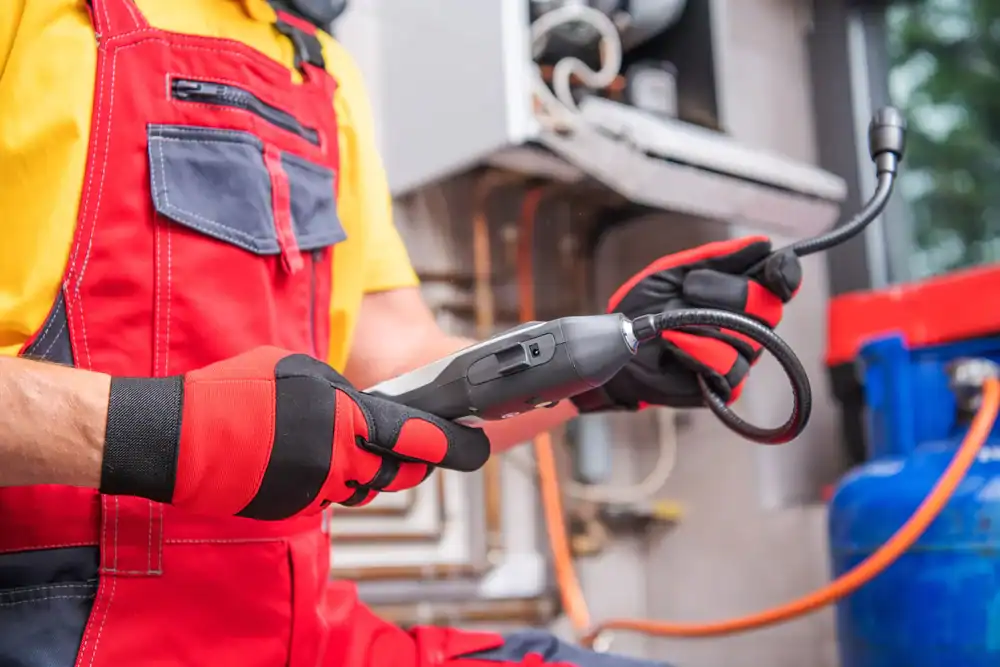
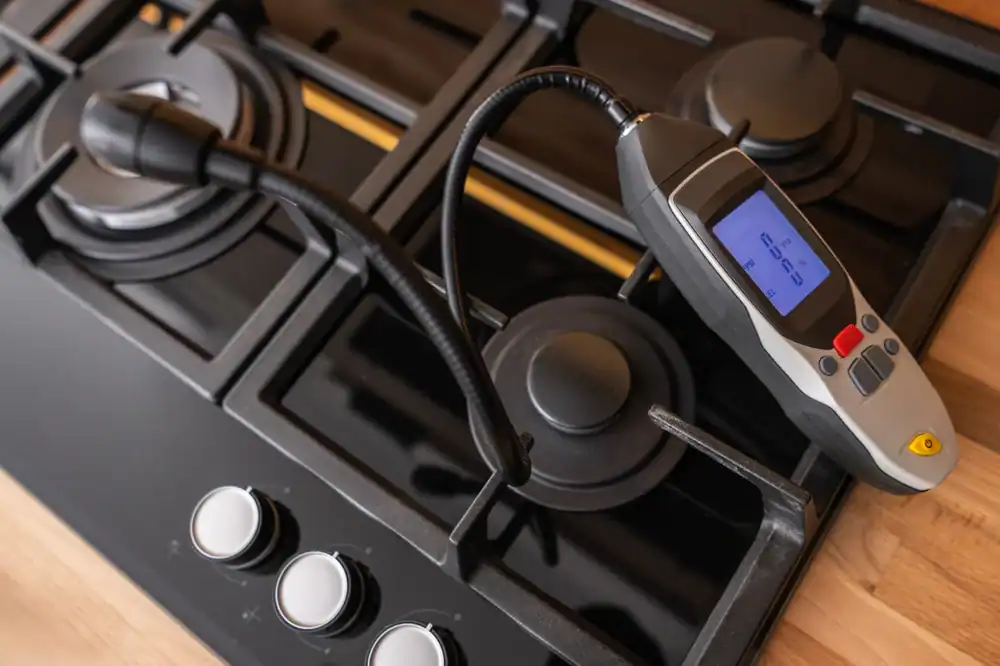
On-site, we use professional-grade gas detectors and infrared cameras. This matters in Stapleton specifically because so many buildings have gas lines running inside walls, under original flooring, and through basement utility chases that haven’t been accessed in decades. A consumer detector from a hardware store can tell you gas is present in a room. It cannot tell you where it’s coming from or how serious it is. Infrared cameras can locate sources hidden behind walls without tearing anything open unnecessarily.
If a leak is found, you’ll know exactly what it is, where it is, and what the repair involves — before any work starts. If your building requires a Local Law 152 certification, we handle the inspection, any required repairs, and the DOB filing as one complete service. Once the work is complete, you receive documentation confirming the system has been inspected and cleared. For Stapleton building owners dealing with the compliance cycle for Staten Island Community District 1, that paperwork is what closes the loop.

Ready to get started?
Gas leak detection in Stapleton isn’t a one-size-fits-all job. The neighborhood’s building stock — heavily pre-war, heavily multi-family, with a high concentration of 2-, 3-, and 4-unit apartment buildings — creates a specific set of challenges that require more than a standard walkthrough. Our approach accounts for the realities of working in older Stapleton buildings: aging joints and fittings, original steel piping, gas lines that run through spaces that haven’t been opened in 50 years, and the accelerated corrosion that comes with the waterfront environment along Upper New York Bay.
We cover the full scope of what a Stapleton property owner or renter might need. That includes locating and repairing active gas leaks, inspecting exposed gas piping as required under Local Law 152, installing natural gas detectors to meet the Local Law 157 deadline of January 1, 2027, coordinating with National Grid when a utility shutoff or lockoff is required, and handling DOB violation removal and permit filing when the work triggers a compliance requirement. If your gas was shut off — by National Grid, by the DOB, or following an FDNY inspection — we can work through the restoration process from the building side.
It’s also worth knowing that if a gas leak causes property damage, we work directly with insurance companies to help coordinate the claim. That’s not something most plumbing companies offer, and in a neighborhood where many property owners are managing older buildings with aging systems, it’s a practical benefit that can make a real difference when something goes wrong.

This is one of the most common points of confusion for Stapleton residents, and it’s worth being clear about. National Grid is the gas utility for all of Staten Island — they handle the distribution infrastructure, meaning the gas mains and the lines that run up to your building’s meter. If you smell gas and call National Grid at 1-800-892-2345, they will respond and check the utility side. If they find an issue with the main or the service line up to your meter, that’s their responsibility to fix.
But National Grid’s authority stops at the meter. Everything inside your Stapleton building — the gas piping from the meter to your appliances, the boiler connections, the stove lines, the risers running through the floors — is the building owner’s responsibility. Only a NYC Licensed Master Plumber can legally inspect, diagnose, and repair that building-side piping. So if National Grid comes out, clears the distribution side, and leaves, that doesn’t mean the inside of your building has been checked. If you’re still smelling gas after they leave, or if you want confirmation that your building’s internal gas system is sound, that’s when you call us.
The short answer is no, and this is a genuinely important point. Natural gas has a chemical odorant called mercaptan added to it so people can detect it by smell. But mercaptan can dissipate over time through a process called odor fade — meaning the smell can decrease or disappear even if gas is still present or still leaking slowly. The absence of the smell is not confirmation that the leak is gone.
This is especially relevant in older Stapleton buildings, where gas can accumulate in enclosed spaces — basement utility rooms, wall cavities, crawl spaces — without the concentration reaching a level that triggers the human nose in the living areas above. If you smelled something, even briefly or intermittently, that’s enough reason to have it checked. A professional gas detector doesn’t rely on smell — it measures actual gas concentration in parts per million, which gives you a real answer rather than a guess based on what your nose is or isn’t picking up at a given moment.
Local Law 152 applies to all NYC buildings except one- and two-family homes. If you own or manage a three-unit or larger apartment building in Stapleton — and a significant portion of the neighborhood’s housing stock falls into that category — your building is in the compliance pool. The law requires exposed gas piping to be inspected by a Licensed Master Plumber or a Qualified Gas Operator under LMP supervision once every four years, on a schedule tied to your community district.
Stapleton falls within Staten Island Community District 1. If you’re unsure where your building falls in the current inspection cycle, the NYC Department of Buildings maintains the schedule. Missing the deadline carries a $5,000 civil penalty, and the building owner is responsible for submitting the Gas Piping System Periodic Inspection Certification to the DOB within 60 days of the inspection. We’re licensed to perform the inspection, make any required repairs, and handle the DOB filing — so you’re not coordinating multiple vendors to close out a single compliance requirement.
Professional gas leak detection uses equipment that goes well beyond what’s available at a hardware store. The two primary tools are professional-grade gas detectors and infrared cameras. The gas detectors measure actual gas concentration in the air — they can identify the presence of natural gas at levels far below what a human nose would register, and they can be used to trace a leak to its source rather than just confirming gas is somewhere in the room.
Infrared cameras are particularly valuable in Stapleton’s older building stock. When gas piping runs inside walls, under original flooring, or through basement chases that haven’t been accessed in decades, you can’t always get to the source directly. Infrared imaging allows us to detect temperature anomalies and trace gas movement through enclosed spaces without unnecessary demolition. In a pre-war Stapleton building where the original plaster walls and hardwood floors are still intact, this matters — you want the leak found and fixed without tearing apart the structure unnecessarily. That combination of detection tools is what makes a professional inspection meaningfully different from a consumer-grade check.
It’s a reasonable thing to think about. The New Stapleton Waterfront development is a 35-acre active construction project currently transforming the former Homeport naval base site into over 2,100 residential units, with extensive excavation, road reconstruction, and underground infrastructure work underway. Active construction of that scale creates documented risk to underground gas infrastructure — external damage during excavation is one of the leading causes of gas distribution incidents according to federal pipeline safety data.
If your building is in close proximity to the active construction zone along the Stapleton waterfront, having your gas system inspected is a reasonable precaution. Ground disturbance and vibration from nearby excavation can affect buried service lines and connections, particularly in a neighborhood where much of the underground infrastructure is already aging. A professional inspection gives you a clear picture of whether anything has been affected and whether any connections or fittings show signs of stress or movement. It also gives you documentation, which matters if something does surface later and you need to establish the condition of your system at a specific point in time.
The core process is the same — professional-grade detectors, infrared cameras, a thorough inspection of the accessible gas piping — but the scope and focus differ depending on the property type. In a single-family Victorian home in Stapleton Heights, the inspection typically centers on the gas lines serving the home’s appliances: the boiler, the stove, the water heater, and any other gas-connected equipment. These homes are often 100 or more years old, and the gas piping may follow routes that reflect the original layout of the house rather than any modern standard. Older flexible connectors behind appliances are a common source of slow leaks in homes of this age.
In a multi-family building — the 2-, 3-, and 4-unit apartment buildings that make up a large share of Stapleton’s housing stock — the inspection covers the full gas distribution system within the building, including the risers, the branch lines to each unit, and the connections to appliances in each apartment. Multi-family buildings also carry the Local Law 152 compliance obligation, so the inspection can serve double duty: identifying any safety concerns and generating the documentation required for your DOB filing. Pricing for each job is stated upfront before work begins, based on the actual scope of what needs to be inspected and addressed.
Other Services we provide in Stapleton