

The moment a gas leak is properly located and repaired, a few things shift at once. The immediate anxiety — that low-grade worry every time you walk into the kitchen or head down to the boiler — goes away. Your home is safe again. And if National Grid had shut off your service, you’re back on the path to getting heat and hot water restored.
For Staten Island homeowners specifically, that last part matters more than people realize. National Grid won’t reconnect your gas until a Licensed Master Plumber has located the problem, made the repair, and cleared it for service restoration. A family on Kissel Avenue learned this the hard way — running eleven space heaters through a winter after a minor dryer-line leak triggered a full shutoff. Getting the right plumber involved early is what keeps that scenario from happening to you.
There’s also the longer-term picture. Staten Island’s gas infrastructure is older than most homeowners know. Researchers from the Environmental Defense Fund mapped methane leaks across the borough and found roughly one underground gas leak per mile of road driven — and noted the pipe systems feeding these neighborhoods are over fifty years old. The utility-side mains are National Grid’s responsibility, but the building-side piping connecting your home to those mains is yours. A professional inspection gives you a clear picture of where things stand, so you’re not caught off guard.
We’ve been operating on Staten Island since 1983. That’s not a marketing claim — it’s a physical address on the South Shore, and we’ve been working in homes across this borough for over four decades, from the older rowhouses in Tompkinsville and Stapleton to the single-family neighborhoods stretching down Hylan Boulevard toward Tottenville.
Bobby and Rob — and now Rob Jr. — are the people who show up. Not a dispatcher, not a rotating crew of subcontractors. Every technician on our team is a NYC Licensed Master Plumber, which is the credential National Grid requires before they’ll restore gas service to your home. We’re also drug-tested and vetted, which matters when you’re letting someone into your house.
Customers across Staten Island have called us for winter boiler emergencies, gas range installations, and water heater replacements — and the reviews consistently mention the same things: we showed up when we said we would, we explained what was happening, and the final bill matched the quote.
When you call us, the first thing that happens is a real conversation — not a form submission that goes into a queue. You describe what you’re noticing: a smell that comes and goes, a higher-than-usual National Grid bill, a hissing sound near the stove or boiler. Based on that, we give you a clear sense of urgency and a transparent price before anyone drives out.
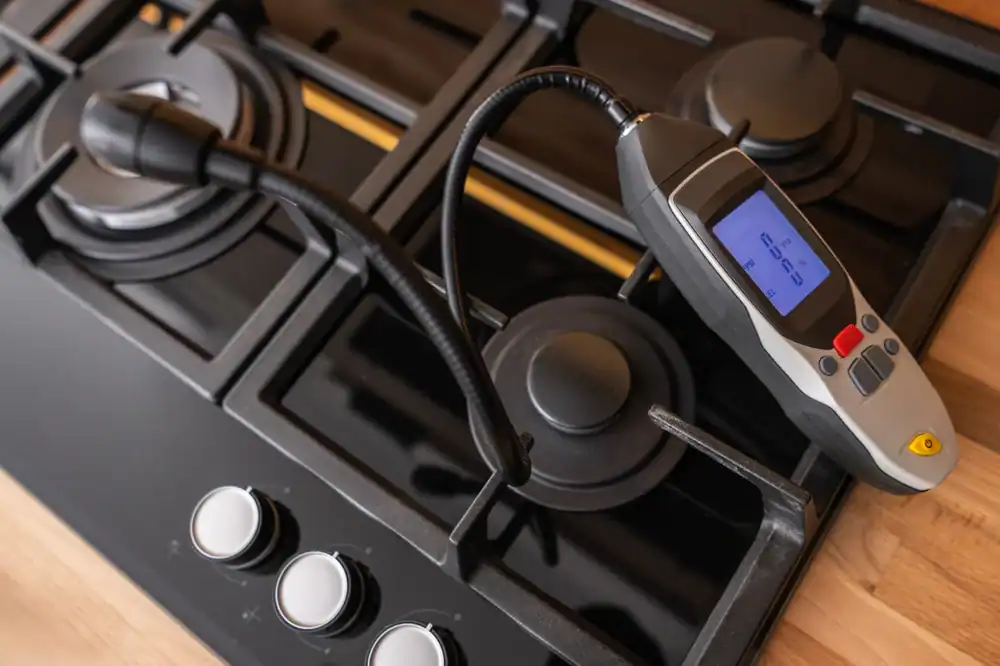
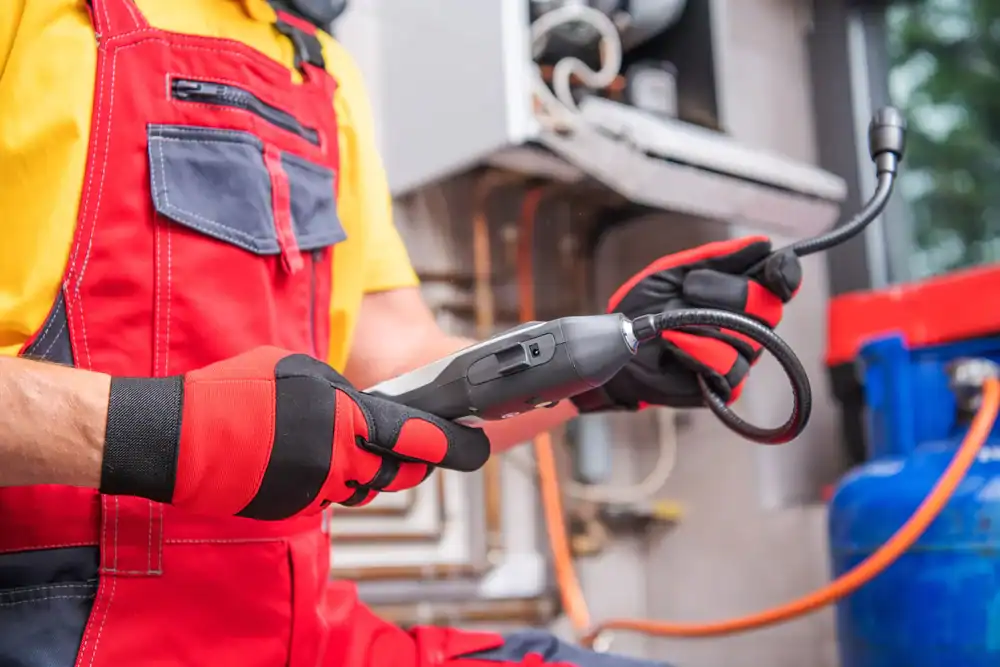
On-site, our technician uses professional-grade gas detectors and infrared cameras to work through your gas system methodically. This is not a sniff test. The infrared camera is particularly useful in older Staten Island homes where piping runs behind walls, through crawl spaces, or in basement utility areas that haven’t been touched in decades. Our goal is to find the source — not just confirm that something is present.
If a leak is found, you get a straight explanation of what it is, where it is, and what it takes to fix it. We handle repairs with the same licensed team, same visit when possible. If National Grid needs to be involved in restoring service afterward, we handle that coordination too — including any required documentation or permit filings with the NYC DOB. You don’t have to navigate that process alone.

Ready to get started?
Our gas leak detection service covers the full scope of your building-side gas system — from the meter into your home, through every line feeding your boiler, water heater, stove, and dryer connection. On Staten Island, where single-family homes make up the majority of the housing stock and most residents have never had a formal gas inspection, that scope matters. There’s no building manager handling this for you. It falls to you, and it helps to know exactly what we’re checking.
Our detection visit includes a thorough inspection of exposed and accessible gas piping, appliance connections, shutoff valves, and flexible connectors — the kind behind ranges and dryers that age quietly and fail without warning. If your home was rebuilt or significantly repaired after Hurricane Sandy, those post-reconstruction gas connections are worth a specific look. A lot of work was done quickly in 2012 and 2013 across the East Shore neighborhoods, and those repairs are now over a decade old.
For buildings that fall under Local Law 152 — which applies to multi-family and commercial buildings in Staten Island’s three community board districts, with CB1 on the North Shore due in the 2024 cycle and CB2 and CB3 due in the 2025 cycle — we handle the full compliance process. That means the inspection, any required repairs, the DOB filing, and the certification. One call, no runaround, and no $5,000 non-compliance penalty. We provide pricing upfront before any work begins — no hidden fees added after the fact.

If you smell gas — even faintly, even if it comes and goes — leave the building immediately. Don’t turn lights on or off, don’t use your phone inside, and don’t try to locate the source yourself. Once you’re outside and away from the building, call National Grid’s gas emergency line at 1-800-892-2345. They’ll send someone to assess the utility side of the situation.
Here’s what a lot of Staten Island homeowners don’t know: National Grid handles the gas mains and the service line up to your meter. They do not repair the piping inside your home. Once they’ve confirmed the utility side is safe — or shut off service at the meter — you need a Licensed Master Plumber to handle everything from that point forward. That’s where we come in. We can locate the source inside your home, make the repair, and coordinate with National Grid to get your service restored.
Yes, and this is one of the most common points of confusion for homeowners across Staten Island. National Grid inspects and maintains the distribution system — the mains running under your streets and the service line coming into your property. When they clear a call, they’re saying the utility-side infrastructure looks okay. They are not inspecting the gas piping inside your home.
If you still smell something, or if you had a smell that went away, that doesn’t mean the problem is gone. The odorant added to natural gas — called mercaptan — can dissipate over time through a process called odor fade. The absence of a smell is not a clearance. A Licensed Master Plumber using professional-grade gas detectors and infrared cameras can check the building-side piping that National Grid never touches. Those are two completely different systems, and both need to be clear before your home is actually safe.
Local Law 152 requires gas piping inspections for all NYC buildings except one- and two-family homes. If you own a multi-family building, a mixed-use property, or a commercial building on Staten Island, you are likely subject to the law. The inspection must be performed by a Licensed Master Plumber, and you must file the certification with the NYC DOB within 60 days of the inspection. Non-compliance carries a $5,000 civil penalty.
Staten Island has three community board districts. CB1, which covers the North Shore — neighborhoods like St. George, Stapleton, Tompkinsville, and Port Richmond — was due for inspection in the 2024 cycle. CB2, covering the mid-island, and CB3, covering the South Shore from Great Kills down to Tottenville, were both due in the 2025 cycle. If you haven’t completed your inspection and you’re in one of those districts, you’re either at or past your deadline. We’re certified to perform the inspection and handle any required repairs — so you’re not juggling multiple contractors to get into compliance.
Honestly, you can’t make that call on your own — and that’s not a knock on your judgment, it’s just the reality of how gas leaks work. A slow leak behind a wall or under a floor can read as minor for months before it becomes dangerous. The gas accumulates in enclosed spaces, and by the time it’s detectable by smell alone, the concentration may already be significant.
What determines severity is the location, the concentration, and the source — and those require professional equipment to assess accurately. Consumer-grade detectors from a hardware store will alert you to the presence of gas, but they can’t pinpoint the source, measure concentration levels with precision, or produce any documentation you’d need for insurance or compliance purposes. A professional visit with calibrated gas detectors and infrared imaging gives you an actual answer, not a guess. In a borough where the underlying gas infrastructure is over fifty years old and building-side piping in older North Shore homes regularly predates the 1970s, “probably fine” isn’t a useful standard.
This is where a lot of Staten Island homeowners get stuck, especially in the middle of winter. National Grid will not restore gas service to your home until the issue that triggered the shutoff has been resolved and cleared by a Licensed Master Plumber. They need documentation that the building-side repair has been made before they’ll reconnect.
The process works like this: a Licensed Master Plumber locates and repairs the leak, then coordinates directly with National Grid to schedule a reconnection inspection. Depending on the nature of the repair, there may also be permit filings required with the NYC DOB. We handle all of that — the repair, the paperwork, and the National Grid coordination. If you’re dealing with a shutoff in January or February, the goal is to get your heat and hot water back as fast as possible, and that means having one team that can do everything without handing you off to another contractor mid-process.
We don’t publish a flat rate for gas leak detection because the scope of the visit genuinely varies — the size of your home, the complexity of your gas system, and what’s found during the inspection all affect the work involved. What we commit to is giving you a transparent price before any work begins. No hidden fees, no line items that appear after the job is done.
What’s worth understanding is that the cost of a professional detection visit is a fraction of what a gas shutoff costs you in disruption — especially on Staten Island in winter, where your home’s heat depends entirely on your gas system. The family that ended up running eleven space heaters after a National Grid shutoff wasn’t dealing with a catastrophic failure. It was a minor, undetected leak behind a dryer that nobody had ever checked. Catching it early, with the right equipment, is almost always cheaper than dealing with the aftermath. If you want a clear number before committing, call and describe your situation — you’ll get a straight answer.
Other Services we provide in Staten Island