

When gas line work is done correctly, you stop thinking about it. The stove lights on the first turn. The water heater keeps up. The heat runs through winter without a hiccup. That’s the outcome — not a certificate on the wall, not a permit number emailed to you. Just a home that works the way it should.
Staten Island’s housing stock makes this more complicated than it sounds. A significant portion of the borough’s homes were built between the 1950s and 1980s, and the original gas lines running through those walls were sized for the appliances of that era. If you’re upgrading to a professional-grade range or a tankless water heater, that old half-inch line may not be able to keep up.
Getting the sizing right from the start means your new appliance performs the way it was designed to — not at 70% capacity because the line can’t deliver enough gas. We run the full BTU load calculation before any pipe gets installed, so you know exactly what you’re getting.
For homeowners along the East Shore and South Shore who rebuilt after Hurricane Sandy, there’s another layer. Homes in FEMA flood zones have specific requirements for where gas meters can be placed and how service lines are routed. Those post-Sandy systems are now over a decade old. If you’re renovating or adding an appliance, you need someone who understands what was installed and what the code requires — not someone figuring it out as they go.
We’ve been doing gas work in New York City since 1983. That’s over four decades of navigating DOB permits, utility authorizations, and the kind of building-specific complications that only show up when you’ve been doing this long enough to have seen them before.
Staten Island runs entirely on National Grid — not Con Edison. That distinction matters at every stage of a gas line project, from pulling the permit to getting the meter activated after the work is done. We’ve coordinated with National Grid on countless jobs across the borough, which means the authorization process doesn’t slow your project down.
Whether the job is in a pre-war North Shore building near St. George, a 1970s ranch in New Springville, or a rebuilt home in New Dorp, our approach is the same: assess what’s there, size the new line correctly, pull the permit, do the work, test it, and document everything. No shortcuts, no surprises on the invoice.
It starts with understanding what you actually need. Before any pipe gets run, we calculate the total BTU load of every connected appliance — your range, your water heater, your dryer, whatever else is on the line. That calculation determines the correct pipe diameter for the entire run. Skipping this step is how you end up with a professional range that flames out on high heat because the line was undersized from day one.
Once the scope is clear, we file the DOB permit through DOB NOW — the city’s required online portal for all gas piping work. On Staten Island, that also means coordinating with National Grid for any new service connection or capacity upgrade. Both need to happen before the work is done, and both need to be in order before gas service can be activated. National Grid will not turn on gas to work that hasn’t been properly authorized and permitted.
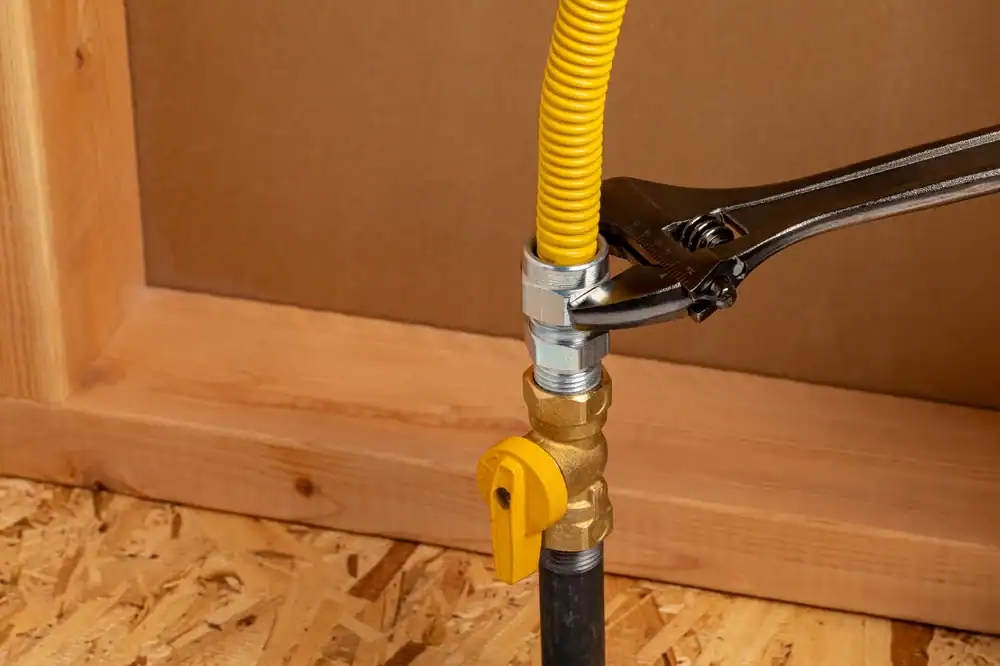
The installation itself uses black iron pipe or listed CSST systems depending on the run and the building. Every joint gets tested at 1.5 times working pressure before the gas goes live — that’s the NYC Fuel Gas Code standard, and it’s not optional. When the job is complete, you receive written documentation of the permit, the pressure test results, and the LMP certification. That paper trail matters for your insurance, for building records, and for anyone who buys your home down the road.

Ready to get started?
Gas line installation covers more ground than most people expect. A new gas line installation for a single appliance — a stove, a dryer, a water heater — typically runs between $500 and $2,000 depending on the length of the run and what’s involved in getting there. Whole-home gas piping, where multiple appliances or an entire system is being addressed, generally falls between $1,300 and $3,500. Linear footage is priced at $12 to $25 per foot based on complexity and pipe type. All of that gets laid out in a written estimate before anything starts.
Beyond new installs, we handle appliance gas hookups for ranges, dryers, water heaters, boilers, and generators. Gas line sizing is assessed as part of every job — if your existing line can’t handle the demand of your new appliance, that gets identified and corrected before the appliance gets connected, not after.
For property owners in Staten Island’s North Shore neighborhoods — Port Richmond, Stapleton, St. George — who have multifamily or mixed-use buildings, Local Law 152 compliance is part of the picture. LL152 requires gas piping inspections every four years for most NYC buildings outside of one- and two-family homes, with GPS-2 certification filed electronically through the DOB. Staten Island’s Community Districts 1 and 3 had a December 31, 2024 deadline; Community District 2 had a December 31, 2025 deadline. If your building missed that window, the penalties reach up to $10,000 — and we provide the full compliance package: inspection, repairs, and GPS-2 filing.
Yes — every gas line installation, repair, or alteration in Staten Island requires a permit filed with the NYC Department of Buildings. There are no exceptions for small jobs or appliance hookups. The permit has to be filed through DOB NOW, the city’s online portal, and it has to be filed by or under the direct supervision of a Licensed Master Plumber. A general contractor, handyman, or unlicensed plumber cannot legally file this permit or perform the work.
On Staten Island specifically, there’s an additional step that doesn’t apply in every borough: National Grid authorization. For any new gas service connection or service capacity upgrade, National Grid has to approve the work and conduct its own inspection before the meter gets activated. We handle both the DOB permit filing and the National Grid coordination as part of every installation — you don’t have to navigate either process yourself.
For a single-appliance hookup — connecting a new stove, dryer, or water heater to an existing gas supply — most Staten Island jobs fall between $500 and $2,000. That range reflects differences in run length, whether walls or floors need to be opened, and how much existing infrastructure can be used. Whole-home gas piping projects, where multiple appliances or an entire system is being addressed, typically run between $1,300 and $3,500. Linear footage is priced at $12 to $25 per foot depending on complexity and pipe type.
Those numbers don’t change dramatically based on which part of Staten Island you’re in, but the scope of work can. Older homes in Port Richmond or Tompkinsville on the North Shore may have original black iron pipe that needs to be assessed before new work connects to it. Homes rebuilt after Hurricane Sandy along the East Shore sometimes have non-standard meter placements tied to flood zone elevation requirements, which can affect how a new run gets routed. A written estimate before the job starts accounts for all of that — no surprises once work begins.
It can, and it’s worth understanding before any work starts. Homes rebuilt or elevated after Hurricane Sandy in FEMA AE and VE flood zones — particularly along Midland Beach, New Dorp, South Beach, and Oakwood — were required to have gas meters and service lines placed above the base flood elevation level. That’s a specific code requirement that goes beyond standard NYC Fuel Gas Code, and it affects where new lines can be routed and how they connect to the existing system.
Those post-Sandy installations are now over a decade old. If you’re renovating a kitchen, adding an appliance, or upgrading your water heater, the existing infrastructure needs to be assessed in the context of both the flood zone requirements and the current NYC Fuel Gas Code. A plumber who isn’t familiar with what post-Sandy rebuilds look like on the East Shore may not catch a compliance issue until it shows up during the National Grid inspection — which delays your project and costs more to fix. We’ve worked across Staten Island’s full range of building conditions, including flood zone properties, and assess the existing setup before any new work begins.
The short answer is: you need a Licensed Master Plumber to calculate it, because it’s not something you can eyeball. The calculation involves the total BTU demand of every appliance connected to the line, the diameter and length of the existing pipe, the gas pressure at the meter, and the material the pipe is made from. A standard half-inch line that’s been serving a basic range and a tank water heater for thirty years may be completely inadequate for a 48-inch professional range drawing 60,000 BTUs or a tankless water heater that demands 150,000 to 199,000 BTUs.
This comes up constantly in Staten Island’s Mid-Island and South Shore neighborhoods, where a lot of the housing stock was built in the 1960s through 1980s and the original gas lines were sized for the appliances of that era. Homeowners invest in a high-end range and then discover it won’t perform at full capacity because the line supplying it was never designed for that load. Getting the sizing assessed before the appliance is installed — not after — is the right sequence. We run the full BTU load calculation as part of every installation to make sure the line matches what the appliance actually needs.
Local Law 152 is a New York City law that requires gas piping inspections every four years for most buildings in the city. The inspection has to be performed by a Licensed Master Plumber, and the results — including any violations found and repaired — get filed with the DOB as a GPS-2 certification through DOB NOW. If a building misses its inspection deadline, the penalties can reach up to $10,000.
The law applies to virtually every NYC building except one- and two-family homes. That means three-family homes, small apartment buildings, mixed-use properties, and commercial buildings on Staten Island are all subject to it. Staten Island’s community districts are on a staggered schedule: Community Districts 1 and 3 (covering the North Shore and South Shore) had a December 31, 2024 deadline, and Community District 2 (Mid-Island) had a December 31, 2025 deadline. If your building missed either of those windows, you’re currently out of compliance and accumulating exposure to those penalties. We handle the full LL152 process — inspection, any required repairs, and GPS-2 filing — so property owners on Staten Island have a single point of contact for getting back into compliance.
A National Grid shutoff on Staten Island isn’t resolved with a single phone call. The restoration process depends on why the gas was shut off in the first place. If it was shut off due to a suspected leak, a failed inspection, or an LL152 violation, the underlying issue has to be identified, repaired, and certified by a Licensed Master Plumber before National Grid will restore service. That means an LMP has to assess the system, perform whatever repairs are needed, conduct a pressure test, and file the appropriate documentation with the DOB before the utility will schedule their own inspection and reactivate the meter.
The timeline for that process can range from a few days to a few weeks depending on the scope of the repairs and how quickly the permit and documentation can be filed. In winter, when a gas shutoff means no heat and no hot water, that timeline is not abstract — it’s a real disruption to your household. We offer 24/7 emergency response for exactly this situation. The faster the assessment starts, the faster the documentation gets filed, and the faster National Grid can get back out to restore your service. If your gas has been shut off, the first call you make should be to a Licensed Master Plumber who knows National Grid’s restoration process — not a general contractor who will have to figure it out as they go.
Other Services we provide in Staten Island