
The high-ranch houses and split-levels that define Willowbrook were built fast — mostly between the mid-1960s and early 1980s — to meet the demand that followed the bridge opening. The gas systems installed during that construction boom are still the ones running in most of these homes today.
Flexible connectors behind stoves degrade. Valve seals harden and crack. Galvanized fittings corrode slowly, silently, and without any smell until they don’t. A professional gas leak detection visit gives you a clear picture of what’s actually happening inside your gas system — not a guess based on whether you smell something.
We use professional-grade gas detectors and infrared cameras to find leaks that hide behind finished walls and in basement utility areas, the exact spots where aging infrastructure tends to fail first in post-war Willowbrook homes. For a homeowner in this area with a median home value well above $600,000, the stakes of missing a slow leak aren’t abstract. You’re protecting real equity, a home your family lives in, and a property you’ve spent years building.
Knowing the condition of your gas system isn’t paranoia — it’s the same logic that drives any responsible homeowner to stay ahead of what they can’t see.
We’ve been operating in New York City since 1983 — more than 40 years in the same market, longer than most Willowbrook residents have owned their homes. Bobby and Rob are the names behind every job, and that kind of personal accountability doesn’t come from a dispatch center.
Every technician who works on your gas system is a NYC Licensed Master Plumber — the highest credential available for gas piping work in New York State. Not a journeyman working under someone else’s license. Not a subcontractor. A licensed professional who is legally authorized to do exactly what needs to be done, from detection through repair through any required DOB filings.
Staten Island is part of our service area, and that includes Willowbrook. The 30–60 minute emergency response time isn’t a marketing line — it’s our actual commitment. When you’re standing in your kitchen off Richmond Avenue wondering if that smell is something to worry about, that response time matters.

When one of our technicians arrives at your Willowbrook home, the first thing that happens is a full walkthrough of your gas system — not just the appliances you can see, but the supply lines, connectors, fittings, and shutoff valves that run through your basement, walls, and utility areas. In a high-ranch or split-level home, that often means checking multiple levels and the mechanical spaces that tend to get ignored between renovations.
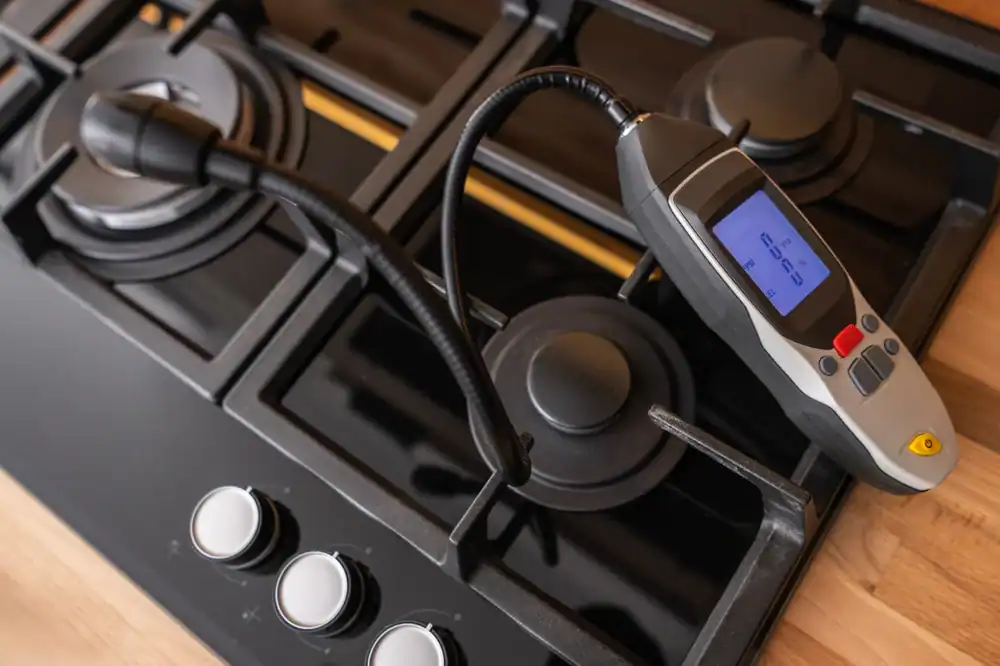
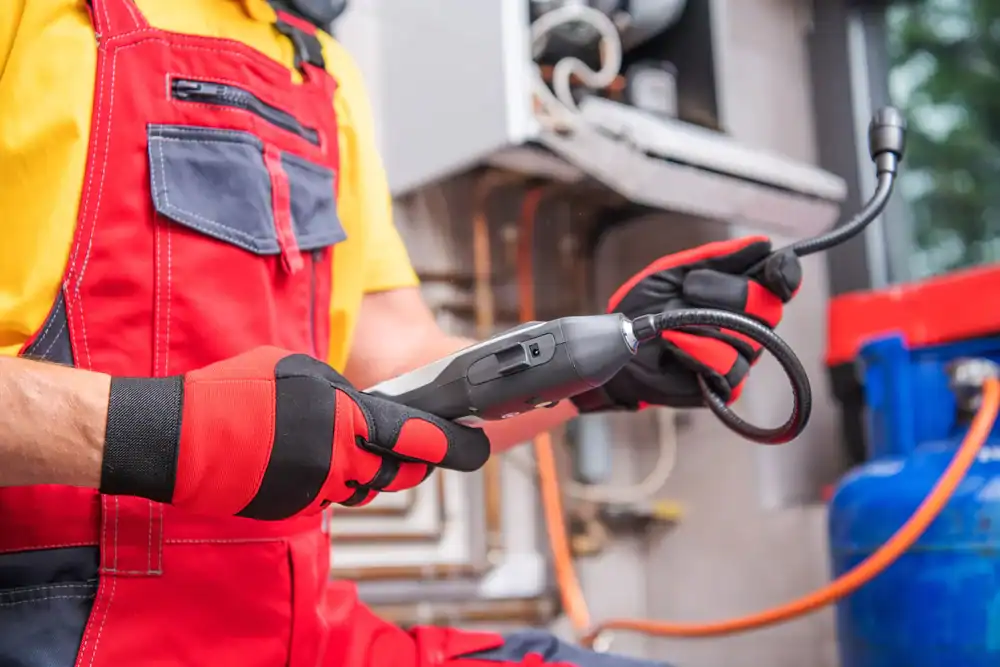
From there, professional-grade gas detectors are used to identify the presence of natural gas at every connection point. Infrared cameras go a step further, detecting temperature variations that can indicate a leak hidden behind drywall or under flooring — the kind of leak a consumer-grade detector from a hardware store simply cannot locate or document. If something is found, you’re told exactly what it is, where it is, and what it takes to fix it, with a clear price before any work begins.
One thing worth knowing for Willowbrook specifically: Staten Island is National Grid territory, not Con Edison. When National Grid responds to a gas call, they handle their side of the infrastructure — the distribution line coming into your property — and then they leave. The building-side piping inside your home is a separate system, and that’s where a Licensed Master Plumber takes over. We handle that side of the equation completely, including any permits, DOB filings, and documentation required to close out the job properly.

Ready to get started?
Gas leak detection with us covers the complete scope of what a Willowbrook homeowner actually needs — not just a reading, but a documented inspection with findings, a repair plan if something is found, and all the compliance paperwork handled in-house. There are no named service tiers here. The job gets done to the standard required, and the price is stated clearly before anything starts.
For multi-unit properties in Willowbrook — including any multi-family homes or apartment buildings in the 10314 ZIP code — Local Law 152 applies. That means a mandatory gas piping inspection by a Licensed Master Plumber on a rotating four-year cycle, with a $5,000 civil penalty for non-compliance. We’re licensed to perform those inspections and make any necessary repairs, so building owners aren’t coordinating between two separate vendors.
For individual homeowners, Local Law 157 is the more immediate concern. NYC’s natural gas detector requirement applies to all residential dwelling units — including every single-family home in Willowbrook — with a compliance deadline of January 1, 2027. If your home doesn’t have compliant natural gas detectors installed within one foot of the ceiling and within ten feet of your gas appliances, that deadline is closer than it feels. A gas leak detection visit is a natural opportunity to assess and address that requirement at the same time.
If a leak has caused damage, we work directly with insurance companies — handling the documentation and coordination so you’re not managing two problems at once.

If you smell something like rotten eggs or sulfur inside your home, don’t try to locate the source yourself. Leave the building immediately, avoid using light switches, phones, or any electrical devices on your way out, and call 911 from outside. National Grid — the natural gas utility serving Staten Island — should also be notified. They will respond to assess the distribution-side infrastructure coming into your property.
Once National Grid clears their side and leaves, that doesn’t mean the issue is resolved. The gas piping inside your Willowbrook home is a separate system, and it requires a NYC Licensed Master Plumber to inspect and repair. That’s where we come in. The 30–60 minute emergency response time means a licensed professional can be at your address quickly — not after a multi-hour wait — to assess what’s happening inside your walls, under your floors, and at every appliance connection point.
National Grid handles the distribution infrastructure — the main gas line running to your property and the meter connection. That’s their jurisdiction, and they’re good at it. But the moment the gas enters your home through your building’s internal piping, you’re in a different system entirely, and National Grid does not repair that side.
This is one of the most common points of confusion for Staten Island homeowners. National Grid responds, checks their equipment, and leaves — and the homeowner is left wondering why the smell is still there or why the gas is still off. The answer is that the problem was never on National Grid’s side to begin with. A NYC Licensed Master Plumber is the party legally authorized to inspect, repair, and document the internal gas piping in your home. We handle exactly that — and can coordinate the full process from initial detection through any required NYC DOB filings to restore service properly.
This is a more common situation than most people realize. The odorant added to natural gas — mercaptan, which creates that rotten egg smell — can actually dissipate through a process called odor fade. Physical and chemical factors can cause the odorant to weaken over time, which means a real leak can exist without producing any noticeable smell. Relying entirely on your nose is not a reliable safety strategy.
Other signs worth paying attention to include a hissing or whistling sound near a gas line or appliance, dead or yellowing patches of vegetation in your yard above where a gas line runs, and unexplained increases in your National Grid bill. Inside the home, symptoms like headaches, dizziness, or nausea that improve when you leave the house can also indicate a slow leak. Professional-grade gas detectors and infrared cameras — the equipment we use — can identify what your nose cannot. For a Willowbrook home with original 1960s or 1970s gas infrastructure, a periodic professional inspection is the only way to know for certain what’s actually happening inside those aging systems.
Local Law 152 mandates periodic gas piping inspections for most NYC buildings, but it specifically exempts one- and two-family homes. So if you own a single-family high-ranch or colonial in Willowbrook, you are not subject to the mandatory LL152 inspection cycle or the $5,000 civil penalty for non-compliance.
That said, the exemption from a legal mandate is not the same as being in the clear. A single-family home that has never had its gas system professionally inspected — particularly one built in the 1960s or 1970s with original piping and fittings still in place — carries real risk regardless of what the law requires. The exemption just means no one is forcing the inspection. It doesn’t mean the inspection isn’t warranted. For multi-unit buildings in Willowbrook, including any multi-family properties or apartment buildings in the 10314 area, LL152 does apply in full, and the inspection must be performed by a Licensed Master Plumber with results filed with the NYC DOB within 60 days.
Consumer-grade gas detectors — the kind available at hardware stores — are designed to alert you when gas concentration reaches a certain level in the air. They’re useful as an early warning system, but they can’t tell you where the leak is coming from, how severe it is, or whether the source is inside a wall, under a floor, or at a specific fitting behind an appliance. They also don’t produce any documentation, which matters for insurance claims and compliance purposes.
We use professional-grade gas detectors that measure gas concentration at specific points along your piping system, allowing our technician to trace a leak to its exact source rather than just confirm gas is present somewhere in the room. Infrared cameras add another layer — they detect temperature variations that indicate gas movement through areas that aren’t visually accessible, including behind finished drywall in a Willowbrook split-level or beneath the concrete floor of a basement utility room. Together, these tools give a complete picture of the system rather than a surface-level reading.
Whether a gas leak and any resulting damage is covered by your homeowner’s insurance depends on the specifics of your policy and the nature of the damage. In general, sudden and accidental damage caused by a gas leak — such as fire damage or structural damage from an explosion — tends to be covered. Damage resulting from a slow leak that went unaddressed for an extended period is more likely to be disputed, because insurers can argue the homeowner had reasonable opportunity to detect and repair the issue.
This is one of the practical reasons a documented gas leak inspection matters beyond just safety. Having a professional inspection on record — showing that you took reasonable steps to maintain your gas system — strengthens your position significantly if you ever need to file a claim. We work directly with insurance companies when gas leak damage has occurred, handling the documentation and coordination on your behalf. For a Willowbrook homeowner with a property valued well above $600,000, that kind of direct insurance coordination during an already stressful situation is a meaningful practical benefit, not just a checkbox.
Other Services we provide in Willowbrook