
Homeowners reasonably assume that permits are for big work. On gas, that assumption is wrong, and the Department of Buildings says so using the most ordinary example it could pick.
The size of the job decides which filing applies. Repair or replacement of existing equipment commonly goes under a Limited Alteration Application, which is self-permitted in DOB NOW: Build and does not generally require a registered design professional. A genuinely new installation is a fuller filing. Either way, something is filed and the work is done by a Licensed Master Plumber.
What happens when it is not filed is worth knowing, because it is not a slap on the wrist. Unpermitted gas work can bring significant fines and a loss of service for the whole building. And an outstanding work-without-permit penalty has to be cleared before any new permit can be issued, which means the quiet job you did in year one is what blocks the legal job you need in year five.
For a house you intend to sell eventually, that is the real argument. Filed work is recorded. Unfiled work is a question a buyer’s surveyor asks.
RB Mechanical Plumbing and Heating is third generation and owner operated, licensed master plumbers working in New York City since 1983. Our base on Staten Island’s south shore puts Dyker Heights minutes away over the Verrazzano.
Most houses here went up between the 1920s and the 1950s, piped for a stove and a boiler. The additions since then have come one at a time: a dryer, a better range, a basement kitchen, sometimes a second unit.
So the first question on an installation here is almost never about the new appliance. It is whether the existing service can carry what is already connected plus what you are adding. If it cannot, connecting anyway gives you an appliance that underperforms and a system under strain, and you will blame the appliance.
We check that before quoting, because it changes the job from a connection to an upsizing, and you deserve to know which one you are buying.
We start with the load. What is on the system now, what you are adding, and whether the service carries it. That is a calculation, not a judgment call.
Then the route through the house. On a detached or semi-detached property that is usually more straightforward than in an apartment building, though basements, crawl spaces and finished rooms all shape it.
Then the filing, through DOB NOW: Build. The Department of Buildings no longer accepts paper filings. We will tell you whether yours is a Limited Alteration Application or a fuller filing before any money is committed.
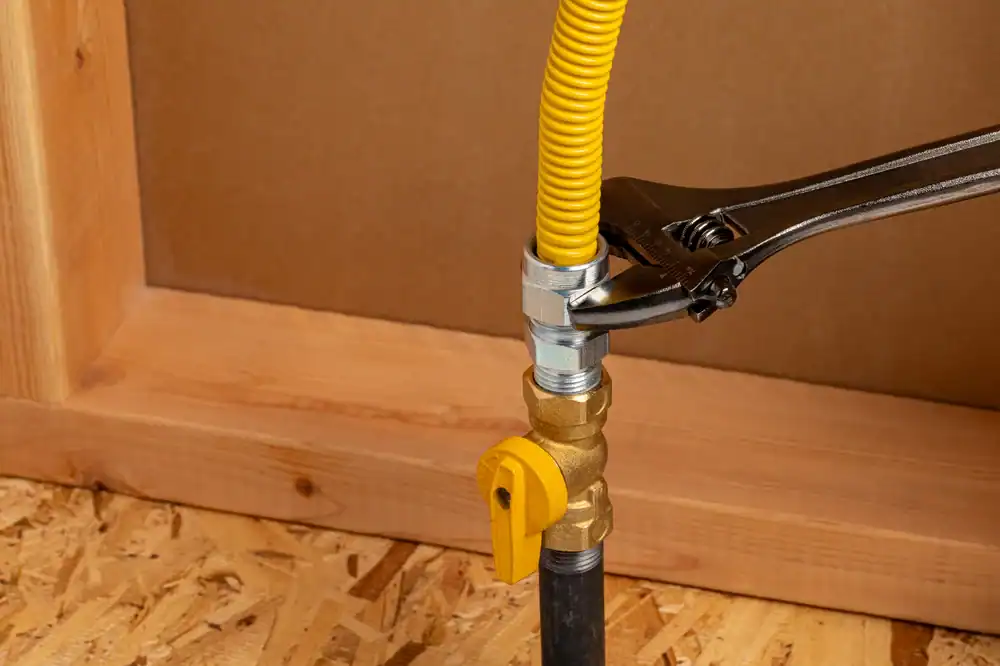
Then the work, the Department of Buildings inspection and the Gas Authorization, which is what allows the utility to connect. We handle the filings and the inspection requests rather than leaving you with a reference number and good luck.

Ready to get started?
A gas dryer. The Department of Buildings’ own example of work that is illegal without a permit. It is a filing.
A professional range replacing a standard one. Usually a meaningfully larger draw, so the question is capacity before it is connection.
A basement kitchen. Gas extended to a new location, often in a converted space. If the conversion itself was never filed, that is a separate issue sitting underneath this one and it is better raised now.
An outdoor line to a grill or a patio heater. Still a gas alteration, still filed, still a Licensed Master Plumber.
A boiler replacement. The appliance swap and the gas connection are related but not identical, and the connection is the part this page is about.
In every case, ask who holds the licence doing the gas work and check it on the Department of Buildings License Search.

Yes, and that is not us being cautious. The Department of Buildings names adding a gas dryer specifically as an example of illegal alteration of a gas system without a work permit.
It is usually a small filing rather than a big one. Repair or replacement of existing equipment commonly runs under a self-permitted Limited Alteration Application. The filing being small is not the same as there being none.
That depends on what the service was sized for and what else is connected. A high output range is a real step up from a standard one, and plenty of houses here are running on gas systems designed for two appliances.
We work that out before the range is ordered rather than after it is installed and underperforming. If the answer is that the service needs upsizing, you will know while you still have options.
It is common and it is fixable, but it affects sequencing. An outstanding work-without-permit penalty must be cleared before a new permit can be obtained, so if the old work has been caught, legalizing it may have to come before the new installation.
Tell us at the start. It is far better planned into the job than discovered when a permit application is refused.
Usually, yes, and it is a popular job here with the garden space. It is still a gas alteration: filed with the Department of Buildings and carried out by a Licensed Master Plumber.
The practical questions are the same as indoors: whether the service carries the extra load, and what route the line takes. Outdoor runs have their own requirements for protection and materials, which is part of why this is not a general contractor job.
For part of it, usually yes, and on a single family house that is simpler than in an apartment building because only your household is affected.
If the gas has been fully shut off, restoration has to be authorized by the Department of Buildings rather than simply arranged with the utility. That is the step worth planning around, and we handle it.
The Department of Buildings runs a public License Search where you can confirm a Licensed Master Plumber’s licence is active, and a Know Your Construction Professional tool that shows disciplinary actions and voluntary surrenders.
Both are free and take a couple of minutes. On gas work in your own home, there is no good reason not to.