

Along 86th Street, 18th Avenue and Bay Parkway, the common building is a storefront with apartments above it. Over decades those storefronts change hands and change use: a bakery becomes a restaurant, a restaurant becomes a laundry, each one needing its gas arranged differently.
Every one of those changes meant piping altered or extended. Commercial cooking equipment draws far more than a domestic range, so lines get added, branched and sometimes pushed past what the original service was sized for. Those alterations are where the joints are, and joints are where leaks begin.
They are also where unfiled work tends to live. A fit-out done quickly twenty years ago may never have been filed, and nobody currently in the building knows it happened.
So on a Bensonhurst mixed use building we test the whole system rather than only the space that reported the smell. The reported location is where the gas surfaced. It is not necessarily where it left the pipe.
RB Mechanical Plumbing and Heating is third generation and owner operated, licensed master plumbers working in New York City since 1983. We are on Staten Island’s south shore, one bridge from Bensonhurst, and on the same gas utility.
Bensonhurst sits in Brooklyn Community District 11, the most populous community district in this part of the borough. That density shows up in the gas systems: more units per building, more commercial space at street level, and more alterations per system than you find in a detached house neighbourhood.
Four decades of New York City permits and Department of Buildings filings is the part that matters on a mixed use building. The plumbing on a leak is often straightforward. Sorting out which alterations were filed, and getting the building legally back on gas, is where the experience earns its keep.
If there is an active smell, the utility or the fire department makes the building safe and shuts the gas off before anyone else does anything.
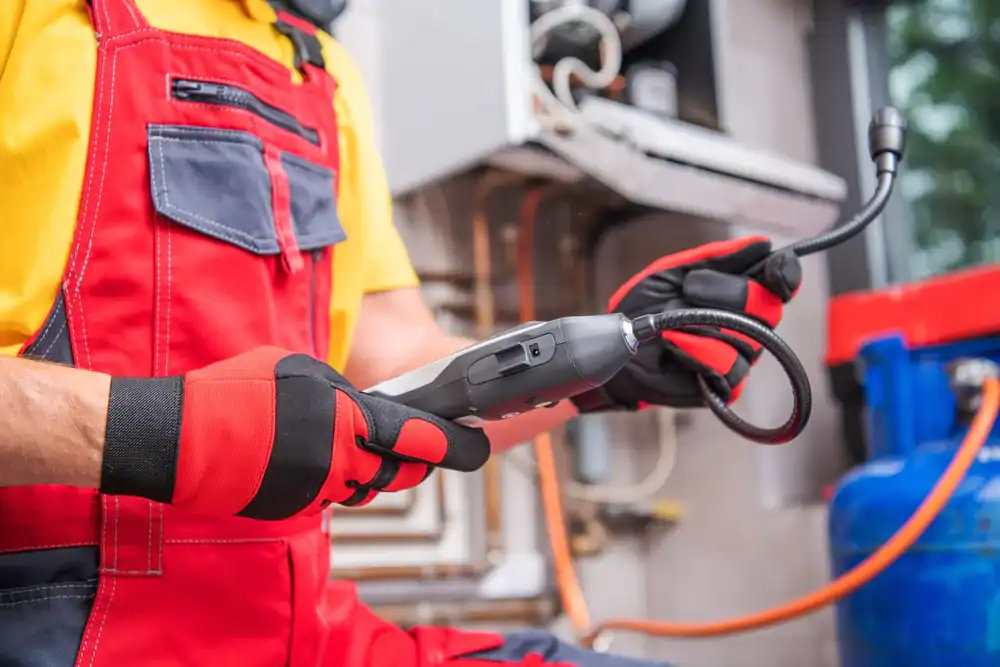
We then pressure test the system and work the exposed piping with a combustible gas detector: the basement run, the service entry, the risers, and the commercial branch if there is one. On a mixed use building that commercial branch is the first place we look.
Repairs are filed through DOB NOW: Build, as the Department of Buildings no longer accepts paper filings. Repair or replacement of existing equipment commonly runs under a self-permitted Limited Alteration Application.
Restoration needs a Department of Buildings authorization, not a utility call. We request the Gas Authorization through DOB NOW: Inspections and the Plumbing Unit reviews it. On a building with a trading business in it, that step is the one that costs money every day it is open, so we handle it rather than hand it back.

Ready to get started?
Leave the building. No switches, no intercom, no phone until you are outside. Call 911 or National Grid on 718-643-4050.
In a mixed use building, tell the other occupants. A restaurant that closes for the evening and locks up does not necessarily know the apartments above have reported a smell, and the families upstairs may not know the kitchen has had work done that week.
Do not reopen a closed gas valve. Restoring service without an authorization turns a safety problem into a compliance one.
If you are the owner and there has been recent work in a commercial space, say so on the first call. It is the single most useful thing you can tell us, and it is better coming from you than discovered later.

Because you are almost certainly on the same gas service. In a typical Bensonhurst mixed use building, one service enters the building and feeds both the commercial space and the apartments, often through shared piping in the basement.
When the gas is cut for safety, it is cut at the point that makes the building safe. Whether your apartment can be isolated and kept on depends entirely on how the building was piped, which a pressure test establishes.
Nobody can honestly tell you before seeing the system, and be wary of anyone who does. What determines it is the repair, then the Department of Buildings inspection, then the Gas Authorization approval, and only then the utility.
Where commercial kitchens lose time is usually not the pipe. It is a filing gap found during the inspection, from work done years earlier. Telling us upfront about past alterations is how that gets managed rather than discovered.
It is common on these strips and it is fixable, but the order matters. Unpermitted gas work can bring significant fines and a loss of service for the whole building, and an outstanding work-without-permit penalty has to be cleared before a new permit can be issued.
That new permit is the one you need to get the gas back. So legalizing the old work usually has to happen before the restoration, which is exactly why it is better raised at the start than found at the inspection.
That is worth establishing properly, and a leak is a good moment to do it. Commercial cooking equipment draws considerably more than domestic appliances, and plenty of these buildings are running kitchens on services sized for a different era.
An undersized system does not usually fail dramatically. It runs badly, stresses connections, and gives you recurring faults that each look like a separate problem.
A Licensed Master Plumber. Altering, relocating or removing gas piping serving restaurant cooking equipment must be done by an LMP, and that holds for repairs to fuel gas piping generally across New York City.
If a range hood suppression system is involved, that is a separate licensed trade again, installed and tested by a Licensed Master Fire Suppression Piping Contractor with an FDNY inspector, and the Department of Buildings Plumbing Unit checks it before the utility supplies gas.
Yes, and on a mixed use building that is the point. The gas system is one system. Splitting it between a commercial plumber and a residential one is how buildings end up with two partial pictures and no one accountable for the restoration.
We are licensed master plumbers in New York City, so detection, repair, filing and sign off stay in one place for the whole building.