


Most Shore Acres homeowners who call about a gas odor have already done the same thing: opened a window, waited for the smell to pass, and convinced themselves it was probably nothing. That hesitation is understandable. It’s also one of the most common patterns before a serious gas event.
The absence of a smell doesn’t mean the absence of a leak. The odorant added to natural gas can dissipate over time — a documented phenomenon called odor fade. Your nose alone isn’t a reliable detector.
Shore Acres sits directly on Upper New York Bay, and that coastal exposure matters more than most residents realize. Salt air and persistent waterfront humidity accelerate corrosion on metal gas fittings, flexible connectors, and appliance hook-ups at a rate that inland neighborhoods simply don’t experience. Much of Shore Acres’ housing stock dates to the 1930s through the 1960s, meaning gas infrastructure in many homes is 55 to 90 years old. That combination warrants professional eyes, not just a sniff test.
When we properly locate and repair a leak, you get your home back. No more second-guessing an intermittent odor. No more wondering whether the smell near the stove is real or imagined. For building owners in Shore Acres, you also get the compliance documentation that protects you from a $5,000 Local Law 152 penalty.
We’ve been operating in New York City since 1983 — over 40 years in the same market, through building code changes, utility transitions, and the full evolution of NYC’s gas infrastructure. Bobby and Rob run this operation as a father-and-son team, and every technician who touches a gas line holds a NYC Licensed Master Plumber credential. Not licensed in a general sense — Master Plumber, the highest level of gas work authorization in New York State.
Shore Acres falls squarely within our Staten Island service area. The neighborhood’s mix of Victorian-era residences, mid-century bungalows, and small apartment buildings along streets like Nautilus Street and Bay Street Landing represents exactly the kind of older, coastal building stock we’ve worked in for decades. Our technicians are drug-tested and vetted before entering any home — something that matters when a plumber needs access to a private residence or a multi-unit building where management controls who comes through the door.

When you call about a suspected gas leak in Shore Acres, the first thing that happens is a real conversation — not a form submission, not a callback queue. You’ll speak with someone who can assess whether this is an immediate emergency requiring a 30–60 minute response or a scheduled inspection. If there’s any active concern about gas in the air, the protocol is clear: get out of the building, don’t use any switches or appliances, and call from outside. Con Edison or National Grid handles the utility side of the line. Once the utility has cleared their infrastructure, we address the building-side gas piping — a completely separate system that the utility company cannot repair.
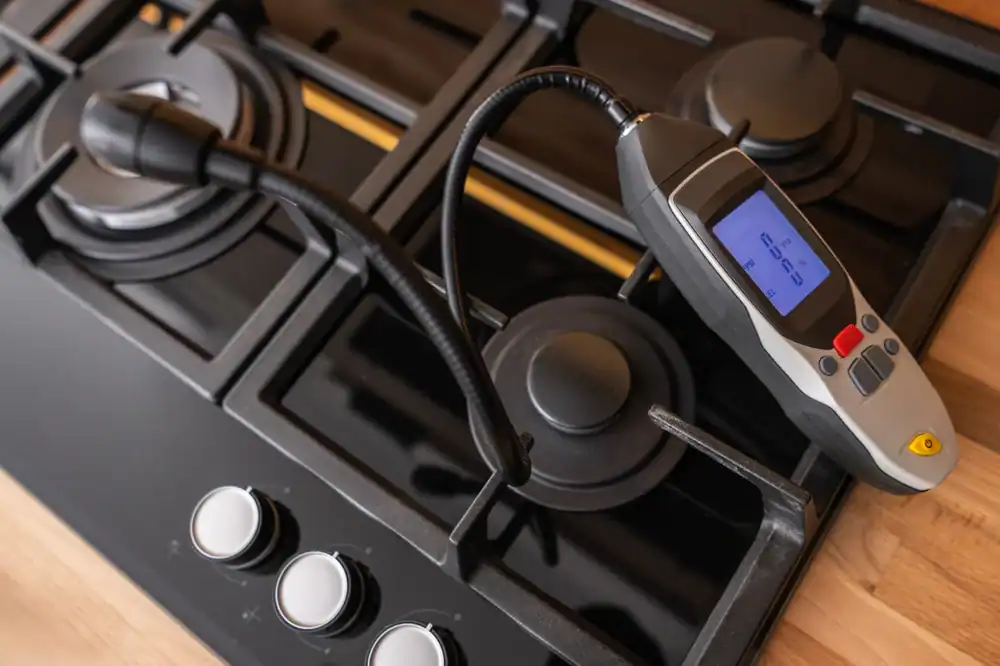
On arrival, we use professional-grade gas detectors and infrared cameras to locate the source. This matters specifically in Shore Acres because older homes with basements, enclosed mechanical rooms, and aging pipe connections can accumulate gas in spaces where the smell never reaches the living area. Infrared cameras find leaks behind walls and underground — places a consumer detector simply can’t reach.
If a leak is confirmed and repaired, we handle the full paperwork trail: DOB filings, permit coordination, and — for multi-unit building owners in Shore Acres’ Community District 1 — the Local Law 152 Gas Piping System Periodic Inspection Certification. The Cycle 2 deadline for Community District 1 was December 31, 2024. If your building hasn’t filed, you’re already in violation. That certification doesn’t file itself, and the $5,000 penalty doesn’t disappear on its own either.

Ready to get started?
A gas leak detection visit from us isn’t a quick walk-through with a handheld reader. We cover exposed gas piping, appliance connections, flexible connectors behind stoves and dryers, and any accessible sections of the gas system throughout the property. In Shore Acres specifically, we pay close attention to connection points that face the highest corrosion risk — exterior meter connections, basement entry points, and fittings on older appliances that may not have been serviced in years.
The combination of 1930s–1960s construction and year-round salt air from Upper New York Bay creates corrosion patterns that require a more thorough look than a newer, inland property would. For Shore Acres multi-unit building owners, our service extends beyond detection and repair. We’re licensed to perform Local Law 152 gas piping inspections and certified to make any repairs identified during that inspection — meaning one call handles your entire compliance workflow.
That includes the DOB filing and the Gas Piping System Periodic Inspection Certification required under NYC law. Given that Community District 1’s Cycle 2 deadline passed on December 31, 2024, building owners who haven’t yet filed are already past due. Pricing is transparent and provided before any work begins. There are no hidden fees added after the fact. If the inspection reveals a problem that requires repair, you’ll know the scope and the cost before anything is touched.
We also coordinate directly with insurance companies when gas leak damage is involved — reducing the paperwork burden on homeowners who are already dealing with enough.
Yes, and it’s worth understanding why. Shore Acres’ core residential development began in the 1930s under developer Cornelius G. Kolff, with additional construction through the 1950s and 1960s. That means the gas piping in many Shore Acres homes is between 55 and 90 years old. Pipe materials, connection standards, and appliance hook-up requirements from that era were fundamentally different from today’s codes, and the infrastructure has had decades to corrode, loosen, or degrade.
Layered on top of that is Shore Acres’ waterfront position on Upper New York Bay. Salt air and coastal humidity accelerate corrosion of metal fittings and flexible connectors far more aggressively than in inland neighborhoods. A home that has never had a professional gas inspection — and many haven’t — may have connection points that are well past their reliable service life. That doesn’t mean there’s definitely a leak, but it does mean the risk profile is meaningfully higher than in a newer home in a drier, inland location.
Not necessarily, and this is one of the most common points of confusion for NYC homeowners. Con Edison and National Grid inspect and maintain the utility distribution infrastructure — the main lines running to your building and the meter connection. That’s their jurisdiction. The gas piping inside your building, from the meter onward through your walls, basement, and appliances, is building-side infrastructure. It’s a completely separate system, and the utility company does not inspect or repair it.
So when Con Ed clears their side and leaves, that tells you the utility line is intact. It says nothing about the condition of your building’s internal gas system. We inspect the building-side piping — the part that runs through your home and connects to your stove, boiler, water heater, and dryer. In an older Shore Acres home with decades of coastal exposure, the building-side system is where the real risk tends to live. If Con Ed found nothing and you’re still concerned, that’s exactly when a professional building-side inspection makes sense.
Local Law 152 is a NYC law that requires exposed gas piping in most buildings — excluding one- and two-family homes — to be inspected by a Licensed Master Plumber once every four years. The inspections are scheduled on a rotating cycle by community district. Shore Acres falls within Staten Island Community Board 1, which corresponds to Community District 1 in the LL152 schedule. Community District 1 buildings had their Cycle 2 inspection deadline on December 31, 2024.
If you own or manage a multi-unit building in Shore Acres and haven’t filed your Gas Piping System Periodic Inspection Certification with the NYC DOB, you are currently in violation. The civil penalty for non-compliance is $5,000. The next required inspection cycle for Community District 1 buildings will be due December 31, 2028 — but that doesn’t resolve a missed 2024 deadline. We’re licensed to perform the LL152 inspection and certified to make any required repairs, handling the entire compliance process from inspection through DOB filing.
An intermittent gas odor should be taken seriously, not dismissed because it comes and goes. There are two things happening when a smell appears and then disappears. First, gas leaks are rarely constant — pressure fluctuations, appliance cycling, and ventilation patterns all affect when and where the odor is detectable. Second, the odorant added to natural gas (mercaptan) can actually dissipate through a process called odor fade. This means a leak that was once detectable by smell may become undetectable over time — not because the leak stopped, but because the odorant has degraded.
In Shore Acres, this risk is compounded by the neighborhood’s building character. Homes with basements, enclosed mechanical rooms, and older construction can accumulate gas in spaces that aren’t well-ventilated to occupied areas. You might catch a brief whiff in the kitchen and nothing in the basement where the actual source is. The only way to know for certain is a professional inspection with equipment that detects gas concentration, not just odor. An intermittent smell is a reason to call — not a reason to wait and see.
A standard gas leak detection visit typically takes one to a few hours depending on the size of the property and how accessible the gas system is. For a single-family Shore Acres home, most inspections can be completed in a single visit. For a multi-unit building, the timeline depends on how many units and how much of the gas system is exposed and accessible.
Whether you’ll be without gas during the inspection depends on what’s found. The inspection itself is largely non-invasive — our technician uses gas detectors and infrared cameras to locate issues without opening walls unnecessarily. If a repair is needed, gas service to the affected line or appliance may need to be temporarily shut off while the fix is made. In most cases, we can complete repairs the same day, and service is restored before we leave. We understand that being without gas — especially for heating or cooking — is a real disruption, and our goal is always to resolve the issue and restore service as quickly as possible.
We explicitly serve Staten Island as part of our stated service area, which means Shore Acres is covered directly. We’ve been operating in New York City since 1983, and that experience includes the full range of NYC building types — from Manhattan pre-war apartments to Staten Island’s older North Shore residential neighborhoods like Shore Acres, with its Victorian-era homes, mid-century bungalows, and small apartment buildings along Bay Street and Nautilus Street.
The 30–60 minute emergency response time applies to Shore Acres calls. Our technicians are dispatched with the same licensed credentials and equipment — professional-grade gas detectors, infrared cameras, and full NYC DOB filing capability — regardless of borough. For Shore Acres residents dealing with a gas odor, a utility shutoff, or an overdue Local Law 152 compliance filing, the response and the process are the same as anywhere else in our service area: a Licensed Master Plumber, transparent pricing before work begins, and no hidden fees after the fact.
Other Services we provide in Shore Acres