

When your gas line is properly sized and installed, your appliances perform the way they were designed to. That Wolf range hits its full BTU output. The tankless water heater doesn’t stutter under demand. You’re not troubleshooting an underperforming appliance six months after a renovation because the line feeding it was undersized from the start.
For Shore Acres homeowners, that matters more than it does in newer neighborhoods. The homes here were developed in the 1930s by Cornelius G. Kolff as some of Staten Island’s finest residential properties — and they still are. But the original gas piping in a home that age was sized for appliances that drew a fraction of what modern equipment demands. When you upgrade, the line has to be evaluated and often replaced, not just extended.
There’s also the coastal factor. Shore Acres sits directly on the Upper New York Bay, and that salt air doesn’t just affect your view — it accelerates corrosion on exterior gas components, meter risers, and any piping near bay-facing crawl spaces. A proper installation here accounts for that environment. You get documentation of everything: pressure test results, permit records, and LMP certification — the paper trail that protects your insurance coverage, satisfies your building’s managing agent if applicable, and holds up at resale.
We’ve been doing gas line work in New York City since 1983. That’s over four decades of navigating pre-war housing stock, co-op board requirements, DOB permit systems, and Con Edison coordination across all five boroughs — including the Shore Acres neighborhood and the rest of Staten Island.
The Licensed Master Plumber on our staff is the person who shows up, does the work, and signs the certification. Not a name on a license while someone else handles the job. In NYC, only an LMP can legally perform gas line work, and that credential is verifiable through the NYC Department of Buildings. For Shore Acres homeowners who’ve invested significantly in their properties — the median home value here sits near $719,000 — that accountability isn’t a small thing.
Whether you’re in a single-family home on Nautilus Street or a unit in one of the co-op buildings along Bay Street Landing, the process is the same: a real assessment, a written estimate, and a job that’s documented from start to finish.
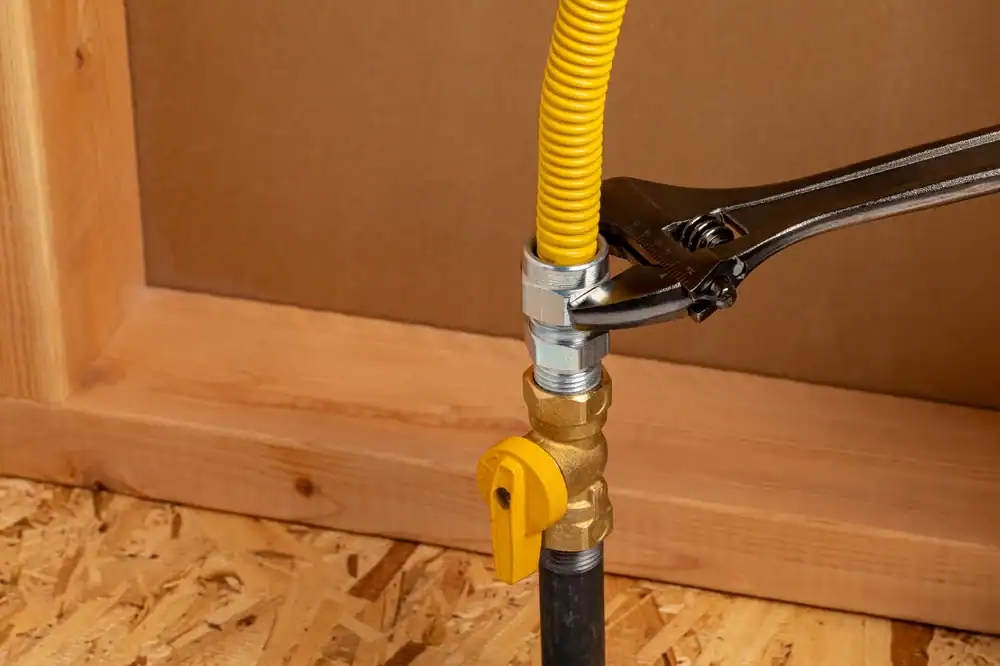
It starts with an assessment, not an assumption. Before any pipe is cut or any permit is filed, our Licensed Master Plumber evaluates your existing gas infrastructure and calculates the full BTU load of every appliance connected to the line — not just the one you’re adding. In a Shore Acres home built in the 1930s, that step is critical. The original piping may be undersized for a modern high-BTU range or a tankless water heater, and discovering that after installation is expensive. The assessment tells you exactly what you’re working with.
Once the scope is clear, a DOB gas piping permit is filed through DOB NOW — the NYC Department of Buildings’ online portal. All gas line work in New York City requires this permit, no exceptions, regardless of how minor the job seems. After the permit is approved, installation proceeds using the correct materials for your specific setup, whether that’s black iron pipe for interior runs or properly bonded CSST where applicable.
After installation, the line is pressure-tested at 1.5 times working pressure, as required by the NYC Fuel Gas Code. Then Con Edison is coordinated for service authorization and meter activation — a step that many homeowners don’t realize is separate from the DOB permit. When everything clears, you receive written documentation of the completed work: test results, permit records, and LMP certification. You don’t touch a single government portal throughout the process.

Ready to get started?
Gas line work in Shore Acres covers a range of situations, and the scope varies significantly depending on what you’re starting with. A new appliance hookup — a gas range, dryer, or water heater — typically runs between $500 and $2,000 for a single appliance, depending on the complexity of the run and the type of pipe required. Whole-home gas installations or full re-piping projects run $1,300 to $3,500. Pipe itself is priced at $12 to $25 per linear foot. Every job starts with a written estimate before any work begins.
For Shore Acres specifically, the most common scenario involves aging infrastructure meeting modern appliance demands. A home built in the 1930s with original black iron piping may need a full line replacement when a homeowner upgrades to a professional-grade range or installs a tankless water heater — both of which draw far more BTUs than the appliances those lines were originally sized for. The assessment determines whether extension is viable or whether replacement is the right call.
For multifamily buildings and co-ops in the 10305 zip code — including buildings subject to Local Law 152’s mandatory four-year gas piping inspection cycle — we handle the complete compliance process: LMP inspection, violation remediation, and GPS-2 certification filing through DOB NOW. Staten Island’s 2023 inspection deadline has passed, and buildings that missed it are in active violation. The 2027 cycle is approaching. If your building is behind, the time to address it is now, not when the penalty notice arrives.
Yes — every gas line installation, repair, or alteration in New York City requires a permit filed through the NYC Department of Buildings, regardless of the size or scope of the job. There is no exemption for minor work, single-appliance hookups, or work inside a private home. The permit must be filed through DOB NOW, the city’s online portal, and it must be filed by a Licensed Master Plumber. A handyman, general contractor, or unlicensed plumber cannot legally pull this permit.
Beyond the DOB permit, new or altered gas service in Shore Acres also requires coordination with Con Edison, which serves this area of Staten Island. Con Edison’s authorization is a separate step from the DOB permit — both are required before gas service can be activated. Skipping either one means the utility won’t turn the gas on, and any work done without permits can void your homeowner’s insurance and create serious liability issues if something goes wrong down the line.
Maybe — but you shouldn’t assume it can. A professional-grade range can draw 60,000 BTUs or more across its combined burners, and a tankless water heater typically demands between 150,000 and 199,000 BTUs. The gas line feeding those appliances has to be sized to that load, accounting for the total BTU demand of every appliance on the line, the length of the run, and the pipe diameter.
In Shore Acres, where a significant portion of the housing stock dates to the 1930s, the original gas piping was sized for the appliances of that era — modest ranges and early water heaters that drew a fraction of what modern equipment demands. That mismatch is one of the most common issues we find during assessments in this neighborhood. The result of an undersized line isn’t always an obvious failure — it often shows up as inconsistent appliance performance, pressure drops, or a range that never quite reaches the heat output it’s rated for. A proper BTU load calculation before installation tells you definitively whether your existing line is adequate or whether it needs to be upsized.
Local Law 152 requires gas piping inspections every four years for virtually all New York City buildings, with the exception of one- and two-family homes. If you own or manage a multifamily building, co-op, or mixed-use property in Shore Acres, it almost certainly applies to you. The inspection must be performed by a Licensed Master Plumber or a Registered Journeyman Plumber under direct LMP supervision. After the inspection, a GPS-2 certification must be filed electronically through DOB NOW. Non-compliance carries penalties of up to $10,000.
Staten Island’s first Local Law 152 inspection cycle began in 2019. The 2023 deadline has already passed, which means any building in the 10305 zip code that hasn’t completed its inspection and filed its GPS-2 is currently in violation. The 2027 cycle is the next deadline. If your building missed the 2023 window, the priority right now is completing the inspection, addressing any violations found, and getting the GPS-2 filed — the penalty clock is running. We handle the entire process, from inspection through filing.
For most single-appliance hookups or straightforward new line installations, the work itself typically takes anywhere from a few hours to a full day. What adds time is the permit and utility coordination process that happens before and after the physical installation. The DOB permit needs to be approved before work begins, and Con Edison needs to authorize and activate service after the installation and pressure testing are complete. That full sequence — from permit filing to gas flowing — generally takes a few days to about a week for standard residential jobs, though it can vary based on DOB processing times and Con Edison’s schedule.
For Shore Acres homeowners dealing with a gas shutoff — whether due to a Con Edison-detected issue, a failed Local Law 152 inspection, or a meter problem — the timeline depends on how quickly violations can be identified, repaired, and certified. The fastest path to restoration is having a Licensed Master Plumber who’s already familiar with the DOB NOW filing process and Con Edison’s coordination requirements, so nothing gets delayed by paperwork errors or missed steps. That’s where experience in NYC’s specific regulatory environment makes a real difference.
It’s a legitimate concern, and one that doesn’t apply equally to every Staten Island neighborhood. Shore Acres sits directly on the Upper New York Bay, and the salt air coming off the water accelerates corrosion of metal components — particularly anything with exterior exposure. That includes meter risers, outdoor shutoff valves, and gas piping that runs through crawl spaces on the bay-facing side of a home. In a neighborhood where the gas infrastructure is already approaching 70 to 90 years old in many homes, salt-air exposure is a compounding factor, not a minor one.
The issue is that this kind of corrosion isn’t always visible from inside the house. It progresses in spaces that most homeowners rarely inspect. Electronic gas detection equipment can identify leaks and deterioration that a visual check would miss entirely. If you haven’t had your gas piping inspected recently — and particularly if you’re in a home close to the waterfront on Bay Street Landing or the eastern edge of Shore Acres — it’s worth having a Licensed Master Plumber take a look before a small problem becomes a shutoff situation.
The verification process is straightforward and takes about two minutes. Every Licensed Master Plumber working in New York City is registered with the NYC Department of Buildings, and their license is publicly searchable through the DOB’s online license lookup tool. You’re looking for an active LMP license — not a journeyman plumber’s license, not a general contractor’s license, and not a license from another state or municipality. The LMP credential is the specific one required by NYC law for all gas line work, and it’s the one that allows the plumber to file DOB permits and sign GPS-2 certifications.
It’s also worth asking directly whether the person doing the work is the LMP or whether they’re a subcontractor working under someone else’s license. In some cases, a company holds an LMP license but sends unlicensed workers to the job site. That arrangement creates real liability for the homeowner if something goes wrong. Our Licensed Master Plumber is on staff and on-site — the person signing the certification is the person doing the work. For a Shore Acres home worth $700,000 or more, that distinction is worth asking about before you hire anyone.
Other Services we provide in Shore Acres