
You stop wondering. That’s the honest answer. When a gas line issue gets properly diagnosed and repaired by a licensed master plumber, the low-grade anxiety that comes with aging infrastructure — the faint smell you couldn’t quite place, the fitting you noticed looked a little rough — goes away. You get your home back.
For Shore Acres specifically, that peace of mind carries a little more weight. A meaningful portion of homes in this neighborhood were built during the 1930s development wave that created Shore Acres as an upscale enclave. That’s original gas infrastructure approaching 90 years old in some cases — black iron pipe, original threaded fittings, connection points that have been stressed every time an appliance was replaced over the decades. Getting that system properly inspected and repaired isn’t overcaution. It’s just smart ownership.
There’s also the water. Shore Acres sits directly on the Upper New York Bay, and homes on the eastern streets face salt air from the Narrows year-round. Salt-laden air attacks threaded gas pipe joints at a rate that simply doesn’t apply to inland neighborhoods. The corrosion is invisible until it isn’t. A thorough repair and inspection from someone who knows what to look for in a coastal environment like Shore Acres is a different thing entirely than a generic service call.
We’ve been doing this work on Staten Island since 1983. Bobby and Rob — a father and son — built this business on the kind of reputation that only holds up when you’re consistently honest with people. We’re not a dispatch center. When you call, you know who’s coming.
We’ve worked on homes throughout the North Shore, from the older housing stock near the St. George Ferry Terminal corridor down through Rosebank and into Shore Acres. The 1930s and 1940s-era homes in this neighborhood, with their original systems and their decades of accumulated appliance swaps, are familiar territory. So is the coastal environment — the salt air, the bay-facing exposures, the specific corrosion patterns that show up in homes this close to the Narrows.
We’re fully licensed, carry a Gas Work Qualification endorsement required by NYC DOB for gas piping work, and are comprehensively insured. Written estimates before any work begins. No after-hours surcharges — ever.

It starts with a call. Whether you’re smelling something you can’t explain, dealing with a Con Edison shutoff, or you’ve received a Local Law 152 notice for your building in Community District 1, the first step is the same: you reach out, describe what’s happening, and get a real response — not a voicemail and a callback window.
When we arrive, the first priority is safety. If there’s an active leak, we isolate it. Then comes a full assessment of the affected system — not just the obvious problem, but the surrounding pipe, the fittings, the connection points. In Shore Acres homes with older gas infrastructure, what looks like a single issue sometimes has a neighbor. We look at the whole picture before we give you a number, and you get that estimate in writing before any work starts.
Once the repair or replacement is done — whether that’s a corroded fitting, a section of damaged pipe, a full gas line reroute for a kitchen renovation, or a pressure test after prior work — we handle the DOB permit process and coordinate directly with Con Edison for service restoration. That last part matters more than most people realize. The utility controls when your gas comes back on, and a plumber who understands how to move that process forward can save you days of waiting. We’ve done this enough times on Staten Island to know exactly how to handle it.
Ready to get started?
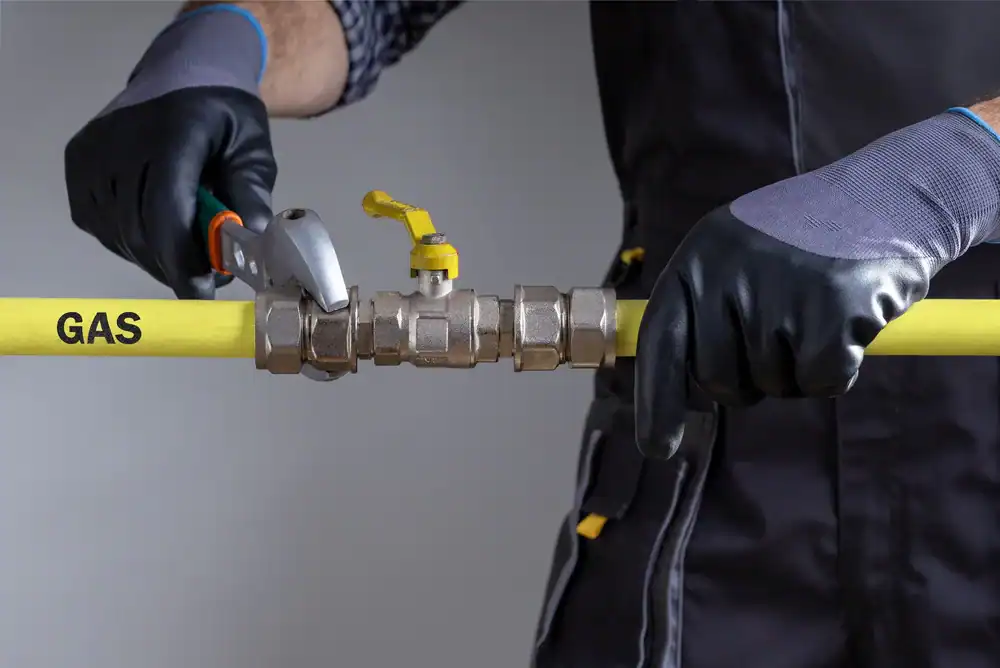
Gas line repair in Shore Acres covers a wider range of work than most homeowners initially expect. The most common calls are for gas pipe leak repair — a fitting that’s worked loose, a corroded joint near an exterior wall, or a section of pipe that failed during a pressure test. We handle all of it, and we do it with the proper permits pulled through NYC DOB, not around them.
Corroded gas pipe replacement is particularly relevant in this neighborhood. The combination of 1930s-era black iron pipe and year-round salt-air exposure from the Upper New York Bay creates corrosion conditions that accelerate joint failure. When we find a compromised section, we replace it with code-compliant materials and pressure test the system before we leave. Gas pressure testing is also available as a standalone service — useful after any prior repair work, after an appliance installation, or as part of a proactive check on a home you know has older infrastructure.
For homeowners renovating kitchens or adding new appliances, gas line rerouting is a common part of the job. We map the new routing, pull the required permits, complete the work, and coordinate the utility sign-off. And for any qualifying multi-unit or mixed-use building in Shore Acres — the neighborhood falls within Staten Island Community District 1, which had its Local Law 152 Cycle 2 deadline on December 31, 2024 — we handle the full compliance process from inspection through DOB filing.

The clearest sign is smell — natural gas has a sulfur or rotten egg odor added specifically so you notice it. If you’re catching that smell anywhere near your stove, your boiler, your basement, or along an exterior wall, don’t wait to see if it goes away. That’s the call to make immediately.
Beyond active smells, there are subtler signs that are easy to dismiss: a pilot light that keeps going out, a hissing sound near a pipe connection, a gas bill that’s crept up without a clear reason, or appliances that aren’t performing the way they used to. In Shore Acres homes with older gas infrastructure — particularly the 1930s and 1940s-era houses that make up a notable portion of the neighborhood — these kinds of symptoms are worth taking seriously. Aging black iron pipe and original fittings don’t announce failure in advance. A pressure test can confirm whether your system is holding the way it should, and it’s a straightforward process that doesn’t require tearing anything apart.
Yes, most gas line repair and replacement work in New York City requires a permit filed through the NYC Department of Buildings. The work must be performed by a Licensed Master Plumber who holds a Gas Work Qualification endorsement — a separate credential from a standard plumbing license, required specifically for gas piping work under Local Law 150 of 2016.
Skipping the permit process is a risk that follows your property, not just the repair. Unpermitted gas work creates violations that show up in title searches, complicate insurance claims, and can result in Con Edison or National Grid refusing to restore service after a shutoff until the violation is resolved. For Shore Acres homeowners with significant property values — median home values in the neighborhood run close to $720,000, with waterfront properties well above that — unpermitted work on a high-value asset is a liability that simply isn’t worth the short-term convenience. We pull the required permits on every job, handle the DOB filing, and coordinate utility restoration from start to finish.
Local Law 152 requires qualifying buildings in New York City to have their gas piping systems inspected every four years by a Licensed Master Plumber. The law applies to most buildings other than one- and two-family homes — so multi-unit residential buildings, mixed-use buildings, and commercial properties are in scope.
Shore Acres falls within Staten Island Community District 1. The second LL152 inspection cycle deadline for CD1 was December 31, 2024. If you own a qualifying building in Shore Acres and you did not file a gas piping inspection certification by that date, your building is currently in violation. Non-compliance fines can reach $10,000 per year, and Con Edison has the authority to shut off gas service to buildings that remain out of compliance. The 20 Cliff Street apartment complex and any other multi-unit properties in the neighborhood are directly subject to this requirement. We handle the full LL152 process — inspection, any required remediation, and DOB filing — so you’re not navigating the compliance paperwork on your own.
When Con Edison shuts off gas service — whether due to a detected leak, a failed inspection, or a reported violation — they don’t simply turn it back on when you call to ask. The restoration process requires a Licensed Master Plumber to complete and certify the required repairs, file the appropriate documentation with NYC DOB, and then coordinate with the utility for service restoration. Con Edison controls the final step, and they move on their own timeline.
What makes a real difference is having a plumber who understands that coordination process and knows how to move it forward efficiently. We’ve handled this sequence repeatedly on Staten Island — the repair, the DOB filing, and the direct utility coordination. Families in Shore Acres who lose gas service lose their cooking and heat, and in winter months along the Upper New York Bay, that’s not a small inconvenience. Getting the restoration process right the first time, without gaps in the paperwork or missed steps with the utility, is what gets your gas back on without unnecessary delays.
It does, and it’s one of the more underappreciated maintenance realities for homes in this part of Staten Island. Salt-laden air accelerates corrosion on metal components — and gas pipe fittings, particularly the threaded joints on black iron pipe, are vulnerable to exactly the kind of pitting and surface degradation that salt air causes. The corrosion typically starts at connection points where two sections of pipe meet, and it progresses invisibly until a fitting weakens enough to leak.
Homes on the eastern streets of Shore Acres — the ones closest to the Narrows and the Upper New York Bay — face the highest exposure, but the effect extends throughout the neighborhood given how close the entire area sits to the water. This is a meaningful difference from inland Staten Island neighborhoods where soil moisture is the primary corrosion driver. For Shore Acres homeowners, especially those in 1930s or 1940s-era homes where the original black iron pipe is still in place, the combination of age and coastal environment makes a proactive inspection more than just a precaution. It’s the kind of thing that catches a problem before it becomes an emergency call at midnight.
The honest answer is that it depends on what the repair involves. A straightforward fitting replacement or a localized pipe repair on an accessible section can often be completed in a few hours, with gas restored the same day once the pressure test confirms the system is holding. More involved work — replacing a longer section of corroded pipe, rerouting a gas line for a kitchen renovation, or handling a repair that requires DOB permit filing and Con Edison coordination — takes longer, and the utility restoration step adds time that isn’t fully within our control.
What you can control is how prepared you are going in. Getting a written estimate that lays out the full scope of work before anything starts means you know what to expect — how long the job will take, whether same-day restoration is realistic, and what the permit and utility coordination timeline looks like. For Shore Acres homeowners dealing with older gas infrastructure, it’s also worth knowing that a thorough inspection sometimes surfaces additional issues that weren’t visible from the original complaint. We address those findings transparently — you’ll know what was found and what it costs to fix before any additional work proceeds.
Other Services we provide in Shore Acres