
When your gas line is properly sized, permitted, and installed, your appliances perform the way they’re supposed to. That professional-grade range you installed doesn’t underperform. The tankless water heater delivers what the manufacturer promised. You’re not left wondering why the burners are weak or the hot water cuts out — because the line feeding them was calculated for the actual BTU demand, not just whatever pipe was already there.
For Tompkinsville homeowners and landlords dealing with pre-war building stock, this matters more than it does almost anywhere else on Staten Island. A lot of these buildings have gas infrastructure that hasn’t been seriously evaluated in decades. When you upgrade an appliance or renovate a unit, that old pipe becomes your problem fast — and the consequences range from poor appliance performance to a failed DOB inspection to National Grid refusing to activate service.
Getting it done right means you have written documentation when it’s over. Pressure test results, permit records, LMP sign-off. That paperwork protects your insurance coverage, satisfies your building’s management requirements, and gives you something concrete to hand over if you ever sell the property or face a compliance review.
We’ve been operating in New York City since 1983. That’s four decades of navigating DOB permit systems, utility company requirements, pre-war building complications, and the kind of gas line situations that don’t show up in any textbook. We serve residential, commercial, and industrial clients across Manhattan and Staten Island — and the experience that comes with that tenure is the kind you can’t fake.
On Staten Island’s North Shore, including Tompkinsville and the surrounding neighborhoods along the Bay Street corridor, the buildings tell a different story than the newer construction further south on the island. Older risers, outdated configurations, gas piping that was never sized for modern appliances. Our Licensed Master Plumber is on staff and on-site — not a name on a license while someone else does the work. That distinction matters when the LMP has to sign the GPS-2 certification and stand behind every installation.
Every job comes with a free online quote and transparent pricing before anything starts. No surprises on the invoice.

It starts with an assessment of what’s already there. In Tompkinsville’s older building stock, that step isn’t optional — it determines whether the existing gas line can handle the new appliance’s demand or whether it needs to be upsized before anything else happens.
A professional-grade range can pull 60,000 BTU or more. A tankless water heater can demand 150,000 to 199,000 BTU. If the current pipe diameter can’t support that load, the appliance will underperform and the installation will fail inspection. We run the BTU load calculation first, then design the line to match.
Once the scope is clear, the DOB permit gets filed through DOB NOW — the city’s all-digital portal. No paper submissions, no shortcuts. The permit covers the full scope of work, and it’s filed by our Licensed Master Plumber, which is the only way it can legally be filed in New York City.
From there, the installation happens: pipe run, fittings, shutoff valves at each appliance, and a pressure test at the standard required by the NYC Fuel Gas Code. The last step is National Grid. Because Tompkinsville runs on National Grid — not Con Edison — the utility coordination for service activation, meter work, or shutoff restoration goes through National Grid’s specific authorization process. We manage that coordination directly.
When it’s done, you get the documentation: test results, permit records, and LMP certification. Everything you need, in writing.
Ready to get started?
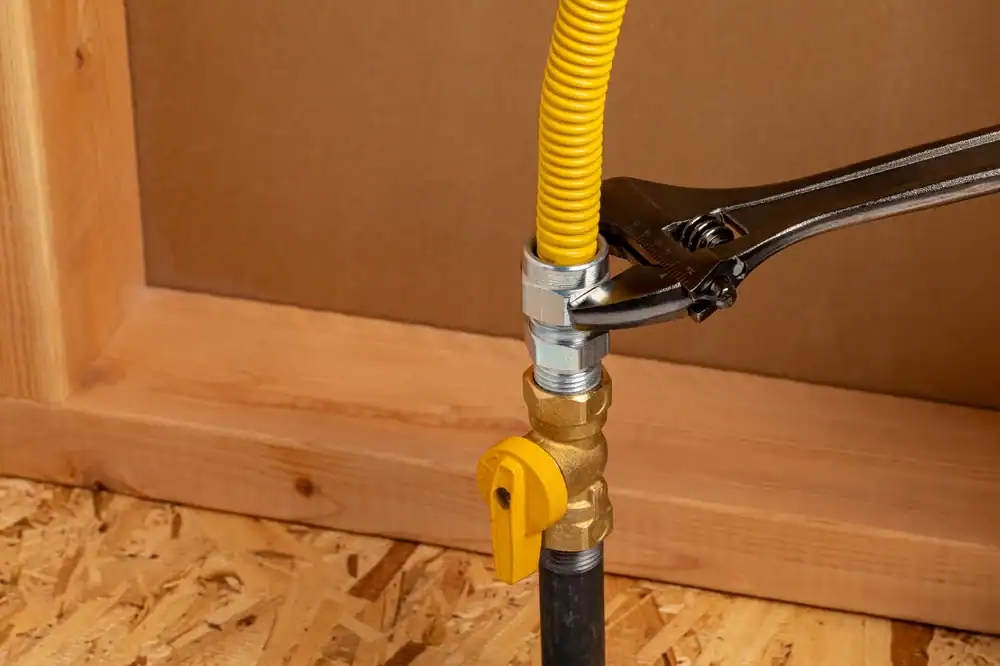
Gas line installation through RB Mechanical Plumbing and Heating covers the full scope — not just the pipe. That means the DOB permit filing, the BTU load calculation, the installation itself, pressure testing, and National Grid coordination for service activation. For appliance hookups, whether it’s a new gas range, a boiler replacement, a gas dryer, or a tankless water heater, each installation includes a dedicated manual shutoff valve, proper line sizing for that appliance’s specific demand, and a pressure test before the gas is turned on.
For Tompkinsville landlords and building owners managing multifamily properties, Local Law 152 compliance is a separate but related service. We handle the complete cycle: LMP-led gas piping inspection, remediation of any violations found, and GPS-2 certification filing with the DOB via DOB NOW. This is the filing that legally closes out the inspection requirement for your building. Miss the deadline or leave violations unresolved, and the penalties reach up to $10,000 — plus the risk of National Grid shutting off gas service to the entire building.
Pricing is straightforward: gas line work runs $12 to $25 per linear foot depending on pipe type and project complexity. Single-appliance hookups on Staten Island typically fall between $500 and $2,000. Whole-home installations generally run $1,300 to $3,500. Every job starts with a written estimate so you know what you’re looking at before any work begins.

Yes — every gas line installation in Tompkinsville requires a permit filed through the NYC Department of Buildings, regardless of how small the job is. There’s no exception for minor work or single-appliance hookups. The permit has to be filed through DOB NOW, which is the city’s all-digital portal — paper submissions are no longer accepted.
Critically, only a Licensed Master Plumber can legally file that permit and perform the work in New York City. This isn’t a technicality. If the work is done without a permit, National Grid won’t activate gas service to the installation. Building insurance can be voided. And if a violation is discovered later, the cost to correct unpermitted work is significantly higher than doing it right the first time.
We handle the entire permit process — filing, coordination, and documentation — so you’re not navigating the DOB system on your own. For Tompkinsville properties specifically, the permit also needs to reflect the full scope of work accurately, which matters especially in older multifamily buildings where the gas system may be more complex than a straightforward single-appliance run.
The cost depends on the scope of the job. For a single-appliance hookup — a new gas range, a water heater, or a dryer — most Staten Island installations fall between $500 and $2,000. Whole-home gas line installations typically run $1,300 to $3,500. For linear footage, the going rate is $12 to $25 per linear foot, depending on the type of pipe and the complexity of the run.
Longer runs, wall or ceiling penetrations, and older building configurations that require rerouting all push the number higher. In Tompkinsville specifically, the pre-war building stock adds a layer of complexity that can affect pricing. Older buildings sometimes require upsizing the existing line before a new appliance can be connected — that’s additional pipe, additional labor, and a more involved permit filing.
The only way to get an accurate number for your specific situation is to have a Licensed Master Plumber assess the existing infrastructure before quoting. We provide free online quotes, and every job starts with a written estimate before any work begins.
Local Law 152 requires gas piping inspections every four years for virtually all NYC buildings — with the main exception being one- and two-family homes. If you own a multifamily building, a mixed-use property, or a commercial building in Tompkinsville, LL152 almost certainly applies to you. The inspection has to be performed by a Licensed Master Plumber or a Registered Journeyman Plumber under LMP supervision.
After the inspection, the LMP files a GPS-2 certification with the DOB through DOB NOW to confirm the building’s gas piping system is compliant. Tompkinsville falls within Staten Island Community District 1, which determines your building’s inspection cycle deadline. If violations are found during the inspection, they have to be repaired before the GPS-2 can be filed — and National Grid can shut off gas service to the building if hazardous conditions are identified.
For a multifamily landlord, that means no heat, no hot water, and no cooking for every tenant in the building until the issues are resolved and service is restored. We handle the full LL152 process: inspection, repairs, GPS-2 filing, and National Grid coordination if needed.
The short answer is: you don’t, until a Licensed Master Plumber calculates it. Gas line sizing isn’t a visual check — it depends on the total BTU demand of every appliance connected to the line, the diameter of the pipe, the length of the run from the meter to the farthest appliance, and the gas pressure available.
A line that was correctly sized for a 1950s gas range may be completely inadequate for a modern professional-grade range pulling 60,000 BTU, or a tankless water heater demanding 150,000 to 199,000 BTU. This is especially relevant in Tompkinsville, where most of the residential building stock dates to before 1939. The gas piping in those buildings was sized for appliances that no longer exist, and it’s common to find undersized lines, missing shutoff valves, or configurations that don’t meet the current NYC Fuel Gas Code.
Before recommending new work, we assess the existing infrastructure and run the BTU load calculation — so you know exactly what the line can handle and what, if anything, needs to change before the new appliance goes in.
For a single-appliance hookup, the installation itself typically takes a few hours. But the full timeline — from permit filing to gas activation — depends on how quickly the DOB processes the permit and how National Grid schedules their portion of the work. On Staten Island, all gas service runs through National Grid, and their authorization process for new service connections or service restoration after a shutoff has its own timeline that’s separate from the DOB permit.
In practice, straightforward appliance hookups where the existing line is adequate can move quickly once the permit clears. More complex jobs — upsizing a line in a pre-war Tompkinsville building, or restoring gas service after a National Grid shutoff — involve additional steps that add time. The best way to get a realistic timeline for your specific job is to have the scope assessed upfront. We walk through the full sequence with you before work starts, so you’re not caught off guard waiting on a step you didn’t know was coming.
A National Grid shutoff in Tompkinsville — whether triggered by a failed LL152 inspection, a suspected leak, or a meter issue — isn’t resolved with a single phone call. The restoration process involves identifying and repairing whatever caused the shutoff, having a Licensed Master Plumber certify the repairs, filing the appropriate documentation with the DOB, and then coordinating with National Grid to schedule their inspection and reactivate the meter.
In a multifamily building, every tenant is affected from the moment the gas goes off until the moment it comes back on. The speed of restoration depends almost entirely on how quickly the violations are diagnosed, repaired, and documented — and whether the LMP managing the job knows National Grid’s specific requirements for Staten Island service restoration.
This is not the moment to hire someone who’s learning the process on your building. We have 24/7 emergency availability, a track record of same-day and next-day response confirmed by customers, and direct experience navigating National Grid’s authorization requirements for the North Shore. Getting the right team on it immediately is the only thing that shortens the timeline.
Other Services we provide in Tompkinsville